Let me move beyond my introductory blog posts on skepticism and hand you over to Tim Minchin performing his brilliant 9-minute long beat-poem ‘Storm’ (audio only):
Enjoy :)

Random tangent (blog)
Ameel Khan's personal blog. This is a blog about life, technology, photography, typography, the internet, science, feminism, books, film, music, and whatever other random stuff I come across or happen to be interested in today.
Let me move beyond my introductory blog posts on skepticism and hand you over to Tim Minchin performing his brilliant 9-minute long beat-poem ‘Storm’ (audio only):
Enjoy :)
My previous blog post was the story of how I set off on my skeptical journey. Here are some resources to help you along yours:
These are some organizations whose websites you should explore:
Here are some good blogs to read:
There are many, many more out there and they’re very easy to find.
You need to listen to the following podcasts:
Also check out Hunting Humbug, Skepticality, and the Pseudo Scientists.
The following are excellent resources on critical thinking and logical fallacies:
Here are some excellent general resources on skepticism:
These are a few good YouTube channels to subscribe to:
Here are some magazines worth subscribing to:
And, finally, here are a list of books worth reading (all but one as suggested by Dunning in Here be Dragons):
If you can think of any other resources that are worth adding to this list, please let me know. Thanks.
The BBC’s Ilyas Khan has written an excellent article on how casually top Pakistani officials continue to treat the local fundamentalist militant threat that has grown so quickly over the last year.
Khan uses the official reaction to the recent attack on the Manawan police academy in Lahore to make his point:
Eight hours of siege, eight policemen killed, nearly 100 injured, and at the end of the day what do we know about the stand off at the Manawan police academy?
Very little, as usual.
And just as usual, analysts have continued to point out on television news shows that Pakistan has yet to stop being casual about the militant threat.
…
The question is, why do top Pakistani officials continue to make off the cuff remarks about a problem that appears to be ripping the country apart?
I don’t know the answer to that question but it saddens me to see a lack of outrage from many of those top officials. Certainly they claim to be upset by what’s happened, but they’re obviously not upset enough to do anything concrete and long-lasting about it. All they seem to want to do is apply another roll of duct tape to the problem in the hope that it’ll hold everything together.
I mean, seriously, why are analysts, journalists, and reporters the only ones – aside from the general public, of course – who are openly discussing the gravity and long-term implications of attacks such as these? And why are they the only ones who seem to be saddened by the loss of life that accompanies each and every one of those attacks?
This lack of acknowledgement (of gravity) from the top is an issue because openly admitting that you have a problem really is the first step you have to take before you can start to solve things. And it’s that very acknowledgement that doesn’t seem to be coming from the people who can actually do something about it.
Some Optimism
Mosharraf Zaidi, meanwhile, is optimistic that this most recent attack will finally get the bureaucracy to do something about the situation. In his most recent article and blog post, ‘Counter-Terrorism Through the Civil Service’, he writes:
The attack on the Lahore police training facility yesterday, which as of the time of this article’s writing had not ended, should wake Pakistan up. There is an existential monster that Pakistanis are unable to acknowledge because of the weakness of their Muslim faith. This weakness is exacerbated by the average Pakistani Muslim’s dependence on unholy mullahs whose money-ing by General Zia, radical Saudis, and the joint efforts of the CIA and the ISI is now proving to be the single gravest threat to the sustainability of Pakistan as an operational entity.
The ostrich-like reaction to terrorism is driven by the average Pakistani’s inability to debate the mullah, and an unwillingness to invest the effort and time required to tame that mullah. Abandoned and let loose by the “shurafa” that once were able to tame the mullah, and to speak his language, the mullah’s new master–the comfort of Land Cruisers and bottled water–has no scruples.
Do make sure you read his entire blog post as well as the comments the post has generated. The comments on all of Zaidi’s posts are always worth a read.
What Happens Now?
So there you have it: a reason to be pessimistic about the whole situation and yet there’s always a glimmer of hope that maybe this time people will be motivated enough to actually do something concrete to fix the problem (or at least start to fix the problem). The lawyers certainly did with their long march. How long before the rest of us wake up and really do something about the militancy problem too?
Here’s hoping there is cause for optimism over the next few days as officials tell us exactly what happened during the Manawan attack and what they’re going to do about it. As one expert commentator on Geo News said a couple of days ago: until the government actually captures, punishes, and makes an example of the people who are carrying out these acts of terrorism, the militants don’t really have any incentive to stop doing whatever it is they darned well want to. This, then, is the opportunity for the government to do just that. If they want to send a message to the militants, now is the time.
Here’s hoping…
If you’re wondering why I published only one blog post in February that’s because I spent most of that month in Pakistan attending (and, of course, helping organize) my younger sister Maliha’s wedding. This is her and my brother-in-law, Ibaad, at their wedding in Islamabad:
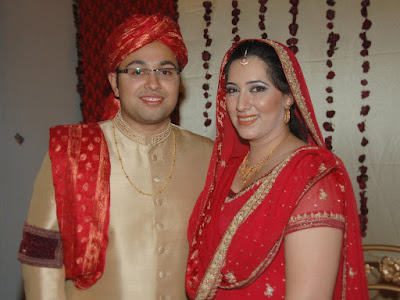 |
| From Maliha and Ibaad's Wedding |
Yes, I know I’m about a month late in blogging about this but I’ve only recently gotten the time to organize the photos from that trip. This is me ‘n Nadia in Karachi, which is where Maliha and Ibaad now live:
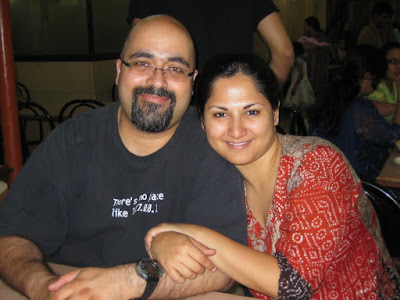 |
| From Pakistan Trip Feb-09 |
You can view all these photos on my Picasa Web Albums page in these two albums:
Enjoy :)
I used to be a champion procrastinator but, over the last few years, have gotten a lot better at managing my work schedule – almost to the point that I end up doing things well ahead of time.
The techniques I use to get around my procrastinational tendencies were mentioned in the recent PsyBlog post on ‘How to Avoid Procrastination: Think Concrete’. These are:
Surprisingly, these techniques pretty straightforward to execute and they work really well too. Yes, I am simplifying a bit here so read the full PsyBlog post for the details. Also read this post: ‘Getting Big Projects Done: Balancing Task-Focus with Goal-Focus’.
I also have a theory on why it's easy to procrastinate on simple, low-value, 'chore'-type tasks. My theory is that these tasks don't present much of a challenge to you so, in an attempt to make your life more exciting, your subconscious delays doing them. That way, you’re forced to do them in a rush and at the last minute which, basically, ends up making the tasks more challenging and your life a little less mundane.
Of course this also happens because the tasks themselves aren’t all that important so they get put in your lowest priority queue which, by definition, means you’ll only do them when you really have to…but I’m sure my theory is also partly true. Anyone have any other theories?
This month’s Newsline has a couple of excellent articles on the Islamization of Pakistan.
First there’s an article called ‘The Power of the Pulpit’ by Mohammad Hanif, author of ‘A Case of Exploding Mangoes’ which was shortlisted for the 2008 Guardian First Book Award.
Hanif writes:
Mullahs, maulvis, imamas, or ulema-i-karam as many of them prefer to call themselves, have never had the kind of influence or social standing that they enjoy now. A large part of Pakistan is enthralled by this new generation of evangelists. They are there on prime time TV, they thunder on FM radios between adverts for Pepsi and hair removing cream. In the past few years, they have established fancy websites with embedded videos; mobile phone companies offer their sermons for download right to your telephone. They come suited, they come dressed like characters out of the Thousand and One Nights, they are men and they are women. Some of them even dress like bankers and talk like property agents offering bargain deals in heaven.
Then there’s an article called ‘The Saudi-isation of Pakistan’ by Pervez Hoodbhoy, professor of High Energy Physics and the Head of the Physics Department at Quaid-e-Azam University in Islamabad.
Hoodbhoy writes:
The common belief in Pakistan is that Islamic radicalism is a problem only in FATA, and that madrassas are the only institutions serving as jihad factories. This is a serious misconception. Extremism is breeding at a ferocious rate in public and private schools within Pakistan’s towns and cities. Left unchallenged, this education will produce a generation incapable of co-existing with anyone except strictly their own kind. The mindset it creates may eventually lead to Pakistan’s demise as a nation state.
Both are excellent, though long, articles that I highly recommend you read.
Nadia’s been wanting to get a tattoo for…well, forever. Certainly she wanted to get one soon after we got to Australia (back in the middle of 2006) but there was a problem: she couldn’t decide what she wanted the tattoo to be, say, or represent.
Last week, however, she had a eureka moment and three days later, it was done:
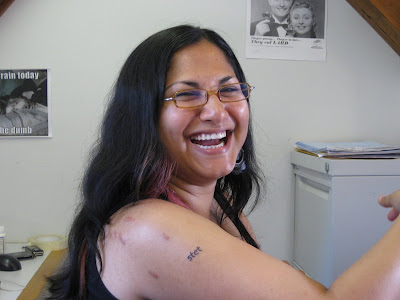
Yes, the tattoo says ‘stet’.
Er, ‘Stet’?
So, what does ‘stet’ mean? Well, ‘stet’ is an editing/proofreading mark that means “Let it stand” or “You know that change you made? Undo it and leave my original text the way it was, thank you very much”. Author Max Barry explains it best:
On Monday I received the copyedited manuscript of Company. This means someone at Doubleday has gone through it with a red pencil and pointed out everything I did wrong …
…[If] I want, I can overrule them, with the awesome power of STET. “Stet,” I discovered while editing my first novel, means, “Put everything back just the way I had it.” (Accompanied, one suspects, by the subtext: “Idiot!”) How good is that? When I discovered this word, it was like a gnawing, hollow place in my heart had finally been filled. Looking back, I can’t work out how I ever made it through a day without it. “Max, I tidied up your desk for you.” “No! Stet! STET, dammit!”
This is the coolest and most powerful mark (read: command) that an author has over her editor and proof reader and I presume this is what JRR Tolkien used when he started spelling the plural of ‘dwarf’ as ‘dwarves’ – instead of the more commonly used ‘drwarfs’ – when he wrote his ‘Lord of the Rings’ trilogy [More on this here].
Anyway, here’s a close-up of the tattoo:
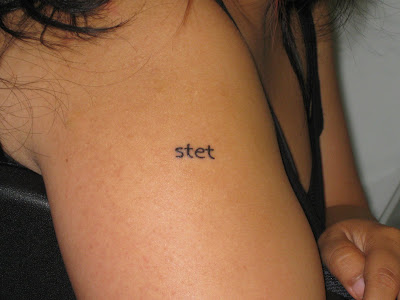
Isn’t it awesome? It’s simple, yet powerful and relevant on so many levels.
The inspiration for this tattoo came from two places, by the way: the Science Tattoo Emporium (that Carl Zimmer maintains on his Discover Magazine blog) and our love of geeky t-shirts (the kind you find on Think Geek). And though I am honoured to be the one who suggested ‘stet’ to her, I’m pretty sure she would have gotten to it on her own anyway.
The Middle of the Story
What was funny, however, was the way in which it finally happened. Nadia had decided to get her tattoo from Tattoo Magic in Fitzroy so, on the morning of 27 January, the two of us made our way down to Tattoo Magic to have a consultation with one of their artist and to book in a date and time for when the actually tattooing would take place (which would hopefully be some time later that week).
When we got there, however, their receptionist was out to lunch so we ended up talking to a couple of tattoo artists directly. When they saw what Nadia wanted for her tattoo, one of them said tattooing this would take just a couple of minutes and he could do it right then. After a slight hesitation, Nadia said ‘yes’ so the artist (Sean Jackson) went to his office to make a stencil that he would use to size and place the tattoo on Nadia’s arm.
Making the stencil took about five minutes, placing it correctly on Nadia’s arm took less than a minute, and the actual tattooing took less than three minutes (and it wasn’t painful). So, after having waited for two and half years to get a tattoo, Nadia walked out of a tattoo parlour with the tattoo she really wanted less than twenty minutes after she had walked in!
Also funny was that Nadia had psyched herself up for a painful tattooing experience and I was there holding her hand when Sean started to make the first line. I didn’t laugh out loud but I did chuckle inwardly as her facial expression went from “Must tolerate this pain…must tolerate this pain…” to “Er, WTF? This barely stings” :)
So there you have it, Nadia has a tattoo:
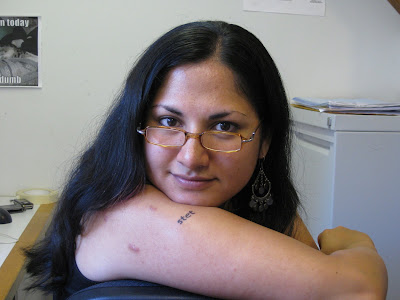
You can see more photos (including some funny ones) on my ‘Nadia and her Tattoo’ Picasa Web Albums gallery.
Lifehacker’s Adam Pash recently blogged about a new article in the Guardian called Napping: The Expert’s Guide which is a text-based re-hash of an older Boston Globe guide called How to Nap (this was published on the web as an image file).
As you would expect, the article gives some pretty useful tips on how to nap. For example, it suggests you limit your afternoon nap to 45 minutes or less. Unless, of course, you don’t get enough sleep at night in which case it might be good to nap for more than 90 minutes.
The sleep science behind these tips also helps explain my own heuristics around napping. For example, I’ve always likened afternoon naps to charging mobile device batteries:
I also have a few heuristics for night time sleeping – some which I have collected over the years (from other news articles or research on sleep) and some of which I’ve come up with myself:
If you have any napping or sleeping tips of your own, please do let me know. I’m always looking for ways to do things better.
Nadia and I like to spend public holidays and other special days doing things we don’t normally do – such as picnicking, sightseeing, and travelling. That’s how, for example, we took a trip down the Great Ocean Road on my birthday last year.
This year, our fifth anniversary [1] fell on a Saturday (24 January) so we decided to do some touristy sightseeing stuff around Melbourne.
Specifically, we did three things: First, we took a cruise up the Yarra River (which, believe it or not, we hadn’t done before):
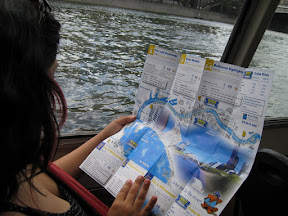
We wanted to go down-river (to the Docklands) as well, but it was too windy for our river boat to go into the Docklands harbour.
Next, we took a trip around part of the city in the Melbourne City Tourist Shuttle. We did this partly because we hadn’t completed the entire circuit the last time we’d ridden on this and partly because, like the City Circle Tram, the tourist shuttle is a free and convenient way to get from one Melbourne touristy hotspot to another.
Finally, since the river boat had failed us, we got off the Tourist Shuttle at Docklands and chilled out there – to a live African band and live video of the Australian Open – for a bit:
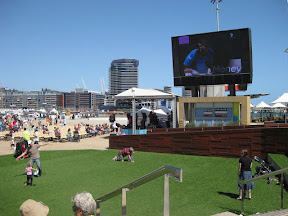
You can see all the photos from this trip on my Picasa Web Albums gallery called 5th Anniversary – River & Dock.
- - - - - - - - - -
[1] Yes, our wedding anniversary is on 1 February but, technically, we signed our nikah nama (marriage contract) on the 24 June, 2004 so we get a whole week’s worth of celebrations! :)
Fill out the TEDx Melbourne evaluation survey: http://is.gd/gVeM.
So a number of interesting things happened in politics this week. I’m not good at writing about this stuff [1] so you get pictures, video, and links to other sites.
I Can Haz Change?
The big news, of course, was the US presidential inauguration and Aretha Franklin’s hat. I guess Americans finally have earned the new puppy that coming with the Obamas to the White House :)
The Struggle for Change
Meanwhile, Nadia and I attended a protest rally in Melbourne over the weekend:

And though the people who attend rallies (myself included) all have their own particular agendas, mine was summed up by this poster:

And The Struggle Continues
Finally, if you’re in Lahore, consider attending the peace rally being organized by the newly-formed Amn Tehreek (peace movement) at 3pm on Saturday, 31 January (click the image for details):

It’s easy to have a “nothing I do will make a difference anyway, so why bother?” attitude towards all this, I know. But if there is one thing that has the potential to make a difference – however small that influence may be to begin with – it’s attending rallies such as this one (at least to start with). Because if you don’t, then you might as well stick your head in the sand, renew your silent majority membership, and lose your right to complain if the future doesn’t turn out the way you wanted. (I extend the same argument to voting in elections, by the way, which is why I love the fact that, in Australia, voting is compulsory.)
- - - - - - - - - -
[1] I have a hard time writing about politics because this is not something I talk about often. As a result, I have far too much to say and far too little space to say it in. I also have a hard time cutting to the chase which, funnily enough, I have no problem doing when I’m writing about other topics (…must work on this). Besides, I find that, when it comes to politics, others say what needs to be said much better than I do. People like Mosharraf Zaidi, for example.
Saturday, 17 January was definitely “a day of TED” in Melbourne [1].

Over forty of us TED geeks got together at Monash University and spent the whole day watching our favourite TED talks, talking about those talks, and also watching a live talk on rebuilding faces (through engineering assisted surgery) given by Dr. Ninian Peckitt of ComputerGen Implants Limited. The video of Dr. Peckitt’s talk will be uploaded to the web some time soon.
What I loved most about the day, though, was meeting and talking to all the people who were there (search for #tedx or #mted on Twitter and you’ll find a whole bunch of them). In between the talks we managed to swap stories on how we got hooked onto TED, we talked about what each of us is doing personally and professionally – we’re a fun bunch doing a lot of fun things, by the way – and, of course, we talked about the talks themselves. [2]
So a million thanks to the organizers who did a wonderful job planning and then running TEDx Melbourne. I’m sure this event will becomes a regular feature from now on – maybe with groups of us taking turns to organize it each time – and I’ll keep you posted on this blog every time such an event does take place.
Meanwhile, Shawn Callahan has written about this on his blog as well so make sure you check that out. Also, keep an eye out for the post-event survey that Cheng is in the process of putting together.
- - - - - - - - - -
[1] This despite the fact that they didn’t include one of my all-time favourite TED talks: ‘Benjamin Zander: Classical music with shining eyes’. Oh well. Next time, perhaps :)
[2] My apologies but the over-use of the word “talk” in this blog post was inevitable!
The TEDx Melbourne schedule has been published:
Schedule
09:30 - Get checked off the list and get your name tags
10:00 - Introductions
10:30 - 'Do schools kill creativity?' - Ken Robinson (2006)
11:00 - 'Why are we happy? Why aren't we happy?' - Dan Gilbert (2004)
11.30 – BREAK (30 minutes)
12:00 - 'My stroke of insight' - Jill Bolte Taylor (2008)
12:30 - 'How ordinary people become monsters ... or heroes' - Philip Zimbardo (2008)
Bonus video: 'A 3-minute story of mixed emoticons' – Rives
13:00 LUNCH (1 hour)
14:00 - 'Our priorities for saving the world' - Bjorn Lomborg (2005)
14:30 - 'The art of collecting stories' - Jonathan Harris
15:00 BREAK (30 minutes)
15:30 - 'Sliced bread and other marketing delights' - Seth Godin (2003)
16:00 - GUEST SPEAKER: Ninian Peckitt - 'Rebuilding the Face' + Q&A
16:30 BREAK (30 minutes)
17:00 - 'The mystery box' - J.J. Abrams (2007)
17:30 - 'Why we age and how we can avoid it' - Aubrey de Grey
18:00 - Wrap-up + Bonus video: 'How I built my family a windmill'- William Kamkwamba
Further details
More details on the TEDx Facebook Event page. Oh, and we’re up to 83 confirmed guests :)
The second issue of Chay Magazine is now out. This seems to be a small edition – only five articles, all of which are listed on the front page – but that’s five more articles on this topic than would otherwise have been written. Good job, folks!
Meanwhile, they are now accepting submissions for Issue 3, which is on the topic of sexual diversity.
There are ten days to go to TEDx Melbourne marathon! Thanks to Monash University entry to the event is now free and there are already over sixty confirmed guests :)
Here are the basics:
Date: 17 January, 2008
Time: 10am to 7pm
Location: Lecture Theatre H1.25, Building H, Monash Caulfield campus
For more details visit:
There’s still time to nominate your favourite TED talk on the TED Facebook app (there’s a link on the Facebook group page) so make sure you do that soon.
See you there :)
Awesome blog post by Lee Kottner on the Cocktail Party Physics blog on the “old guard” or “old boys’ club” attitude that tends to permeate through religious or specialist knowledge communities. In this case, of course, she’s writing about the scientific community:
…Richard Dawkins' selection of writers for the new Oxford Book of Modern Science Writing is damned odd, if not downright insulting. For one thing, there's nary a mere science writer among them; they're almost all scientists…
…And, of course, there are too few women, three, to be precise…
Make sure you check it out.
I’m a day late in posting this but the International Year of Astronomy 2009 has begun!
Over 130 countries are participating and, indeed, 87 countries have their own IYA websites (including, of course, both Pakistan and Australia). Be sure to check those out so you can take part in the events being held in your area.
This is personal website of Nadia Niaz and Ameel Zia Khan. Here we document our lives in Melbourne, Australia.
Melbourne, Victoria, Australia