Why the Sinn 903 and not the Breitling Navitimer?

For my fiftieth birthday I got a Sinn 903 St II chronograph (AU $5,600) instead of saving up for several years till I could afford a Breitling Navitimer B01 Chronograph 43 (AU $13,890).

(Read my previous post if you want to know why I picked that specific watch and not one of the other mechanical chronographs I’d shortlisted.)

Graphic showing the promotional photos of two wristwatches from two separate brands that look almost identical. Text below these watches reads, “Sinn 903 St II” and “Breitling Navitimer B01 Chronograph 41”.

I made that decision because the latest Sinn 903 series of watches (ie the mark-two models released from 2024 onwards) suit me better than watches from the modern Breitling Navitimer line up (ie the ones that use the B01 movement and were released from 2009 onwards).

This is for three reasons:

  1. Modern tool watch. The Sinn 903 St II watches are proper modern tool watches while current-day Breitling Navitimers have specs that are similar to modern field or dress watches. For my fiftieth birthday I wanted a practical, relatively hard-wearing tool watch and the Sinn 903 fit the bill.

  2. Cost per wear. Breitling Navitimers are blingy and expensive looking, which means I wouldn’t want to wear one all the time. Of course they don’t just look expensive, they are expensive, which means their cost-per-wear is too high for me.

  3. Brand association. Breitling has a fantastic history and the Navitimer is a historic series of watches, but Sinn has its own reputation of building seriously tough tool watches for the modern age. The Sinn 903 mark-two series is also more historically accurate in its design – meaning it looks more like the Navitimer versions I saw advertised, and subsequently fell in love with, in the 1980s. This combination of being historically accurate in terms of design but incredibly modern in terms of manufacture was a win-win for me.

Of course I’m not going to just leave it there :) Let’s talk about each of these reasons in a little more detail so I can explain why the Sinn 903 was the better watch for me.

Modern tool watch for aviators

The Breitling Navitimer was launched in 1952, and if you’ve read my previous post, you’ll know that Sinn purchased the Navitimer design from Breitling when the latter went bankrupt in 1979 due to the influx of lower-cost, but much more accurate quartz watches [1]. Sinn also bought Breitling’s Navitimer watch parts and machinery, but not the Navitimer brand name itself.

The rest of Breitling was purchased by Ernest Schneider who, over the 1980s, revised, refreshed, and rebuilt the Breitling brand.

What’s relevant to our discussion is that, from this point forwards, the Navitimer design evolved along two separate paths.

Graphic showing the promotional photos of three wristwatches. Text below these watches reads, “Sinn 903 St II (2024, 41mm case)”; “Breitling Navitimer Mk8 Ref. 806 (1968, 40.2mm case)”; and “Breitling Navitimer B01 Chronograph 41 (2011, 41mm case)”.

Breitling Navitimer: a modern luxury watch

Under Schneider’s leadership, Breitling moved from the tool watch space to the luxury watch space, and so its Navitimers were evolved into luxury watches – starting with the ‘Old Navitimer’ model launched in 1986 which had a gold bracelet option.

Here’s how the these watches evolved at Breitling:

  • Standard Navitimers dials were simplified, with the time scale – ie the inner-most scale on the original dial – removed to make the dial cleaner.

Graphic showing the cropped promotional photos of two wristwatches along with some annotations. The annotation on one watch reads, “Time scale on the Sinn 903 St II” and this points to said time scale printed on this watch’s dial. The annotation on the second watch reads, “No time scale on the Breitling Navitimer B01 Chronograph 41” and this points to a blank space on the watch dial where the time scale would have been.

  • Luxury elements were introduced. These included gold cases and bracelets; moon-phase complications; perpetual calendar movements; and collaborative special editions.

  • Standard-model cases became thinner (13.6mm vs 14.5mm for the 903s) but larger case sizes were now on offer: 43mm and 46mm in diameter, instead of just the 41mm original.

  • The water resistance rating of these watches, however, was kept at 30m. In the modern era of watchmaking, the only watches with 30-50m of water resistance are dress watches, “everyday” watches, and some lower-end field watches. Modern tool watches like dive, field, and aviation watches have at least 100m of water resistance across pretty much their entire price range.

Sinn 903: a modern tool watch

Sinn, the German watch manufacturer founded in 1961 as an aviation watch brand, has a different ethos, with a focus on “functionality, reliability, and technical prowess”. The 903 series evolved accordingly, while staying true to its 1970s-era design.

Here’s how these watches evolved (or didn’t) at Sinn:

  • Dials layouts weren’t changed from the 1970s versions (ie all the scales are still there) and cases sizes were kept at 41mm.

  • Instead of luxury elements being added, the construction of the watch was brought up to modern tool-watch manufacturing standards. The 903 II series, for example, was engineered to have a whopping 200m of water resistance! This is obviously overkill, but it is a very on-brand flex from Sinn.

Tool watch vs luxury watch

Modern Sinn 903s are tool watches, just like they were in the 1970s. Today they’re slightly anachronistic tool watches for the modern day GPS-connected, smartphone-carrying pilot, but they are very much watches that are built to modern tool-watch standards – which is what I was after. [2]

Modern Breitling Navitimers are luxury watches, though they still work as tool watches. I think these watches are fantastic, and I would love to own one, but when you’re after a robust tool watch, this isn’t the watch for you.

Cost per wear calculation

With its complex visual presence and highly-polished case, the Navitimer is a shiny, blingy, and unmistakeably expensive luxury watch. I can totally rock that look, but only on occasion. Shiny, blingy, and unmistakeably expensive isn’t my usual style, so this isn’t something I’d want to wear all the time.

The 903 on the other hand, has a combination satin/polished case (instead of an all-polished case) and that makes it look less blingy. Yes, this is a pretty thick watch – meaning it does have a certain wrist presence – but being a little less eye-catching than a Navitimer means I’m comfortable wearing it more often.

Close-up photo of a man’s wrist, on which he is wearing a mechanical watch. The man is seated at his desk at work. The watch has black dial, cream coloured hands, and three white coloured sub-dials. This watch is a chronograph so it has two pushers on the side that are used to start and reset the chronograph function.

Given all that, the cost-per-wear calculation for a Navitimer just doesn’t add up. And because a new 903 costs 40% of what new Navitimer costs, the cost-per-wear calculation for the 903s does add up.

Does this mean I’ll never buy a luxury watch because of the cost-per-wear factor? Nope. If someone was to give me twenty thousand dollars right now to spend on watches for myself, I’d buy an Omega Speedmaster first…and then I’d go buy the Sinn 903 :) A brand new Navitimer just isn’t the first luxury watch I’d buy. [3]

Brand association trade-off

While the Sinn 903 might not be as refined or historically significant as the Breitling Navitimer, it more than makes up for this by being a robust and understated (though still gorgeous) timepiece that I can see myself wearing all the time.

Meaning, as a tool-watch guy, in a head-to-head comparison, the Sinn 903 series works better for me than the current Navitimer offerings from Breitling.

Also, with its more complicated, more historically-faithful dial layout, the Sinn 903 is closer to the Navitimers I fell in love with when I saw them advertised in glossy magazines in the 1980s. Sinn’s 903s are modernised, beefed-up versions of those older watches, and so they’re the ones I wanted to go with.

Ultimately, what I’m doing is making a brand-association trade-off: a modern, seriously robust tool watch over a modern, luxury tool watch. Both are great; I just wanted the former.

To sum up

When I was presented with the choice of saving up to get a modern Navitimer in the future or to get a Sinn 903 now – a watch that’s an even tool-watch-ier version of a 1970s-era Navitimer – I chose the latter.

Having made my choice and, as the brand new owner of this most fantastic of watches, I have absolutely no regrets :)

Very close-up photo of half of a watch dial of the Sinn 903 St II.


[1] The rest of the world calls this the “quartz revolution” in watchmaking while the Swiss watch industry calls it the “quartz crisis”. ¯\_(ツ)_/¯

[2] If you want a truly modern tool watch for pilots, you should look at getting an aviation-focused Garmin watch, like the D2 Mach 2, D2 Air X15, or MARQ Aviator. Or you should get a Casio G-Shock GRAVITYMASTER from its ‘Master of G: Air’ line of watches.

[3] I might still buy a Breitling in the future, but it’ll be a pre-owned one and it might not be a Navitimer. Also, buying a luxury watch (whether first- or second-hand) is not something I’m even going to think about till I’m in my sixties!
A chronograph for turning 50

tl;dr After a great deal of research, for my 50th birthday I asked for and received a Sinn 903 St II wristwatch. This mechanical chronograph is a modern evolution of a 1970s-model Breitling Navitimer, but one that was developed and manufactured by the German watchmaker Sinn.


Birthdays, particularly notable birthdays, are a good time to ask for (or buy for yourself) something special that you want but don’t need. For me that special thing is wristwatches and, happily, I’ve asked for and received several over the years.

(My family and friends are awesome.)

A special watch every five years

When I turned 40 in 2016, Nadia and my friends got together and bought me a Seagull 1963 Airforce. This is a dress watch (at least by current standards) with a basic mechanical chronograph complication that was built for the Chinese People’s Liberation Army Air Force in 1963.

Close-up photo of a man wearing a relatively small, stainless steel mechanical watch on his wrist on a brown leather strap. The watch has a cream coloured dial, gold coloured applied numerals, blue-coloured hours/minutes hands, and a red-coloured chronograph seconds-hand.

To celebrate turning 45 in 2021, I wanted to get a nice dive watch that could also be a GADA watch (GADA = Go Anywhere, Do Anything). The watch I went with was the 60th Anniversary Oris Divers 65 with a black-and-blue dial. I love this watch and have worn it more than any other watch in the last five years.

Close-up photo of a man wearing a stainless steel mechanical watch on his wrist on a blue-and-black woven cloth strap. The watch has black and deep-blue coloured dial, cream coloured numerals in a retro 1960s typeface, and silver coloured hands.

Now it’s 2026 and I’m turning 50, and this year I wanted to get a nicer mechanical chronograph. This didn’t have to be a GADA watch, but I did want it to be a genuine tool watch and perhaps even a flex watch.

Deciding which chronograph to get

The only mechanical chronograph I own – the Seagull 1963 Airforce that I got for my fortieth – is one I don’t wear much these days because it’s a light-coloured dress watch and I’m usually in dark-coloured casual clothes. [1]

Also, the watch itself is quite basic. It may be shiny and pretty, but:

  • its styling isn’t particularly sophisticated;

  • its production is mass-market;

  • it’s powered by the the Chinese-made ST1901 movement, the cheapest mechanical chronograph movement available; and

  • it’s not even a particularly useful chronograph because, as a dress watch, its legibility-at-a-glance is severely limited.

What I was after now was a mechanical chronograph with:

  • a nicer, more functional, more tool-watch-ey design;

  • much nicer styling, manufacture, and finishing; and

  • a better chronograph movement, like the Japanese-made Seiko 8R48 or the Swiss-made ETA/Valjoux 7753.

So that’s what I went looking for.

Screenshot from the Time & Tide web store showing a grid of chronograph wristwatches that are available.

Creating a longlist

I started my research broadly, by looking at all the chronographs that are out there [2]. I didn’t focus on price, though I did stop looking at anything that cost more than $15k. Watches that cost more than $15k when new weren’t going to be affordable to me even on the secondary market.

All prices mentioned here are in Australian dollars, by the way.

Looking without shortlisting let me figure out what I liked, what I didn’t like, and what I’d have to settle for in a chronograph – like watches that are 14mm thick (or more) where I normally wear watches in the 10-12mm thickness range.

Through this browsing I was able to set a minimum price above which the design and functionality I wanted became readily available. This came to roughly $3k.

Next I created approximate price bands based on functionality, design, aesthetics, and brand premium:

  • Basic chronographs, $3-4k: Basic mechanical chronograph functionality; wide range of design aesthetics; relatively low water resistance (only 30-50m in many cases). Brands like Hamilton, Baltic, Tissot, and Junghans are represented here.

  • Enthusiast/tool-watch chronographs, $4-5k: Better movements (eg column-wheel chronographs, longer power reserves); higher grade construction (eg 100m water resistance); higher brand premiums; and better finishing. Here you’ll start to see brands like Sinn, Seiko, and Hanhart; as well as some Longines models on the secondary market.

  • Quasi-luxury chronographs, $5-6k: Higher grade construction (eg 200m water resistance, open case back); better finishing; and even higher brand premiums. This is where we get into Longines and where we also find some higher-tier Sinn models and some Oris models that are on sale.

  • Higher tier quasi-luxury chronographs, $6-10k: Better movements (eg even longer power reserves); less bulky (eg smaller diameter, thinner); better finishing; and still higher brand premiums. This is where you’ll find higher-tier Longines models and where brands like Oris, Frederique Constant, and Baume & Mercier come into the picture.

  • Entry-level luxury chronographs, $10k-15k: Even better finishing; even higher brand premiums; additional chronograph functionality (eg fly-back chronograph movements). This is when you get to proper “luxury” brands like Omega, Breitling, Zenith, Tudor, and Tag Heuer.

Finally, based on these price bands and my budget, I set my maximum price for a new or pre-owned watch. This came to roughly $6k, with a little wiggle room if needed.

Shortlisting criteria

Based on my preferences and what I learned from my initial research, I came up with a list of requirements that I could use to create my shortlist:

Movement type: Mechanical chronograph of any construction (ie column or cam wheel; vertical or horizontal clutch).

Size: 38–42mm in diameter; as thin as possible.

Price range: AU $3,000 to $6,000.

Sub-dial configuration: Bicompax or tricompax – I think bicompax sub-dials look cooler but the tricompax configuration is more functional.

Graphic showing promotional photos of two black-dial, stainless steel wristwatches side by side. Text next to the first watch reads, “Bicompax sub-dial configuration” and “Omega Speedmaster ‘57”. This watch has two sub-dials. Text next to the second watch reads, “Tricompax sub-dial configuration” and “Omega Speedmaster Moonwatch Professional”. This watch has three sub-dials.

Dial design: Ideally, contrasting sub-dials in a panda configuration or a reverse-panda configuration – though other dial-colour configurations would do if the design is really good (like the Omega Speedmasters in the graphic above).

Graphic showing three things: the photo of a panda’s face and the promotional photos of two stainless steel wristwatches. Text next to the panda reads, “Panda” and “Panda in China”. Text next to the first watch reads, “Panda dial” and “Tudor Black Bay Chrono”. The design of this watch resembles the panda’s face in that it has a white dial and two horizontally-oriented, black sub-dials that represent the panda’s eyes. Text next to the second watch reads, “Reverse-panda dial” and “Tudor Black Bay Chrono”. This watch has a black dial and two horizontally oriented, white sub-dials.

Style: Aviation and field styles watches over dive and dress styles watches – think more Omega Speedmaster, Zenith Chronomaster, and Breitling Navitimer and less Oris Divers Sixty-Five Chronograph, Baltic Scalegraph, and Junghans Max Bill Chronoscope.

Graphic showing two groups of three wristwatches each. Text above the first group reads, “YES: aviation, field style”. Text below this group reads, “L-R: Omega Speedmaster; Zenith Chronomaster; Breitling Navitimer”. Text above the first group reads, “NO: dive, dress style”. Text below this group reads, “L-R: Oris Divers Sixty-Five Chronograph; Baltic Scalegraph; Junghans Max Bill Chronoscope”.

Inspiration: Watches that draw inspiration from, broadly reference, or make me feel how I feel when I look at my dream chronographs.

My dream chronographs

Graphic showing the promotional photos of five wristwatches. Text below these watches reads, “Breitling Navitimer B01 Chronograph; Omega Speedmaster Moonwatch Professional; TAG Heuer Monaco Chronograph; Zenith Chronomaster Original Automatic; and A. Lange & Söhne Datograph”.

I have five dream chronographs:

The first three of those watches got imprinted on me when I saw them in magazines as a kid in the 1980s – advertising works, folks! – and the last two I fell in love with when I properly got into wristwatches (because I could now afford nicer ones) about sixteen years ago.

Will I ever buy any of my dream chronographs? Yes! My plan is to get the Omega Speedmaster for my 60th birthday, but I don’t think I’ll get any of the others. Why?

  • The Breitling Navitimer is probably my grail watch, but it is very shiny and I’m not sure its something I’ll wear often – which, for me, defeats the purpose of buying an expensive watch.

  • The TAG Heuer Monaco is super cool, but it doesn’t match my usual style – meaning I’d only want to wear it with certain outfits. So, again, I don’t see the point in buying a luxury watch if I’m not going to wear it all, or at least most, of the time.

  • The Zenith Chronomaster is fantastic, but I suspect (hope?) the Speedmaster will have already scratched my tricompax chronograph itch.

  • Unless I win the lottery, and probably not even then, I don’t think I’ll ever buy the Lange Datograph!

Creating a shortlist

In the end, these were the six watches that made it to my shortlist (in increasing order of price):

Let’s look at them one by one.

Tissot Telemeter 1938

If you’re wondering after all my talk of requirements and preferences how this style of watch of made it through my shortlisting criteria, the answer is simple: I adore pulsometer watches! Or, more generally, I love watches with spiral or contrasting-colour scales printed on the dial or the crystal.

Pulsometer watches have been around since the early 1700s and the coolest recent release in that style was the 2015 limited edition Longines Pulsometer Chronograph. I would love to get my hands on this watch, but it isn’t available anywhere.

Graphic showing the promotional photos of a wristwatches with text below it that reads, “Longines Pulsometer Chronograph”.

Probably the nicest pulsometer watches available right now are the Omega Speedmaster Chronoscope series. My favourite is the version with blue spiral track, though the panda version with the red spiral track is cool too.

Graphic showing the promotional photos of two wristwatches with text below them that reads, “Omega Speedmaster Chronoscope”.

All this to say that, when the white-dial Tissot Telemeter 1938 ($3,500) came up in my research, it went straight onto my shortlist. The black-dial version is pretty cool too.

Graphic showing the promotional photos of two wristwatches with text below them that reads, “Tissot Telemeter 1938”.

I checked out both these watches in Tissot’s Melbourne boutique. Sadly, they felt a little unwieldy on my wrist. Also, the black-dial version, while gorgeous, isn’t super legible and is therefore not practical as a chronograph (even though it’d be great as a dress watch). I guess this is a case of watches looking cooler in photos than they are in the metal – at least as far as my current taste in watches and my current watch-buying objectives are concerned.

STATUS: Removed from the shortlist.

Hamilton American Classic Intra-Matic Chronograph H

I fell in love with Hamilton’s Intra-Matic Chronograph series many years ago. In fact, when I decided I was going to get a nice mechanical chronograph for my fiftieth birthday, these were the watches I thought of first.

While I love the automatic, panda version from this series, my favourite is the black-dial, manual-wind, reverse panda: the Hamilton American Classic Intra-Matic Chronograph H ($3,650).

Graphic showing the promotional photos of two wristwatches with text below them that reads, “Hamilton American Classic Intra-Matic Chronograph H” and “Hamilton American Classic Intra-Matic Auto Chrono”.

Funnily enough, it was only while writing this post that I consciously realised that, even though they’re parsecs apart in quality, looks-wise the reverse-panda Intra-Matic for me scratches the same itch as the A. Lange & Söhne Datograph!

Graphic showing the promotional photos of two wristwatches with text below them that reads, “Hamilton American Classic Intra-Matic Chronograph H” and “A. Lange & Söhne Datograph Up/Down”.

Time & Tide, our local Hamilton authorised dealer (AD) didn’t have the reverse-panda version in stock, but I did check out the blue-dial version, which is also super cool.

Status: Black-dial version moved to the top of the shortlist.

Hamilton Khaki Aviation Converter Auto Chrono

I think it’s obvious why the Hamilton Khaki Aviation Converter Auto Chrono ($3,650) made it to my shortlist: its converter dial is reminiscent of the Breitling Navitimer.

The black-dial version of this watch is cool, but I think the blue-dial version is cooler.

Graphic showing the promotional photos of two wristwatches with text below them that reads, “Hamilton Khaki Aviation Converter Auto Chrono”.

I have over the years considered getting one of the quartz-based flight chronographs that pay homage to the Navitimer and Speedmaster: watches like the Citizen Promaster Sky or the Islander Calverton Flight Chronograph (which itself was inspired by the discontinued Seiko Flightmaster).

Graphic showing the promotional photos of two wristwatches. Text below these reads, “Citizen Promaster Sky” and “Islander Calverton Flight Chronograph”.

I never got around to buying one of these though, so this could be my chance to get something in that style but with a mechanical movement.

Sadly, when I tried on this watch at my local AD, it didn’t work. Yes, the watch fit physically on my wrist, it just didn’t have the presence or vibe that I connected with. Oh well.

Status: Removed from the shortlist.

Seiko Prospex Speedtimer

The Seiko Speedtimer has a long history. Released in 1970 as the world’s second automatic chronograph (after the Zenith El Primero in 1969) a slightly newer version of this watch even made it into space in 1973 with American astronaut William Pogue.

Seiko didn’t do much with the Speedtimer during the quartz era, but they revived it in 2021 and have since released a bunch of mechanical and solar-quartz versions.

The black-dial version of the Seiko Prospex Speedtimer ($3,900) is my favourite, but the white-dial version is pretty cool too. And there are many other dial-colour variations to choose from.

Graphic showing the promotional photos of two wristwatches, one with a black dial and one with a white dial, with text below them that reads, “Seiko Prospex Speedtimer”.

People also love this watch because versions of it scratch the Omega Speedmaster Moonwatch Professional and Rolex Cosmograph Daytona itch for a fraction of the price – specifically the SRQ055 and SSC911 shown in the graphic below.

Graphic showing the promotional photos of four wristwatches in two pairs, with some resemblance between the watches that have been paired. Text below the first pair reads, “Omega Speedmaster Moonwatch Professional” and “Seiko Prospex Speedtimer”. Text below the first pair reads, “Rolex Cosmograph Daytona” and “Seiko Prospex Speedtimer”.

I checked out these Speedtimers at two local ADs – and I looked at both the 39mm and 42mm diameter versions – but ultimately decided that, if I was going to get one, I’d get a solar-quartz version ($1,150, but currently on sale for $851) at some point in the future.

Status: Eliminated from the shortlist. (Well, at least from my current birthday shortlist.)

Longines Avigation Big Eye

I was very curious about this watch when I first heard about it. Its design feels like that of a flieger-style aviation watch (which is a style I love) merged with the Omega Speedmaster (which is another style I love) but with the added twist of the 3 o’clock sub-dial being larger than the others – hence the “big eye” name.

Graphic showing the promotional photos of three wristwatches in a mathematical equation. Text below these reads, “Stowa Flieger Classic” plus “Omega Speedmaster Moonwatch Professional” equals the “Longines Avigation Big Eye”.

I initially didn’t shortlist this watch because I thought it was out of my price range, but then I realised I was looking at the blue-dial titanium version ($6,500) and not the black-dial, stainless steel Longines Avigation Big Eye ($5,075 full price, but was on a 30%-off sale).

Graphic showing the promotional photos of two wristwatches, one with a black dial and one with a blue/black gradient dial, with text below them that reads, “Longines Avigation Big Eye”.

The black-dial version wasn’t in stock at my local AD or the Melbourne Longines flagship store, but the flagship store did have the titanium, blue-dial version which I got to check out.

Sadly, this watch just didn’t grab me.

Yes, there is a lot going for it: it is gorgeous, very well-executed, and runs on a high-grade chronograph movement. It was also on a 30%-off, end-of-financial-year sale when I saw it, which is probably the best price I’ll ever get for it.

The problem is that I already own two watches that have the same flieger / aircraft instrument panel look. These are the Stowa Flieger Classic 40 Baumuster B and the Techné GosHawk (Techné being a brand created by a former Longines watch designer).

Graphic showing the promotional photos of three wristwatches with text below them that reads, “Stowa Flieger Classic 40 Baumuster B”, “Techné GosHawk”, and “Longines Avigation Big Eye”.

I wanted a special watch for my fiftieth birthday, not one that’s in the same style as two watches I already own. So, disappointingly, I had to let this one go.

This is not to say I don’t think this watch is cool – it is cool, and I can totally see myself wearing it and loving it – but it’s just not the right watch for me right now.

Status: Moved to second place on my shortlist, but with the knowledge that I’m not going to buy it this time around.

Sinn 903 St II

The final watch on my shortlist was the Sinn 903 St II ($5,600). And while its blue-dial version is cool, I think its OG black-dial version is cooler.

Graphic showing the promotional photos of two wristwatches, one with a black dial and one with a blue dial, with text below them that reads, “Sinn 903 St II” and “Sinn 903 St BE II”.

“But Ameel,” you exclaim, “the Sinn 903 looks just like the Breitling Navitimer! Isn’t this design just a blatant rip-off of the watch you love so much?”

Graphic showing the promotional photos of two wristwatches from two separate brands that look almost identical. Text below these watches reads, “Sinn 903 St II” and “Breitling Navitimer B01 Chronograph 41”.

My reply would be a rather irritating, “You’re not wrong; but you’re not right either.”

I’ll let Brice Goulard, writing in Monochrome, explain:

Before you start commenting on the fact that this watch is a copy of the Breitling Navitimer, let me explain why you’d be right on one side, but also why Sinn has the legitimacy to do so.

Some might not know the story behind the creation of the Sinn 903 and why it is so close to a Navitimer in both design and technical specs. The story is that, back in the late 1970s, Breitling (like many other brands) was in a difficult situation due to the quartz crisis.

Parts of Breitling were liquidated in 1979 and the rights to the Navitimer were sold to the highest bidder. This resulted in Sinn, but also Ollech & Wajs, acquiring not only the design and rights to produce a watch identical to the Navitimer (the name remained the property of Sicura, then returned to Breitling) but also stocks of parts, such as cases and dials.

Sinn obtained the rights and parts of the Navitimer 806 and 809 and then produced watches under its own name with the reference 903…a model that has been in the collection for over 45 years.

So, yes, this is the Breitling Navitimer design but, no, it’s not a rip-off because Sinn legitimately owns this design as well.

Now before I started this round of research, I hadn’t seriously considered buying the Sinn 903 for two reasons:

  1. There is no Sinn AD in Australia

  2. I wasn’t a huge fan of the original Sinn 903 because the only way to rotate the slide-rule bezel was through an additional crown at the 10 o’clock position

Happily, while doing my research I learned two new things:

  1. There is now one (1) Sinn AD in Australia: Define Watches up in Noosa, Queensland

  2. In June 2024 Sinn released the 903 St II, and this upgraded version has a directly-operated slide-rule bezel along with a whole host of other minor upgrades

Woohoo!

Still, I had a problem: this watch was all the way up in Noosa, which meant I wouldn’t be able to get any hands-on time with it pre-acquisition.

So I did the next-best thing: I went into the local Breitling flagship store and checked out the 41mm version of the Navitimer :) I figured if that worked well on my wrist, then the Sinn 903 would too. Happily, it did! And I could totally picture myself wearing a slightly thicker, more tool-watch-like version of that watch very comfortably on my wrist. [3]

Status: Moved to the top of the shortlist, with the Hamilton Intra-Matic pushed down into second place and the Longines Big Eye pushed further down into third place.

Honourable mentions

Graphic showing the promotional photos of five wristwatches. Text below these watches reads, “Baltic Scalegraph Classic Panda; Sinn 356 Pilot; Junghans Telemeter; Longines Master Collection Chrono Moonphase; Oris Divers Sixty-Five Chronograph”.

Before I tell you which watch I ultimately got – as if you haven’t figured it out already – here are six honourable mentions that I want to, well, mention but not go on about:

  • If I wasn’t actively trying to avoid 1930s/40s-style watches (opting instead of 1960s/70s-style watches) I would have shortlisted the Baltic Scalegraph Classic Panda ($2,670). Also, I think it was the 1930s styling of the Tissot Telemeter 1938 chronographs that stopped me from connecting with them when I checked them out in the store.

  • The Sinn 356 Pilot ($3,550) is cool but, like I said when I talked about the Longines Avigation Big Eye earlier, I already have two flieger style watches so I didn’t shortlist this one.

  • When I’m ready to buy a telemeter watch (since I probably won’t be able to find an affordable pulsometer watch) I’ll likely get the lovely Junghans Telemeter ($4,300).

  • The Longines Master Collection Chrono Moonphase ($6,400) was outside of my budget but a great-condition version of it became available on the secondary market ($3,900) so I had to go take a look. Unfortunately, this particular watch was on display at the AD’s Sydney store and I wasn’t going to consider it without seeing it in the metal first.

  • The Oris Divers Sixty-Five Chronograph ($6,800) is great, and I might have found a version on sale that was under my budget, but I already have an Oris Divers Sixty-Five and there was no point doubling up.

Making a decision

By this point I’d pretty much decided that the Sinn 903 was the watch I was going to get.

Screenshot of the Sinn Catalogue 2025-26 showing the ‘Series 903’ watch that is described as “The navigation chronograph”. The screenshot shows the blue-dial and black-dial versions of the watch on one page and text about this series of watches on the second page.

“But why was the Sinn 903 even in consideration?” you might ask. “If you love the Breitling Navitimer so much, wouldn’t it have been better to wait till you’d saved enough money to buy the ‘real thing’?”

Normally, I would agree with that sentiment. If you’re pining for the “real thing”, there’s a decent chance you won’t be satisfied with a less costly substitute – whether that’s a replica, an homage, or something heavily inspired by what you really want.

However, this argument doesn’t work here because the Sinn 903 isn’t a substitute, it is the real thing – it’s just a version that’s built and sold by a different manufacturer.

Yes, the Sinn brand doesn’t have the same historical associations that the Breitling brand does, but as far as watches go, I actually prefer the Sinn 903 over the Breitling Navitimer. Also, I very much love the associations that the Sinn brand does have. I’ll explain all this in my next post because this post is already too long.

The real decision I needed to make was about something else.

Which version of the 903?

The Sinn Series 903 comes in two editions (standard and anniversary) and in five dial colours (black, anthracite, dark blue, green, and sunburst blue). I was pretty sure I wanted to get the standard black-dial version, but before committing to that decision I called up the folks at Define Watches to have a chat.

I wanted to ask about the standard dark-blue-dial version of this watch because, while I love a good blue dial, the blue of that dial needs to be a really good shade. My Oris Divers Sixty-Five 60th Anniversary Edition, for example, has a gorgeous, deep-blue outer dial that I adore, and this shade of blue matches, complements, or nicely contrasts with the colours of pretty much every outfit I own [4].

Close-up photo of a man wearing a stainless steel mechanical watch on his wrist on a blue-and-black woven cloth strap. The watch has black and deep-blue coloured dial, cream coloured numerals in a retro 1960s typeface, and silver coloured hands.

The person I talked to at Define Watches was Peter Petzold, one of the two co-owners, and he told me the blue of the Sinn 903 St II B E’s dial is dark blue, and that too a shade of dark blue that looks black in some light. That was great news.

I then watched a lot of YouTube videos that showed-off this dial colour in high resolution, and I came away impressed.

But even after all that investigation and exploration, I decided to go with the OG black-dial version. Why? Partly because it is the more historically accurate dial colour but mostly because this is the dial colour I fell in love with in the 1980s :)

The fact that this dial colour will never clash with any of the clothes I wear was just a bonus.

How do I feel about my decision?

I feel fantastic! And doubly so since Nadia gave me the watch on my birthday morning and I got to see it in the metal.

Looking at this watch on a screen and wearing it on my wrist are two completely different experiences, and the latter is better than I even imagined it would be.

Close-up photo of a man wearing a mechanical watch on his wrist. The watch has black dial, silver hands filled with a luminous material, and three white coloured sub-dials. This watch is a chronograph so it has two pushers on the side that are used to start and reset the chronograph function. The watch bezel is a slide rule that lets the wearer perform mathematical calculations. The man is wearing a button-down shirt with a navy-blue check, the cuff of which is covering one slice of the watch.

I was concerned, for example, that the watch would be too heavy, too bulky, or too thick. It is none of those things. It does have weight and it does sit taller on my wrist than most of my other watches, but by no means does it feel heavy or look bulky on my wrist. It also doesn’t look too blingy, which is important to me. (More on that in my next post.)

Instead, this watch fits perfectly on my wrist – both in terms of its physical size and its wrist-presence – and the gorgeous, black, vintage-style leather strap I got with it is super comfortable and holds the watch snugly at exactly where I normally wear watches.

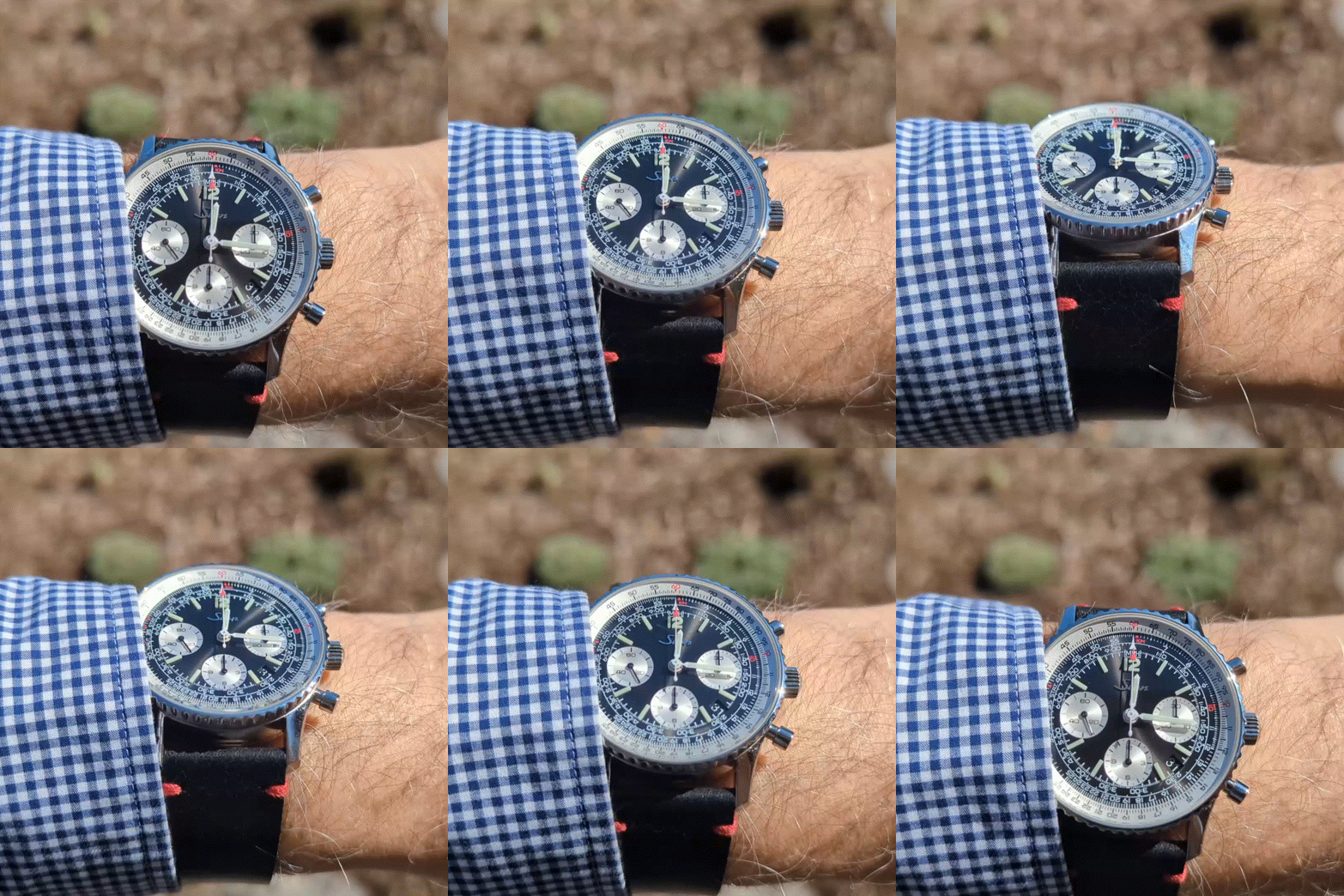
Another cool thing that I hadn’t fully appreciated till I wore this watch was that its dial has a subtle sunburst finish that makes the dial look more dynamic than a plain matte black dial would have looked.

Close-up animated GIF of a man wearing a mechanical watch on his wrist. The watch has black dial, cream coloured hands, and three white coloured sub-dials. The man is standing outside on a sunny day and is twisting his arm towards and away from the camera, which highlights the sunburst pattern on the black dial of the watch.

I’ve only had this watch for two days, but it already fits perfectly with my entire wardrobe and is spot-on for my lifestyle.

Yes, I think I made a really good decision.

So what next?

What’s next is that, in my fifty-first year on this planet, I get to wear this most fantastic watch pretty much all the time!

Close-up photo of a man wearing a mechanical watch on his wrist while seated in the driver’s seat of a parked car. The watch has black dial, cream coloured hands, and three white coloured sub-dials. This watch is a chronograph so it has two pushers on the side that are used to start and reset the chronograph function.

And who knows, maybe I’ll get the Hamilton Intra-Matic that was in second place on my shortlist for my fifty-fifth birthday :)


[1] These days I wear mostly dark and casual clothes but, ten years ago, when I got the Seagull 1963 Airforce watch, with its champagne-coloured dial and dress-watch looks, my work “uniform” used to be khakis with a navy blue check shirt. In other words, this watch was a great fit for the old Ameel – like in the casual-Friday photo from 2019, below – but its colours clash with how the new Ameel dresses every day.

Selfie of a man standing in front of the floor-to-wall window of an office building that overlooks the city. The man is grinning and giving the camera a thumbs-up. He is wearing a textured maroon dress shirt with its sleeves rolled up. On his left wrist he is wearing a small silver watch with a cream-coloured dial: the Seagull 1963 Airforce.

[2] As part of my chronography research, I read or watched all these round-ups from Teddy Baldassarre:

[3] While at the Breitling boutique, I also tried on the 43mm Navitimer and, surprisingly, I think this size looked better on my 19cm/7.5in-diameter wrist than the 41mm version did. What can I say? Breitling watches are fucking cool.

[4] These days I mostly wear black, dark grey, navy blue, maroon, and khaki clothes, with accents in red, orange, yellow, and white. My Oris Divers Sixty-Five 60th Anniversary Edition watch goes with all of these colours, as does my new Sinn 903 St II :)

Collage of four photos, each focusing on a bald man with a salt-and-pepper beard who is wearing glasses. In two of the photos a woman is hugging this man and leaning her head on his chest. In the photos the man is wearing, respectively, a black t-shirt, a dark grey t-shirt, a grey-and-black hoodie, and a navy blue suit.

G-Shock life

Not your typical double-wrist watch shot, but a double-watch wrist shot!

That’s what you do when your wife hands you her G-Shock while she powerlifts her personal best weights :)

Photo of a man's wrist on which there are two black Casio G-Shock watches, one larger and one smaller. In the background of the photo is a barbell with weights on it.

Yay for quality NATO straps

I really love the Blueberry Broad Weave NATO strap that I got from Bark & Jack.

Its extra structure helps keep my heavier watches in place on my wrist. Like this BOLD Expedition Everest that I’d stopped wearing as much because none of my other NATO straps could handle its heft.

Dangling watches begone!

Photo of a man’s wrist with a hefty, brushed stainless steel field watch strapped to it. The watch has a vibrant blue dial colour with bright white numerals, markers, and hands. Near the top of the seconds hand is a pale orange rectangle that is easy to track as it rotates around the dial. The watch case has two crowns sticking out of it on the right side. The watch is on a strap made out of woven material constructed from thick blue and black threads.

The strap’s blue and black weave also elevates its quality, versatility, and looks. I can wear it with practically all my watches and it pairs nicely with most of my outfits.

Close-up (macro) photo of a watch strap on a man’s wrist (you can see the man’s black and white arm hair to the right of the strap). The strap is made out of nylon fabric and has a broad weave pattern of thick black and blue threads.

And, while we’re taking macros photos, here’s one of the dial as well.

Close-up (macro) photo of a watch dial. The watch case is brushed stainless steel, meaning it’s not very shiny. The dial itself is a vibrant medium blue colour. The numbers; hour- and minute-markers; and numerals printed on the watch are all a bright white colour. Above every hour marker, though, there is a small pale orange square. The watch’s hour and minute hands are chunky and slightly tapered towards the end. These are black at the base and white at the tip. The watch’s second hand is thin. It is black at the base and pale orange at the top. Two-thirds of the way up the seconds hand, where the orange colour starts, is a rectangle filled with luminous material. The brand name printed on the watch is BOLDR.

State of the watch collection 2019

I got two watches in 2019.

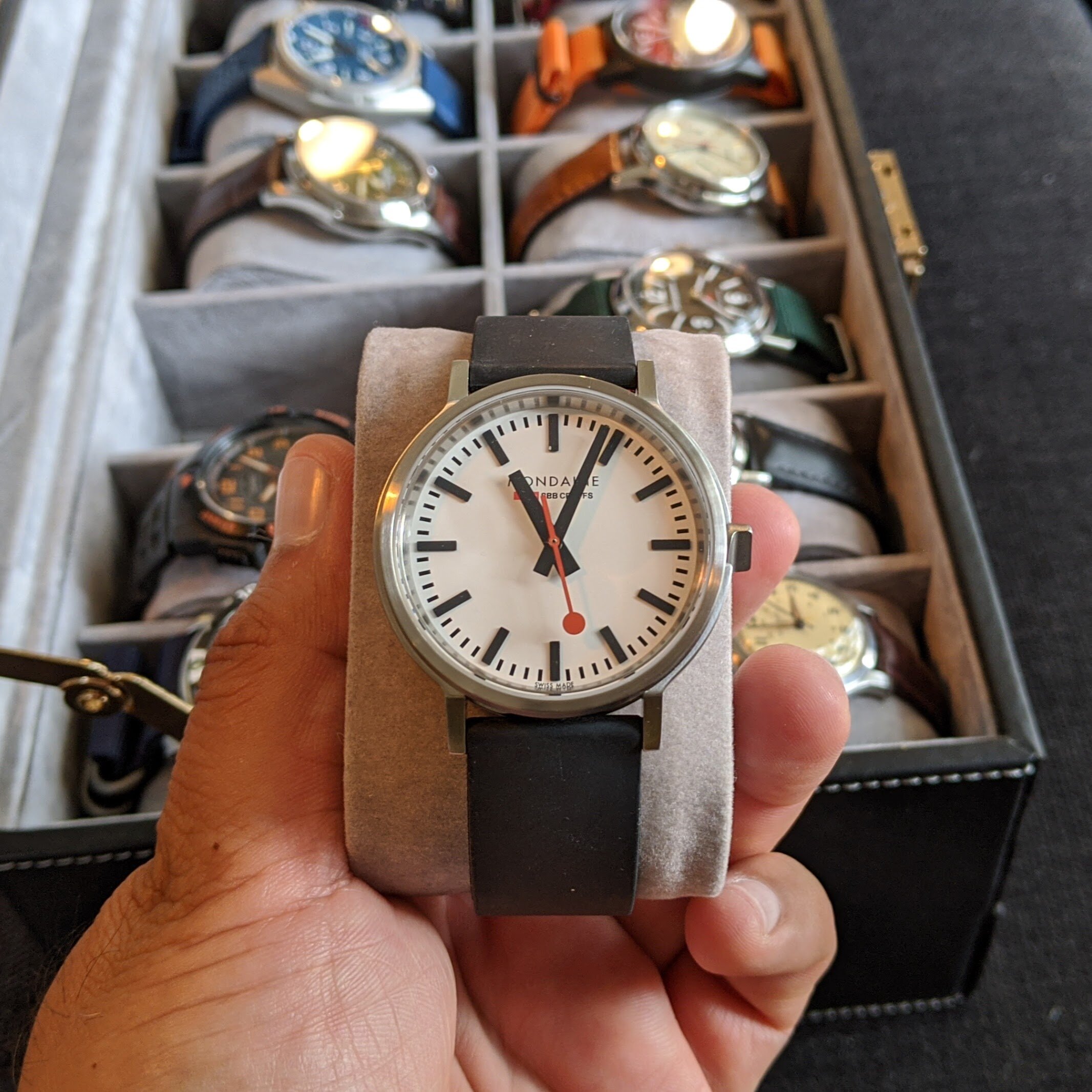
A Mondaine Official Swiss Railways stop2go in September – which was an awesome birthday present from Nadia (thank you!):

And a Boldr Expedition Everest that arrived earlier today (30 December 2019) – with a hat tip to T3 for bringing Boldr to my attention a few months ago:

Achievement unlocked!

The coolest thing in 2019 was that I completed this Mondaine trifecta that I’ve been trying to pull together for several years:

A Mondaine wristwatch, desk clock, and wall clock.

I adore Hans Hilfiker’s Swiss Railway clock design and, thanks to Nadia who got me that wall clock in 2018 and this wrist watch in 2019, I get to see this design all the time.

#MyWifeIsAwesome

State of the collection

So, at the end of 2019 I own seventeen timepieces: fifteen wristwatches and two clocks.

Of those fifteen watches only twelve are in rotation – which is convenient, since that’s the size of my watch box.

(The other three are older Casio quartz watches that I bought when I couldn’t afford much else. Those have since been superseded and boxed away.)

A box full of watches.

The timepieces I have might not be super expensive, but seventeen is still a big number. I am privileged that I’ve been able to afford this many items that I don’t strictly need.

I am also privileged to have friends and family who’ve bought or contributed to four of those timepieces. Thanks, folks!

A theory of watch classification

A photo of watches in a box is a standard ‘state of the collection’ fare (#SoTC). But you know me: I like to take things a step further :)

In my head I organise watches in two ways: I either group them by activity (eg watches I’ll wear to work) or I plot them along the complexity-robustness axis that I think works best to broadly classify a diverse group of watches.

Here’s what that looks like in graphical form:

State of the watch collection 2019: all watches

In case that doesn’t make sense…

As you go from left to right along the x-axis, robustness increases. That’s why my vintage 1950s Wittnauer is on the extreme left and my carbon-fibre strap G-Shock is on the extreme right.

As you go from bottom to top along the y-axis, complexity and functionality increase. That’s why time-only and time-and-date watches are along the bottom and watches with rotating bezels, chronographs, alarms, timers, and so on are along the top.

And generally speaking:

  • the watches along the left are what I’d wear if I was to dress formally,

  • the watches along the right are what I’d wear if I was doing any physical activity (everything from mowing the lawn and walking the dog to swimming and bushwalking), and

  • the watches in the middle are everyday watches, ie what I’d wear to work or on weekends – depending on style and functionality requirements.

Slicing and dicing by watch type

It’s also useful to look at a watch collection by watch type.

So, these are my dress and casual watches:

State of the watch collection: dress, casual watches

State of the watch collection: pilot, military watches

State of the watch collection: field, dive watches

2019 wrist time

The watches that got the most wrist time this year were my Stowa Flieger, Seiko Alpinist, and Mondaine stop2go. These I wore on rotation to work every day and also on weekends. On weekends I wore those or my Casio G-Shock and Techné Goshawk.

The rest of my watches I wore far less regularly.

I expect the Boldr Expedition will feature heavily on my wrist particularly in the next few months.

Where to from here?

I don’t have 20/20 vision so I have no idea which watches (if any) I’m going to get this coming year. And, now that I’ve got the Boldr Expedition, I don’t have a hole in my collection that I want to fill either.

There are still lots tool watches I’d love to get, of course – so I might get something from Seiko, Sinn, or Hamilton. I’d probably want to start with the gorgeous Hamilton Intra-Matic chrono. Or maybe I’ll get something dressier from Oris or Nomos.

I’m also hoping to afford an actual (second-hand) luxury watch in the next few years. I’d love to get something from Cartier, Grand Seiko, or Omega. Though, if I am stepping up to that tier, I might as well go all-in and get my grail watch: the Omega Speedmaster Moonwatch Professional.

Or maybe I’ll scratch that long-time space/moon watch itch with a Bulova Lunar Pilot, Fortis Cosmonaut, or Dan Henry 1962. Who knows? I guess it’ll depend on what my year-end bonus is :)

In the meantime, I have a fantastic bunch of watches and I plan to wear the hell out of them in 2020. So here’s to another fantastic year in horology!

My next pilot watch: Stowa Flieger Klassik 40 Baumuster B

I bought another pilot watch – and this one, finally, is a flieger! Say hello the fabulous Stowa Flieger Klassik 40 Baumuster B.

If you’re not familiar with flieger watches, by the way, here’s a nice overview from Watchuseek: ‘Flieger Friday: Everything You Need to Know About Flieger Watches

Why the Stowa Flieger Klassik 40 Baumuster B?

There are lots of different flieger and flieger-style watches out there so I had a seriously difficult time deciding which one I was going to get.

I knew from the start that I wanted a Type B flieger (the observer/navigator’s watch) and my must-have features were a sapphire crystal and a hacking-seconds movement. Everything else I was flexible on (ie automatic or manual wind movement, open or closed case back, etc).

In the end my decision came down to four key criteria:

  1. Which brands I wanted to consider
  2. What category of watch I wanted
  3. Where along the historical-accuracy versus modern-evolution spectrum I wanted my watch to be situated
  4. What special thing about the watch, brand, or manufacturer appealed to me the most

1. Brand options

The original flieger watches from the 1940s were designed and manufactured by five companies: A. Lange & Söhne, IWC, Laco, Stowa, and Wempe.

Lange no longer make a pure flieger watch (only the Big Pilot’s and its variations) and Wempe no longer make watches at all, so the three remaining brands went straight onto my shortlist.

Since no one has a copyright on the flieger design, lots of other brands make flieger and flieger-inspired watches. Several of these brands went onto my shortlist, as well.

2. Watch category

Not counting quartz-based timepieces, flieger watches can be broadly divided into three quality categories: luxury, enthusiast, and consumer. Each category is served by several brands, for example:

  • Luxury: Bell & Ross, IWC
  • Enthusiast: Archimede, Aristo, Damasko, Fortis, Hamilton, Laco, Sinn, Steinhart, Stowa
  • Consumer: Citizen, Orient, Seiko

I wanted to get something from the enthusiast category because that’s where all the professional/tool watches are (not that pilots need to use these types of watches professionally anymore). Like the original flieger watches, I wanted my flieger watch to be a robust, reliable, high quality tool watch.

From that category I eliminated Damsko and Sinn because they don’t make Type B flieger watches. 

This left me with seven options.

3. Historical accuracy versus modern adaptation

I knew I wanted a watch with historical roots, but not necessarily a replica. I also didn’t want something too modern.

I eliminated Archimede because, even though Ickler (their manufacturer) has been around since 1924, the Archimede brand itself was launched in 2003 – so that’s not enough of a historical connection for me. Same with Steinhart: the brand itself is old, but its modern incarnation is from the 2000s.

I also eliminated Aristo because their modern-sized fliegers (40-44mm) have a huge Aristo logo on the dial (too modern) and their plain-dial version has a whopping 55m case size (far too historically accurate!).

Finally, much as I love what Fortis and Hamilton have done with their pilot watches, those interpretations are more modern that I would like for my first proper flieger.

This left me with two brands: Laco and Stowa – both original flieger manufacturers and both with modern versions of the Type B that I really like.

The Laco flieger versions are truer to the original: sand blasted grey case, closed case back, domed sapphire crystal, straight lugs. The Stowa versions are slightly more modernized: polished case, open case back, flat sapphire crystal, curved lugs.

Laco and Stowa’s brand philosophies are neatly represented in those design differences: Laco is selling you a piece of history (albeit a smaller version of the original) while Stowa is selling you a modern watch with strong historical roots (a slightly evolved version of the original). For my first flieger watch, I found myself leaning towards the latter.

4. That special thing

The other thing that got me to pick Stowa is that I like their brand strategy more than Laco’s.

Laco want everyone to own a piece of history so they have two tiers of pilot watches: ‘Original’ and ‘Basic’. The Basic models are more consumer level watches than they are enthusiast level ones. That means some models have lower cost automatic movements (that don’t have hacking seconds, for example) and some have quartz movements.

Stowa, on the other hand, want everyone to own an excellent quality mechanical timepiece that is deeply rooted in history so they don’t have any models that could be considered consumer level watches.

As someone who studies brands, I appreciate businesses that have identified the specific, narrow customer segment they want to target – in this case, people who want to buy enthusiast level watches – and then chosen to create products for only this segment.

I don’t dislike Laco’s approach, of course. I just respect Stowa’s willingness to ignore other potential market segments and stick to the one segment they specifically want to target with their timepieces.

This focus on selling only professional/tool level watches makes Stowa a slightly more exclusive brand. And, for my first flieger, this was something I liked the idea of.

(Laco have done a clever job of differentiating their Basic and Original tier watches from a brand perspective, by the way. None of their Basic tier watches, for example, have thermally blued hands. So, while Laco are willing to sell lower priced, lower perceived-value watches that have most of the historical markers of the original flieger watches, by holding some of the features back from the Basic tier, they still manage to protect the brand value of their Original tier models.)

Stowa were also among the first heritage watch brands to start selling directly to customers via their website. This means they understood their customer segment much sooner than others did – this is, our desire to easily purchase watches online, directly from the manufacturer.

And Stowa are still one of the only brands that offer several watch customization options up-front. The availability of these customisation options tells me they still understand their customers better than many other brands do. That is, customers wanting a consumer level pilot watch won’t necessarily want to spend extra on customization (eg a gold rotor, instead of a silver one). But someone who is after an enthusiast level pilot watch might. And given that’s the only segment they’re targeting, why not go the extra mile and offer this service? It helps their brand stand out from their competitors and it helps the customer’s watch stand out, as well – a nice win-win.

But this only works if you’ve done your research and have thoroughly understood your customer’s wants and needs (which Stowa has done) and you’re an innovative and nimble enough business to deliver on those customer wants and needs (which Stowa is).

All of which means…

All of which means I chose the Stowa flieger watch over the Laco one.

I do still plan on buying a Laco watch in the future – possible their Type A flieger replica or one of their fantastic special pilot models. But, for now, I’m happy with what I’ve got.

About the Stowa Flieger Klassik 40 Baumuster B

Normally this is where I’d run through the watch’s specs and talk about how awesome a timepiece it is. Fortunately, I don’t have to do that because lots of others have already done all that.

If you want to know more about the Klassik 40 Baumuster B, here’s a recent-ish review from 60Clicks that I quite like: ‘Stowa Flieger Klassik 40 Baumuster B-Uhr: Hands-On Review’.

Final thoughts

I received my Stowa flieger in early October last year and, over the last four months, have worn almost none of my other watches. It’s rare that I give any one watch this much exclusive wrist time but that just goes to show just how much I love it!

So, yay for my first flieger and yay for how excellent both Stowa and this watch are :)


My first mechanical chronograph: Seagull 1963 Airforce

One year ago I started my mechanical watch collection. This was thanks to Nadia and a bunch of awesome friends who got me a Techné Goshawk for my birthday. Since then I’ve bought two more mechanical watches, an Orient M-Force ‘Beast’ and a Vostok K-65 Komandirskie.

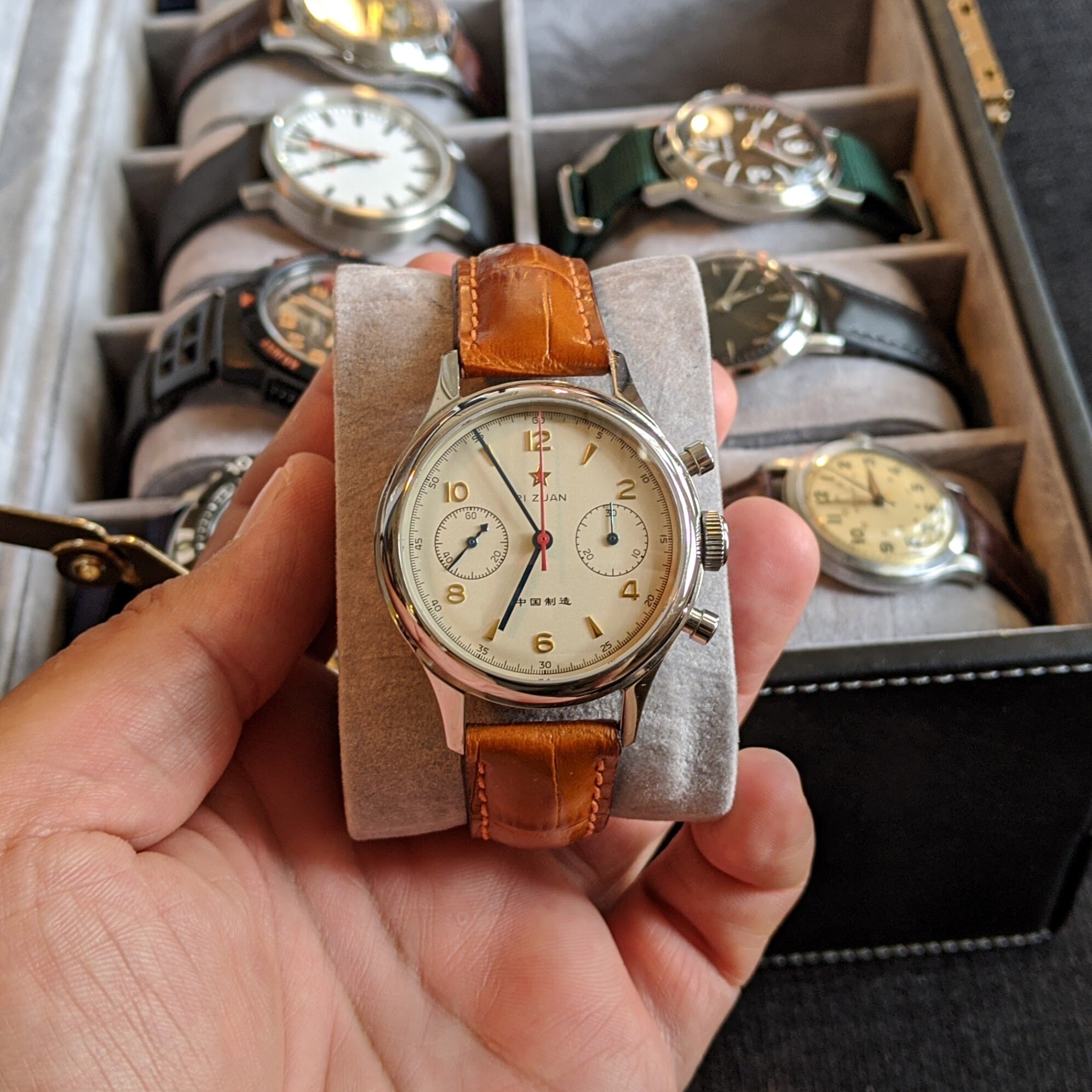
For my birthday this year Nadia and that super awesome bunch of friends got me my fourth mechanical watch – and first mechanical chronograph – the Tianjin Seagull 1963 Airforce chronograph

I’ve been wanting to get a mechanical chronograph for years but most of these are ‘luxury’ level watches (ie in the $1,500+ price range). Only a handful can be classified as ‘mid-range’ ($500-$1,500) and, of those, the Seagull 1963 Airforce chronograph is probably the coolest.

Given this is a brand new watch, you may have guessed from its name that this is a modern reissue of the original chronograph that was produced for the Chinese People’s Liberation Army Air Force in 1963.

About the 1963 Airforce watch

The particular variant of watch that I have is the more historically authentic 37mm version (there are newer, 42mm versions, as well). It has a polished silver case with a sapphire crystal, a crown, and two chronograph pushers. 

The cream dial has an outer index with black Arabic numerals and black minute-markers that double as second-markers for the chronograph. Those second markers are subdivided into one-fifths of a second (which only becomes relevant when you’re using the chronograph). The inner index has applied gold Arabic numerals and applied dart-shaped, gold hour markers.

You use the large blue hands to tell the time and the red hand counts elapsed seconds for the chronograph (which means most of the time it remains in the 12 o’clock position). The two sub-dials have small blue hands.

The ‘small seconds’ sub-dial at 9 o’clock shows you running seconds (this runs whether you’re using the chronograph or not) and the sub-dial at 3 o’clock is a 30-minute counter for the chronograph (it loops if you run the chronograph for more than 30 minutes).

At the top of the dial there’s an applied red star with a gold outline (there are also yellow star versions of these watches). Printed on the dial is the text “21 ZUAN” (21 jewels) and “中国制造” (Made in China).

The watch is powered by the ST1901 movement, which you can see in all its glory through the open case back. 

The ST1901 is a hand-wound, column-wheel chronograph movement with 21 jewels, shock protection, and a 40-hour power reserve.

To see just how cool this movement is, check out this video from Long Island Watch (the link will start the video from the 08:50 mark).

I really wanted to get this watch, not just because it’s gorgeous and has a fantastic chronograph movement, but also because so much history behind it.

History of the 1963 Airforce chronograph

The 1963 Airforce chronograph is historically important because it was the first chronograph built in China that was issued to air force personnel in the Chinese People’s Liberation Army Air Force.

There are two parts to this story of this watch, one set in Switzerland and one set in China.

In 1960s Switzerland there were three competing chronograph movement manufacturers: Lemania, Valjoux and Venus. Venus made the popular Calibre 175 column (or pillar) wheel chronograph movement that was used in several watches in the 1940s and 50s.

Competition in this space was fierce and Venus needed money to develop newer movements so they first tried to sell their existing Cal.175 machinery and designs to the Soviet Union. The Soviets, however, already had the Strela chronograph movement (a copy of Venus’ Cal.150) which meant they weren’t interested. But the Chinese were.

In the 1960s the Chinese were importing all their chronographs from Switzerland and the Soviet Union. They wanted to remove this dependency so the Ministry of Light Industry kicked-off several projects to develop Chinese-made clocks and watches. 304 was the code given to the project that would develop, test, and source a Chinese-built chronograph wristwatch for air force personnel. (100-series projects were for the navy, 200 for the army, 300 for the air force.)

In 1961 Project 304 assigned the task of developing and producing this air force chronograph to the Tianjin Watch Factory. This was partly because Tianjin had already created a popular watch movement of their own but also because Tianjin (the city) is physically closer to Beijing than, say, Shanghai (and, therefore, the Shanghai Watch Factory).

Tianjin bought the Cal.175 machinery and designs from Venus and then upgraded the original 17-jewel movement to their own 19-jewel ST19 movement. They completed their second round of prototypes in 1963 and, for whatever reason, this is the year that gets added to the watch’s name when collectors outside of China refer to it. Inside of China this watch is named after the project code and is called the ‘304 Airforce chronograph’.

By 1965 these watches had met all the requirements and passed all the Ministry’s tests so an order was placed. In 1966 Tianjin delivered 1,400 of these watches to the air force.

Jump forward to 1990 and the Tianjin Watch Factory was promoted to a national level enterprise. This was followed soon after by the creation of the Tianjin Seagull Corporation in 1992.

(‘Sea-Gull’ was the brand name given to the export version of the ‘DongFeng’, ie ‘East Wind’, watch that Tianjin made in 1965 and started exporting in 1973. This ran on the 100% Chinese designed and manufactured Calibre ST5 movement and was the first watch ever to be exported from China. So it made sense to add the most internationally well-known brand to the name of the new company.)

In 2003 Seagull resurrected Project 304’s movements and, by 2005, had reissued the first batch of commemorative aviation watches. The watch version I have is one of the newest models that runs on the further-upgraded, 21-jewel ST1901 movement and has a sapphire crystal.

Final thoughts

I’ve only had this watch for a couple of days (we celebrated my birthday on the weekend before the actual day) but I’ve worn it pretty much non-stop since then and I can safely say that I love it!

All my other watches have black dials so I wasn’t sure how I’d feel about a watch with a lighter dial. Fortunately, this watch is gorgeous and I think it looks nice on me. The awesome RIOS 1931 Bright Brown leather strap that came bundled with it from Poljot24.de adds a lot to its overall aesthetic, too.

Sure the watch doesn’t have a day-date complication or any lume anywhere (which makes it more like a dress watch, really). But the fact that I can instantly start the chronograph with a push of a single button more than makes up for anything that’s ‘missing’ from a near-authentic reissue of a 1960s watch.

I’m also loving wearing smaller watches for a change. I still love my 47mm dive watch, and have worn huge Casio G-Shocks and ProTreks for much of my life, but smaller watches work surprisingly well on my 7¾-inch wrist. I think my next watch will be a vintage watch from the 60s or 70s so this small-watch trend is probably going to continue for a while!

Let me end then by saying a HUGE thank-you to Nadia and all the awesome friends who contributed to this watch! Mechanical watches are very much a luxury item for me and it’s only (a) this year and (b) with your help that I can actually afford to own any of them. So thank you for indulging me and for not looking at me too side-eyed every time you hear I’ve bought yet another watch :)

Further reading

If you’re interested in buying this watch or want to find out (much) more about it – particularly its history and the history of its movement – here’s where you should go:

My third mechanical watch: Vostok K-65 Komandirskie

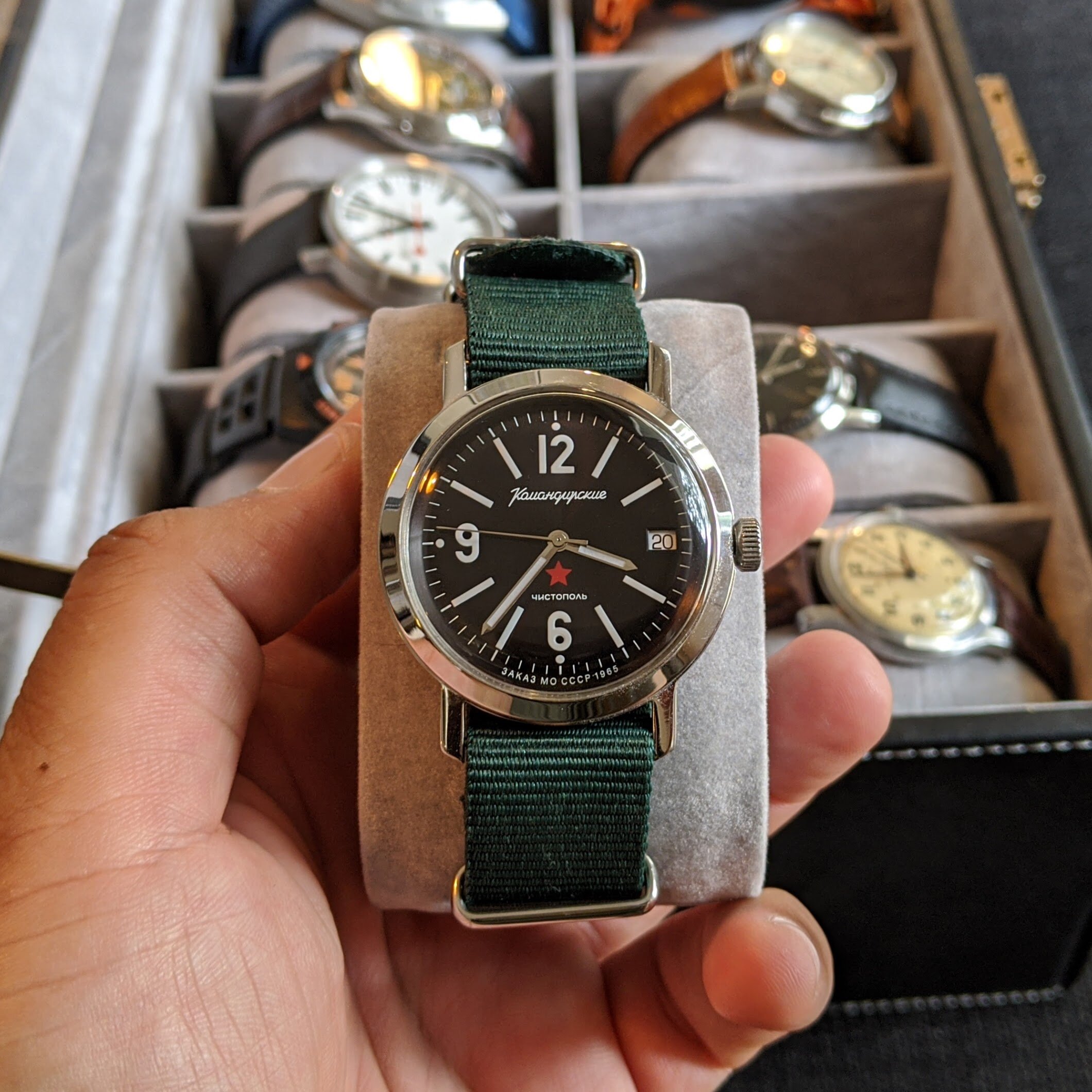
Four months ago I bought my third mechanical watch: a Vostok K-65 Komandirskie 1965 (K-65 2414A 680220).

I hadn’t expected to buy this watch because its silver-and-black version had been out of stock for several months – pretty much since it had gone on sale in August 2015, in fact.

But, as I was writing my roundup of affordable watches post back in March, I discovered – much to my delight – that Meranom had it back in stock! Not wanting to miss out, I ordered it immediately. Which was just as well! That batch was completely sold out three days later and this model hasn’t been available since. 

Shipping woes

Of course buying this watch was one thing; getting it shipped to Australia was something else entirely.

That’s because, for whatever reason, the express mail service EMS decided they didn’t want to deliver it from Russia to Australia. Of course it took them almost two weeks to figure that out. So, fifteen days after being shipped, my watch was returned to Meranom’s offices in Chistopol.

Fortunately, a few quick emails later, it was on its way to me via regular Russian Post and the awesome Rustem from Meranom was quick to refund the difference in shipping fee costs. Rustem also told me that this was the second watch EMS had refused to deliver to Australia. Strange. 

Because delivery via regular post takes time, all told, it took over a month and a half from purchase to final delivery in Melbourne. 

Now that I have this watch, though, it's quickly gone into rotation and I find myself wearing it regularly to work and on weekends. It's classy, unobtrusive, and I can wear it with a wide variety of outfits. Basically, I love it! 

So let's talk about the watch itself.

About the Vostok K-65 Komandirskie

This 2015 reissue of the K-65 Commander’s watch from 1965 celebrates 50 years since the Chistopol Watch Factory became the official supplier of watches to the Ministry of Defence of the USSR. (The Chistopol Watch Factory was founded in 1942 and renamed itself Vostok in the 1960s.)

The K-65 has a no-nonsense, clean and clear design aesthetic.

It has a 39mm round, stainless steel case with a domed acrylic crystal and open case-back.

The dial is black, with:

  • solid, white hour markers;
  • solid, sliver baton hands (filled with a bit of lume); and
  • solid, white Arabic numerals in a neo-grotesque 1960s Russian typeface (which I adore). 

The movement is a hand-wound Vostok 2414A with a date complication, 17 jewels, and a 36-hour power reserve. I wind it every night and it keeps good time.

Basically, this is a solid, dependable, good-looking, versatile military watch with a 1960s neo-grotesque design aesthetic. What’s not to love?!

(For more on this watch check out this review on Krishna’s Russian Watches.)

State of the watch collection

I now own three mechanical watches: a pilot watch (Techné Goshawk), a dive watch (Orient M-Force Beast), and now this military watch.

This means I’m halfway to completing my sub-$500 mechanical watch collection. To do that I need a dress watch (Orient Sun and Moon or Melbourne Watch Company Portsea), a sport watch (Seiko Alpinist), and a chronograph (Seagull 1963 Air Force Chronograph). If all goes well, I’ll have done that by the end of 2017 :)

Stay tuned!

A roundup of affordable watches I like

Watches: they’re expensive.

Fortunately, there are several that I really like and that I actually can afford – with prices ranging from $100 to $1,300. Here are the ones I like the most.

Dress watches

I’m mostly a fan of tool watches but let’s start with a couple of dress watches I really like.

Orient – Sun and Moon

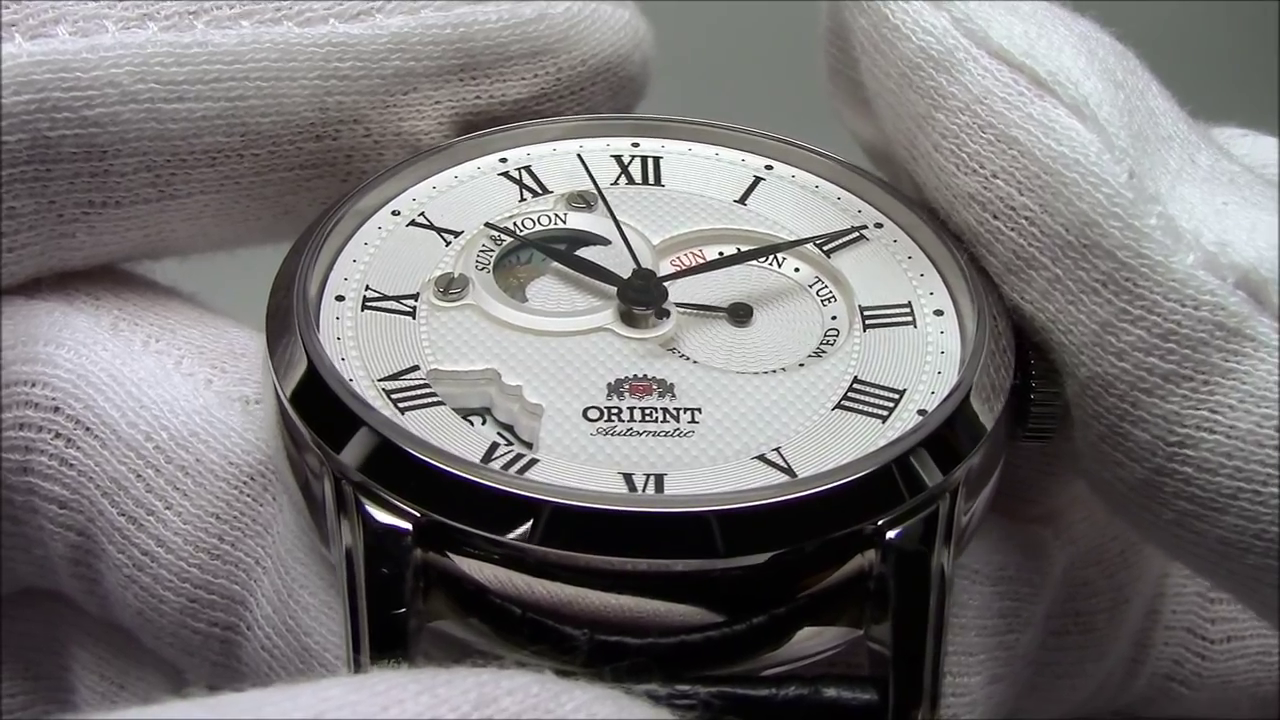
The first is the white dial variant of the latest Orient Sun and Moon series (ET0T002S). 

The thing that makes this watch so cool is the depth and complexity of its multi-layered, multi-textured dial. That dial pattern is machine stamped and not hand-guillochéd, of course, but then this watch does cost $300, not $3,000. The photos above are screengrabs from Long Island Watch’s video overview of the Sun and Moon series; check that out to see how gorgeous these watches are.

Melbourne Watch Company – Portsea

More layered-dial gorgeousness can be found in the Melbourne Watch Company’s Portsea series

I love the colours, the contrast in layer textures, and the overall naval theme of these watches. And isn’t the ‘M’ counterweight on the seconds hand just fabulous? (About as cool as Christopher Ward’s trident seconds hand counterweight.) If I already owned a white dial Orient Sun and Moon, I’d probably get a blue dial Portsea; most likely the Portsea Blue. Costing almost $900 a piece, though, these watches are pricier than the Sun and Moon. But then they have better quality movements, higher quality leather straps, and they come with a two-year warranty – so you get what you pay for.

Military watches

I generally prefer pilot watches to military (or field) style watches but here are three military watches I like.

Vostok – Komandirskie 1965

The first is the 50th anniversary reissue of Vostok’s Komandirskie 1965 or K-65 (2414A 680220). 

Source: Meranom.com

What I love about this watch is its no-nonsense, clean and clear design aesthetic – it’s almost a military-themed dress watch. Which makes sense since it is, after all, a Commander’s watch and not an average soldier’s watch :)

For more on this watch check out this review on Krishna’s Russian Watches.

This is the only watch on my list that has an acrylic crystal instead of a sapphire one, by the way. Given that it costs less than a hundred dollars, though, I don’t mind waiving my sapphire crystal-only rule for it. Not that I have a choice with Vostok, of course, since they don’t make any watches with sapphire crystals, anyway.

Update: I bought this watch! I’ll blog about it once it arrives.

Marathon – General Purpose Mechanical

Given that I like Russian military watches from the 1960s, it’s not a surprise that I also like American military watches from the same era.

Unfortunately, the watch that I like the most – the Benrus 3061 black dial – is no longer being manufactured because the Benrus watch company no longer exists (though the brand does live on). So, until I jump in to buying second hand watches, I’m not going to get my hand on one of these beauties. 

Fortunately, a couple of years ago Marathon released their homage to this watch: the General Purpose Mechanical

Source: Marathon

They’ve toned the design down a bit (particularly the colours) but what they’ve created is a solidly-constructed, no-nonsense military watch that is cool in its own way. Also, it costs just $400, which his nice. Bonus: these watches use tritium tubes instead of lume.

Hamilton – Khaki Field

The third military watch I like is another American classic: the Hamilton Khaki Field series

Source: Hamilton

I really like the dials of these watches, particularly the inner 24-hour ring of numerals (that show military time) and the large day window in the Day Date Auto. The needle-tipped, tapered baton hands on these watches are cool, as are the seconds hands that reach all the way to the minute markers at the outermost edge of the dial. Those hands let you be more accurate with the time so, for example, you can coordinate military action (or, say, a surprise birthday party) down to the last second :) These watches are surprisingly affordable, too, costing around $400 to $600.

Pilot watches

Now we come to my favourite watch category: the pilot watch.

Laco – Fliegeruhren B (Pilot Watch Type B)

My favourite watches in this category are the 1940s German navigator watches – specifically the ones with the Type B dial. Several brands make this style of watch but my favourites are usually from Laco

Source: Laco

The most affordable of these is the Laco Aachen ($400). But, if I had a choice, I’d get the Laco Paderborn ($1,000). That’s a significant upgrade over the Aachen and, with a domed sapphire crystal and solid case back, is much closer to the original flieger watch. As a bonus, it also has thermally-blued steel hands. If I was going all-out, though, I’d get the Laco Friedrichshafen ($1,200). That’s basically a larger, and therefore even more authentic, version of the Paderborn (ie it has a 45mm case compared to the Paderborn’s 42mm).

For more on this series of watches check out this video overview from Long Island Watch.  

Hamilton – Khaki Aviation

The only other pilot watches I love as much as the Laco Type B fliegers are the Hamilton Khaki Aviation range. And that’s a big range so there are lots of models to choose from. 

Source: Hamilton

I think my favourites are the more straightforward ones like the Pilot Auto ($1,300) and the Pilot Day Date ($1,200). Both are gorgeous, with their large sword hands, long seconds hand, and day-date windows (particularly on the Pilot Day Date). I also love the more complicated Pilot GMT ($1,800) with its red, second-time-zone hand. And the limited edition Takeoff Air Zermatt ($1,600), built in partnership with the Air Zermatt Swiss mountain rescue service. 

Other pilot watches

There are many other pilot watches from several other watch brands that I like but the Laco and Hamilton ones are my favourites. However, for completeness’s sake, I should say that I love pilot watches from Alpina, Bell & Ross, Citizen, Damasko, Fortis, Garmin, Graf Zeppelin, Hanhart, Junkers, Sinn, and Techné. And, who knows, I might buy one (or several) of these in the future, too :)

Sport watches and chronographs

Seiko – Alpinist

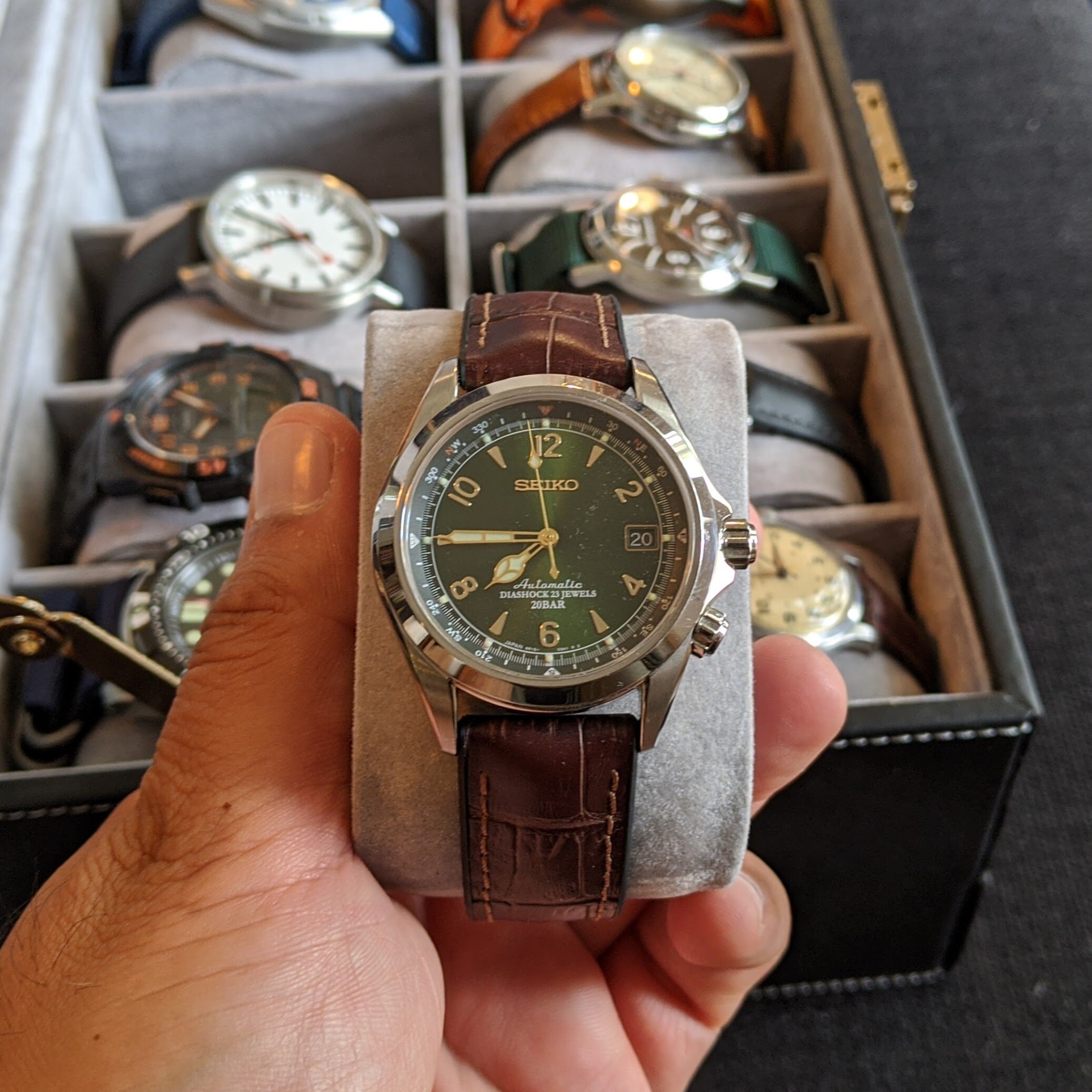
I’ve been a long-time fan of Casio watches – having owned multiple G-Shocks and ProTreks – so I’ve never really paid much attention to non-Casio sport (or field) watches. However, the Seiko Alpinist (SARB017) is difficult to ignore. 

I mean, how cool is that green bezel; the applied gold numerals; those cathedral-shaped hands; and the inner, rotating compass ring (controlled by the second crown at the 4 o’clock position). Not to mention the higher-end Seiko movement with a 50-hour power reserve. Yes, this is a gorgeous, capable watch. Best of all: it costs less than $500.

For more on this watch check out the history of the Alpinist on Springbar and this video review on Urban Gentry.

Seagull – 1963 Chronograph

Not counting day/date, the complication I love most on a watch is a chronograph. Unfortunately, mechanical chronographs are the most expensive type of wristwatch out there. Fortunately, among the handful of affordable chronographs that are available, we have the fantastic Seagull 1963 Airforce Chronograph series. 

These watches are a 50th anniversary reissue of the original chronograph that Seagull made for the Chinese People’s Liberation Army Air Force in 1963. The one I’d want to get is the smaller, more authentic 38mm one with the sapphire crystal (6345G-2901). I adore the overall design of this watch, with its cream dial; blue and red hands; and applied gold numerals and hour markers. What’s even cooler is the open case back that really shows off the ST19 column-wheel chronograph movement (which is based on the Swiss Venus 175 movement that Seagull bought from Venus in the 1960s). This 38mm model is surprisingly affordable, too, costing under $500.

Check out this video overview from Long Island Watch to see just how cool this series of watch is. 

I love this watch so much that, for my birthday this year, I’m thinking of asking my friends and family to pitch in and get one for me. Unless, of course, I find it on sale for a lot cheaper first :)

Other watches

There are several other watches I’d love to own, of course.

Many of these are quartz watches from the Seiko Giugiaro and Astron series; the Casio ProTrek and G-Shock series; the Bulova Accutron and Precisionist series; and the Citizen Promaster Air series.

From the mechanical watch side there are a handful of dive watches I’d like to own, plus several vintage watches I’d love to get my (second) hands on.

For now, though, I’m happy with my shortlist because I can turn this into a shopping list from which I can cross-off items over the next three to five years :)

My first dive watch: Orient M-Force Beast

It’s been only a few months since I got my first mechanical watch but I’ve already gone ahead and bought myself a second one :)

This is not another pilot watch, but a fantastic dive watch. Specifically, the Orient M-Force ‘Beast’ (ref. EL06001B0):

Why a dive watch?

They’re among the most affordable style of mechanical watch: Of the five major watch styles – field, chronograph, pilot, dress and dive – when it comes to mechanicals, dress watches and dive watches are generally the most affordable. 

I didn’t want to spend too much on another watch: I’ve only just started collecting watches in earnest so for my next watch I was looking to get an affordable vintage watch, some type of dress watch, or a dive watch.

They’re the only style of watch I don’t have: My current collection comprises two field watches (both Casio quartz digitals), one dress watch (a Casio quartz analogue), one chronometer (also a Casio quartz analogue), and one pilot watch (a Techné mechanical). So, to round things out, I was leaning towards getting a dive watch, anyway.

Why the Orient M-Force Beast?

There are lots of gorgeous dive watches out there but my favourites from the two ends of the price spectrum are probably the Orient Black Ray Raven and the Blancpain Fifty Fathoms Automatique

I don’t think I’ll ever be able to afford a Fifty Fathoms – certainly not first-hand – but I could have easily bought myself a Black Ray Raven. (Note: This watch isn’t poorly named. The ‘black’ refers to its black dial and the ‘raven’ refers to its black case and bracelet. There’s also an Orient Blue Ray, for example.)

However, in exploring watches over the last few months I decided that, during this early watch collecting phase, I would only buy watches that had sapphire crystals. Why? Because I have a limited amount to spend on new watches so I want to make sure that the watches I do buy are worth it – and watches with sapphire crystals generally are.

Which basically meant I wasn’t going to be buying myself a Black Ray Raven, either,

Now, there are generally four levels of dive watches (that roughly correspond to their price category):

  • Basic: These are the most affordable, but almost all of them have mineral crystals and ‘workhorse’ movements – think the Orient Mako series, Seiko’s SKX007 (probably the most icon affordable dive watch), or the Vostok Amphibia collection
  • Mid-range: Many of these have sapphire crystals and better quality movements – the Orient M-Force Beast falls into this category, as do several professional dive watches (like those from Squale)
  • Professional: These tend to have higher depth ratings, helium release valves, and other features professional divers are interested in – pro watches from Edox, Citizen, Doxa, Marathon, Orient, Oris, Seiko, Squale, Tissot and Victorinox fall into this category
  • Luxury: These don’t necessarily have the features that professional dive watches do, but they do have high quality designs and movements; plus they’re made by luxury brands – think Blancpain Fifty Fathoms, Rolex Submariner, and Omega Seamaster (the James Bond watch)

Since I don’t need a professional dive watch, I can’t afford a luxury dive watch, and I don’t want a basic dive watch, I was looking to buy myself a mid-range diver. Specifically, something from Orient’s M-Force seriesSquale’s 1521 collection or Glycine's Combat collection.

Of course, the problem with most mid-range divers is that they’re beyond my budget. So earlier this month I had decided that I was going to get a dress watch, instead. In fact, I’d even settled on the gorgeous Mondaine Simply Elegant (a quartz watch, I know, but I adore that Swiss railway clock design!): 

Fortunately, with Christmas fast approaching, several online watch stores had huge sales on Seiko and Orient dive watches so, suddenly, a whole range of mid-range divers became affordable.

So pouncing on the Beast when it was on sale at 40% of its original price was an easy decision to make :)

About the Orient M-Force ‘Beast’

Orient is one of Japan’s biggest watch brands (along with Seiko, Citizen and Casio). Its history dates back to 1901, though it was incorporated as Orient Watch Company in 1950 and became a subsidiary of Seiko Epson Corporation in 2001.

Orient’s M-Force series of dive watches has been around since 1997 and this M-Force EL06 line, nicknamed ‘The Beast’, was first released in 2012. The latest M-Force line, EL07 (nicknamed ‘Delta’), was released in 2014 but I actually prefer the older EL06s.

The watch I’ve bought is the M-Force EL06001B0, which is the black dial variant. This watch is large (47mm wide and 53mm tall) and chunky, but very nicely proportioned and very nicely designed:

It is powered by Orient’s 22-jewel, three-hand 40N5A movement – a movement that also provides date and power reserve complications.

Worn & Wound have a really nice review of this watch so I won’t write too much more about it here. Instead, check out their review video or Orient’s own product video.

Or, if all you want to do is see how gorgeous this watch is, check out this promo from Watch Tanaka:

Final thoughts

It’s been a few days since I got this watch and I’m super happy with it! 

It’s good looking, reliable, and its lume is bright and long-lasting. Also, its leftie-crown took surprisingly little time to adjust to.

Yes, its build is a little chunky and it is a little heavy. But, as someone who has owned multiple G-Shock and ProTrek watches over the years, it’s nice to be wearing their equivalent in the mechanical watch world!

Finally, it looks good on different coloured NATO straps (I’m not a huge fan of metal bracelets) and this versatility makes it even more fun to wear.

And all this means I now have two fantastic mechanical watches to choose from every day :)

Techné Goshawk: Attention to design detail

In my previous post I explained how the Techné Goshawk wristwatch has a ‘neo retro’ design that is based on two 1940s aircraft cockpit clocks made by the American watchmaker Elgin: 

Now I want to highlight four small, but important design decisions that Francis Jacquerye took when creating this watch. These decisions give an indication of how talented a designer he is. 

Before we do that, though, here’s a close-up of the Goshawk’s gorgeous watch face: 

Now, on to the design decisions…

24 hour dial is optically centred

If you look closely, you’ll notice that the 24-hour sub-dial in the 9 o’clock position isn’t in the exact horizontal centre of the main watch dial. Instead, it’s been ever so slightly raised. That’s because it’s been placed at the ‘optical centre’ (blue line) of the watch dial, not the ‘mathematical centre’ (red line):

There are two reasons for this. 

First, the shape of the Arabic numeral ‘9’, which is the most dominant element in that sub-dial, has more optical weight in the upper part of the glyph. Had Jacquerye placed the 9 right in the centre – like he has with the 3 (which is a horizontally symmetrical shape) – the 9 would have looked a little low. So, to make this look more balanced, he raised the whole dial ever so slightly from the mathematical centre to the optical centre. 

Second, there are three elements within the main dial: 

  1. the 24-hour sub-dial, 
  2. the Techné logo, and
  3. the date window. 

The ‘Techné’ line in the logo has its baseline set to the mathematical centre of the dial (the red line). But, because that logo has more weight above the line than below it, the 24-hour sub-dial needed to be moved up slightly to help balance those two elements with each other. 

Had the sub-dial been left at the mathematical centre, it would have looked out of alignment with the logo. So, instead of moving the logo lower – which would have made both elements appear a little below centre – Jacquerye moved the sub-dial up ever so slightly.  

Date window is balanced with other elements

Something similar has been done to the date window between the 4 and 5 o’clock positions, with the window having been nudged slightly closer to the 5 o’clock hash mark: 

The date window works better here because, in this position, it looks more balanced in relation to the sub-dial and logo. One way to think of this is that the weight of the sub-dial has pulled the date window a little more clockwise from where it may have otherwise been positioned. 

Had the date window been centre aligned between the 4 and 5 o’clock hash marks (as shown on the left, below), it would have looked a little out of place – and also a little boring. It looks much better slightly off centre (as shown on the right, below):

Date window has a white outline

In one of the reviews of this watch, the reviewer complained that he didn’t like the white outline around the date window. I actually think that’s a super important part of the design. 

Without that outline, the date window wouldn’t be prominent on the dial. And its importance as a design and information element would have been diminished. 

You can see this for yourself if you look at that window without the outline (as on the left) versus with the outline (as on the right):

The style of the crown is similar to the original

Finally, one of my favourite design details on this watch is its crown which, as you can see, follows the design of the original Elgin clock’s winding knob: 

There are a bunch of other things I love about this watch’s design, of course – everything from the typography, to the shape of the hash marks, to the 24-hour hand being half orange – but those elements are more obvious to everyone, I think.  

What I wanted to do here was highlight the smaller things – the attention to design detail – that so impressed me when I first saw this watch. So hats off to Jacquerye from making such an excellent and well-designed timepiece. 


My first pilot watch: Techné Goshawk

Thanks to Nadia and a bunch of awesome friends who chipped in, for my birthday this year I got my very first mechanical watch: a Techné Goshawk (ref. 411.152). And, yes, it’s a pilot watch :)

Why the Techné Goshawk?

After doing a great deal of research on pilot watches I decided that, given my budget, there were two fantastic watches I could start my mechanical watch collection with: the Laco Aachen B-Uhr style flieger or the Techné Goshawk pilot watch:


I would have been super happy to have either of these as my first mechanical watch but, in the end, the Goshawk won out. This was partly because, at the time of purchase, it was slightly cheaper than the Aachen. But, more importantly, because it was the more unique of the two. 

That second point was driven home by a recent Kickstarter campaign from a new watch brand called Air Blue. Air Blue is a spinoff of Deep Blue, a brand that makes affordable dive style watches. The Air Blue Kickstarter is for four lines of watches, and each of these lines borrows from (and, sadly, waters down) the design of a much more expensive pilot watch currently on the market: 


Their non-Kickstarter lines (which you can find in their brochure) also borrow design elements from much more expensive watches currently on the market:

But you know which watch design isn’t up there? That of the Techné Goshawk. Or of any of Techné’s aviation watches, for that matter.

Which means that, not only is the Goshawk a gorgeously designed watch in and of itself, because it’s a new-ish design from a boutique watchmaker, there aren’t many other watches out there that look like it.

There are, on the other hand, lots of B-Uhr style fliegers in the market. Because of this, watchmakers tend to go in one of four directions to differentiate their B-Uhr from everyone else’s: 

  • Authentic: They go super-authentic and make a B-Uhr replica that looks almost exactly like the original – like the Laco Aviation Observer Watch Replica
  • Up market: They borrow from the original concept and make a watch that is fabulously designed and beautifully constructed – like the Hamilton Pilot Auto or the IWC Big Pilot.
  • Enthusiast: They keep the watch design relatively similar to the original but add or remove components to cater to different price brackets – like the range of Laco Type B watches available.
  • Cheap: They stick mostly to the original design but they use cheaper components to drastically lower the price point – like the Tisell Type B Pilot.

Actually, there’s probably a fifth direction. In this, watchmakers change the design so much that you can’t seriously call their product a B-Uhr flieger anymore – though you can still tell that’s where the design originally came from (like the Orient Flight). 

So I had a choice between going with a design that lots of brands are covering or a design that’s unique and interesting, but still has plenty of history behind it. And, though I will eventually get a flieger for myself (next birthday, perhaps?), I figured the Goshawk would be a cooler pilot watch to start with. 

Now, onto the watch itself…

About the Techné Goshawk

The Techné brand

Techné Instruments is a boutique aviation watch brand created by Francis Jacquerye in 2007. Jacquerye was a senior designer and analyst at Longines before he went independent and became a horological product management consultant. 

Now he and his wife run VANTGARD, a company that consults with watch brands and start-ups. They also design and manufacture (through outsourcing) custom watches for clients and for themselves. So far Techné is VANTGARD’s only in-house brand. 

The Goshawk was Jacquerye’s second Techné watch and it was launched 2010. It has since been updated slightly from the original (e.g. the current model uses a sapphire crystal display while the original used mineral glass). 

Watch design

The Goshawk has what you would call a ‘neo retro’ design. 

Its design is based primarily on an aircraft mission timer built in the 1940s by two American watchmakers, Elgin and Waltham. These mission timers were installed in Grumman F9F Panther aircraft in the 1940s and F-9 Cougar aircraft in the 1950s and 60s. 

This is what those timers looked like:


(Source: Cockpit Clock)

This is what the Goshawk looks like next to the Elgin version of that mission timer:

(Source: Techné)

And when you throw a regular Elgin aircraft clock from the 1930s into the mix, you can see how those retro dial and hand designs were combined and modernized by Jacquerye to create the Goshawk:

(Source: Cockpit Clock)

There are a number of specific things I love about the Goshawk’s design but I’ll go over those in a separate post. (UPDATE: That post is now here: 'Techné Goshawk: Attention to design detail'.)

For now, you can read this review from Worn & Wound or just watch their review video (note: Blake pronounces “goshawk” as “g’SHAWK” when its actual pronunciation is “GOSS-hawk”):

Technical specifications

The Goshawk’s case is made from 316L stainless steel with a matte black PVD coating. It has a diameter of 41.1mm and a thickness of 13.5mm. So, while it’s not that big on my wrist (I have a 7.5 inch wrist), it is reasonably thick. 

The case has an anti-reflective sapphire crystal on the front and an exhibition window on the back. It has a matte black dial, silver minute marks, and its hands and hour marks are coated with C3 luminous material (one of the brightest available). The lume on the 24-hour hand is orange, which is a nice design detail.


The watch uses on an automatic Japanese movement: the popular Miyota 8217 from Citizen. This is a non-hacking, self-winding plus hand-winding, 21 jewel movement. It has a 40+ hour power reserve and is accurate to -20/+40 seconds per day. It has three regular hands (hours, minutes, seconds); a quickset date; and a 24-hour hand. 

The Goshawk is also shock resistant; water resistant to 50 metres; and is ISO certified for anti-magnetism (useful for pilots). 

Final thoughts

I’ve only had this watch for about four hours but already I love it to bits. I love how clear its layout is and how quick and easy it is to read time from it – even from oblique angles. Its lume in spectacular, too. 

Mostly, though, it looks great and feels great on my wrist and I’m really enjoying wearing it :)

I’ll have more to say about the Goshawk’s design next time. But, for now, a big, heartfelt thanks to all my friends who contributed towards this watch and have helped me take off on my mechanical watch collecting journey. 

Researching flieger style watches

As I said in my previous post, I'm ready to buy my first mechanical watch. 

Now people in this situation usually look to well-known Japanese brands like Seiko and Orient since these companies produce excellent quality mechanical watches that aren't very expensive. 

And if I was looking for a dive style watch I'd definitely get the Seiko SKX007K1 or Orient Ray EM6500CD. Or, if I was looking for a field style watch I'd get the Seiko SNZG11K1. Or, if I was looking for a dress watch, I'd get the Orient Bambino ER2400CN.

But, no, I'm an aviation enthusiast so I want to get a pilot watch. 

Eventually, I'll want to get myself something like the Breitling Navitimer 01 (which costs $9,800) or the Breitling Navitimer 1461 ($13,400) but that won't happen for another couple of decades at least. Which is fine because the type of pilot's watch that I adore is the flieger style watch from WWII. 

Now the Seiko 5 Military SNK809K2 does have some pilot/flieger characteristics but it's not quite what I'm after. And the Orient Flight ER2A001B is closer, but it's still a loose interpretation of the original and I'd rather get something more visually authentic.

Of course, before I go any further, I should explain what a flieger style watch is. 

Flieger style watches

Pilot watches have been around since 1904 and, if you want to learn more about them, check out this excellent five-part history on Monochrome: 

For flieger style watches we're interested in part five of that series. 

Or, if you want a quicker introduction, check out this blog post: 

But, basically, these 'beobachtungs-uhr' (i.e. 'observer watches') were created for the Luftwaffe in the 1940s by five German watchmakers: 

  • A. Lange & Söhne
  • Laco 
  • Stowa 
  • Wempe 
  • IWC

These watches were required to:

  • Be super readable (so they were 55mm in size and had white Arabic numerals on a black dial plus blue-flamed sword hands filled with luminous material)
  • Have an anti-magnetic case
  • Be chronometer certified
  • Have a hack-capable second hand (i.e. the seconds hand would stop when you pulled the crown out so you could precisely synchronize your watch)
  • Have a large diamond or onion-shaped crown (so you could adjust them while wearing gloves)
  • Have a large strap (so they fit around your flight jacket or on your thigh)
  • Have a triangle marker at the 12 o'clock position (so you could use the dial as a basic solar compass)

They came in two types: Type A for pilots and Type B for navigators. 

And they looked like this: 

Flieger watches on the market 

Because no one company can claim to have designed or built the original flieger style watch lots of companies now make them. 

Most of the luxury flieger style watch are Type A, though, and I much prefer Type B. The one Type B I do like from this bunch (the Bell & Ross Vintage WWI) happens to be the cheapest of the lot - but is still not something I can afford just yet.

Fortunately, there are a number of Type B watches from enthusiast-level watch brands. The STOWA Flieger Baumuster B and Archimede Pilot 42 B Automatic are the most original-looking (and I love them both) but I think the Hamilton Pilot Auto is my favourite. 

Yes, Hamilton have tweaked the design a bit and have even added a day/date complication - but I really like their interpretation. In fact, I like it so much that, as far as pilot watches go, I'll settle on this on till I'm ready to buy a Breitling. But, for now, these watches are still out of my price range.

The watches that are in my price range also come from enthusiast-level brands - though from the lower end. I love both the STEINHART Nav B-Uhr B-Type and the Laco Aachen Type B Dial Automatic but, on balance, I think I prefer the Laco. 

Aside from the fact that Laco is one of the companies that made the original B-Uhr watches back in the 1940s, I prefer its full lume and open case back. Also, Laco's movement is made in-house - which is a plus for any watchmaker. 

The one last category of watch brands I should mention are the less well-known consumer brands. So not the Seikos and Orients of the world, but the brands that build cheaper watches that generally work well and are still decent enough looking.

For example, TISELL is a Korean brand that uses off-the-shelf Chinese watch movements from Sea-Gull. And Ticino is a German brand that uses both Chinese Sea-Gull and Japanese Miyota movements (Miyota is owned by Citizen). Watches with Sea-Gull movements used to be hit-and-miss but both TISELL and Ticino do their own quality control with these movements so their watches generally run well. 

Each of these brands makes a Type B flieger style watch. The TISELL Type B Pilot uses a Sea-Gull movement while the Ticino Type B Automatic uses a Miyota movement (their Type B watch from last year used a Sea-Gull movement but this year they're moving a little up-market). 

Both of these are decent enough watches. They have stainless steel cases and sapphire crystals, and they generally run well. But brand like these save money with cheaper movements, lower production costs and fewer subtle refinements. Which means these two watches are less water resistant, they're not quite as well-built or finished, they use a dimmer lume, and their straps aren't particularly good. Also, they don't have much of an after-sales support, maintenance and repair network to turn to if they're not working as well as you'd like. 

What will I buy?

Deciding which watch I'm going to get depends on a number of things: 

  • What's my budget? 
  • And, given that I have a limited budget, what am I willing to compromise on?
  • Finally, do I have a brand preference?

Keeping all that in mind, this is what I'd get at each budget level:

  • $4,000: Bell & Ross Vintage WWI - choosing the Type B over Type A and picking one of my favourite watch brands
  • $1,500: Hamilton Pilot Auto - choosing the more modern interpretation
  • $500: Laco Aachen Type B - choosing the more authentic interpretation and my preferred feature set
  • $200: None 

That $200 decision was the hardest. If I had just $200 I'd either have to get the Orient Flight, which is not my favourite flieger interpretation but I know will be built well and is guaranteed to run really well. Or I'd have to get a TISELL or Ticino that, while more faithful to the original design, may not be built as well or run as well. 

As it happens, I'm not willing to compromise on either flieger design faithfulness or watch features and quality so I'd probably go with neither of those options. Instead, I'd wait till I had $500 to spend so I could get the Laco, instead :)

Also, for completeness' sake, if I actually had $4,000 just lying around, I wouldn't go for that particular Bell & Ross watch, either. I'd already own those Laco and Hamilton Type B flieger watches and I wouldn't want another one. Instead I'd go for a different Bell & Ross watch or something else entirely. 

So there you have it: my thought process (or, well, brain dump) on buying my first mechanical watch given all that I've learnt about the world of watches in the last few months. I'm hoping at least a couple of you enjoyed reading it. Or at least you looked at the pictures and though: "Ah, so that's what he's been on about these last few weeks!" :)

Exploring the World of Watches

I love watches and, since the age of seven, have owned eleven of them. (Which turns out, on average, to be one watch every three years.) 

Nine of these were Casio watches - including one calculator watch, two G-shocks, one ProTrek, and one Edifice. This is the Edifice (EQS-A500B-1AV) that I bought just a couple of months ago, by the way (which I then customized with Hadley Roma leather strap and butterfly deployant clasp): 

The other two watches I've owned were a Pulsar LED (the one I got when I was seven) and a mechanical hand winding watch that I don't remember the brand of (I was twelve at the time).

The cool thing is that I have I reached a point in my life at which I'm ready to move beyond watches as primarily practical time telling tools. I now want to get watches that, while still good for telling time, are also pieces of jewellery and objects of design, engineering, craftsmanship and history. So, aside from another couple of quartz watches I'll probably want to get in the future (a Casio ProTrek and some type of chronometer), this means I'm looking to get myself my first proper mechanical watch. 

I've spent the last few months researching watches and world or horology - both online and in local stores in Melbourne - and, over the next few months, I'll summarize what I've learnt on this blog. 

Let's start with the basics, though: 

  • What types of watches can you get?

  • Who makes them?

  • How much do they cost?

Watch Styles

Historically, wristwatches have been tool watches. In the early 1900s people were perfectly happy with pocket watches (though women sometimes wore watches as jewellery on their wrists) but, when it stopped being convenient to pull a watch out of your pocket - like when you were diving, flying, driving or marching across Europe in your army - wristwatches started to become popular. 

Accordingly, these are now the main styles of wristwatches available (list sourced from this convenient 'Watches Style Guide' thread on Reddit): 

  • Diver's watches: for divers and sailors

  • Field watches: for infantrymen, rangers and other ground troops 

  • Pilot's watches: for pilots and navigators

  • Chronographs or sport watches: for drivers, racers, yachtsmen and other people who play sports

  • Dress watches: for people who want elegant watches to wear with fancy clothes

Or, more visually: 

There are just the big bucket watch styles, of course. There are many variations within these styles and a handful of other styles, as well (e.g. single hand, Bauhaus, fashion). And a lot of these styles and variations overlap, too. 

Watch Brands

There are a great many watch brands out there but, again, thanks to Reddit, here's a good way of categorizing them: 

  • Consumer: some quartz, some mechanical; brands from all over the world (e.g. Switzerland, Japan, Russia, China, USA, Denmark)

  • Enthusiast: usually tool watches designed for a specific purpose (e.g. pilot or military watches)

  • Quasi-luxury: expensive or fancy enthusiast watches; lower-prices luxury watches

  • Entry-level Luxury: starter luxury watches; expensive enthusiast watches 

  • Luxury: expensive watches with a lot of history behind them

  • High-end Luxury: most well-known luxury brands

  • Ultra Luxury: very expensive watches (for serious watch collectors and very rich people only)

Or, more visually: 

Note: I haven't included the independent watchmakers of the Académie Horlogère des Créateurs Indépendants (ACHI) in that list because, let's face it, I'll never be able to afford any of their watches.

UPDATE: Check out the improved and updated (to March 2021) version of this chart by Earthjade on the WatchUSeek Watch Forums.

It's useful to know that a number of these brands are owned by large multinational holding companies.  

For example, the Swatch Group owns: 

  • Swatch from the consumer group;

  • Hamilton and Tissot from the enthusiast group;

  • Longines and Rado from the quasi-luxury group;

  • Omega from the luxury group; and 

  • Breguet, Blancpain and Glashütte Original from the high-end luxury group.

The Richemont Group owns: 

  • Baume & Mercier and Montblanc from the entry-level luxury group;

  • IWC from the luxury group;

  • Cartier, Jaeger-LeCoultre and Officine Panerai from the high-end luxury group; and

  • Piaget and Vacheron Constantin from the ultra luxury group.

And LVMH owns: 

  • TAG Heuer from the quasi-luxury group;

  • Bvlgari from the luxury group; and

  • Hublot and Zenith from the high-end luxury group.

Also, Tudor is Rolex's lower-end brand and Orient is owned by Seiko. 

I'm sure there are other brand partnerships and joint ownerships out there. 

Watch Prices

You can buy a watch for almost price - from a $25 Casio to a $250,000 Hublot - and different people create different price-range buckets for watches. 

For example, A Blog to Watch has three: 

While ever-practical Reddit has buying guides for these six price ranges (and a separate guide for 'Ladies Watches'): 

I, too, am practical so I have three personalized buckets (each with its own Pinterest board, no less): 

The way I see it:  

  • In my 30s and 40s I'll only be able to justify buying watches that cost less than $1,000

  • In my 50s I'd like to be able to justify buying a watch that costs more than $1,000

  • And in my 60s I might just buy myself a watch that costs more than $5,000 

What Next?

So that was just the basics. There's a lot more to summarize but I'll try to do that over the next few months (though it'll probably take years since there's so much to learn).

Instead, let's move on to something more interesting: like actually buying a watch. That's what my next post will be about. 

I Buy Another Watch

Exciting news! I've bought myself another watch :)

This news is exciting because I love watches – not as pieces of jewellery, but as gadgets that tell the time. I always need/want to know what time it is and, as a result, have been wearing a wrist watch almost every day since the early 80s.

Why another watch?

Why buy a second watch when I already have a perfectly good watch that I love and wear all the time? 

Current vs New watch

Two reasons:

First, the watch I have right now is too thick to fit comfortably under the cuff of my work shirts. As you can see in the picture below, the watch on the left, which is my current watch, is much thicker (16mm) than the watch on the right (8.6mm), which is my new one.

Watch thickness comparison

Now, because my current watch is so thick, for the last year and a half, I have actually not been wearing it to work every day. I know! Crazy, right? Fortunately, I carry two smartphones with me all the time so, even though I’ve been without a watch at work, I have always been able to keep track of the time.

Second, well…let me put it this way: Where is the one place you can't use a smartphone to tell the time? In an airplane, of course – specifically during take-off and landing. And what company do I work for now? Oh, yes, an airline.

So what happened to me last month? I flew to Sydney for work and, for two extended periods of time (well, at least they felt like extended periods of time), I was chronologically disadvantaged because I'd had to turn my phones off and had forgotten to wear my bulky-but-still-functional watch to work that day.

What then?

Scarred by that experience, I decided to look for a nice, cheap, simple, and, importantly, thin watch that I could wear to work. Obviously, I was only going to look at Casio watches.

Unfortunately, there are no Casio outlets in Melbourne so I was stuck with the limited selection on display at Angus & Coote and Thomas Jewellers on Bourke Street in the CBD. Neither of them had what I wanted so I went to trusty old Amazon.com to see what I could find.

That was when I discovered that online retailers sell most Casio watches at about a third of the price that local brick-and-mortar retailers sell them at. Wow. I am never buying a watch from a local brick-and-mortar retailer again.

Anyway, here is my original short list from Amazon (my current watch is in the top left hand corner):

Watch choices

Yes, I get a little obsessive when it comes to buying gadgets. Especially those I’ll be using frequently for a number of years. Heck, I wouldn’t even be writing this blog post if I wasn’t that obsessed with this stuff!

Finally, after getting Nadia's preferences, I made my decision and placed my order. As it happens, Amazon ended up being just the front-end for this purchase because my actual order was placed with the appropriately named MrWatch.

A few days later, through the mysterious powers of FedEx, I had my new watch :) 

So, what did I get?

MTP-1309L-8BV_l

The watch I bought is a Casio MTP-1309L-8BV. (Yes, that’s quite a mouthful.)

It’s simple, good looking, and, fits very comfortably under the cuff of all my work shirts.

Of course, this is the first analogue watch I’ve had in years so using it to tell the time is taking a little getting used to. I can’t just take a quick peek at one part of it, for example. I have to look at the entire watch face before I can tell what time it is. Not that this difficult to do, of course. I’m just not used to doing it.

I am liking its leather strap, though. And I am enjoying the sight of the second hand as it spins around the clock face.

So, “yaay!” for my new watch and my ability to comfortably keep track of time while wearing a business shirt during take-off and landing. (Hmmm…my reason for getting this watch sounds a lot less impressive when you put it that way.)

My New Casio Watch

I love Casio watches and, since the early 80s, haven’t bought anything other than a Casio for myself. (I’ve also never bought anything other than a Casio calculator but that’s another blog post.)

When the battery on my latest watch started to die for the second time a couple of weeks ago (I’d owned this one for about 5 years) I figured it was time for me to buy a new one.

28 years of Casio Watches

But, before I get to that, here’s a quick trip down memory lane of the Casio watches that I remember owning over the years (thanks to Watch Shock and their awesome watch archive).

I owned this watch when I was six or seven years old (i.e. in the early 80s):

w-36

And this one some years later:

F-91W-1XY

I then got this fabulous calculator watch in the early 90s (which I loved dearly):

CA-53W

Through the rest of the 90s I owned G-Shock watches; first this one:

DW-6000GJ-1

And then this one:

G-6900-1D

Finally, in the mid 00s, I got myself a ProTrek:

F1230027

My New, Simple Watch

My newest Casio is one of their basic models (the AE-2000W) which really just tells the time (though it does do that across 31 time zones):

ae2000w-1av_xlarge

I bought this simpler type because I don’t use my watch as often as I used to. That’s mainly because the ProTrek was too bulky to wear under business shirts so I couldn’t wear it to work every day. This new one isn’t much thinner but I’ll certainly give it a try.

That said, I do still wear my watch whenever else I’m out of the house and I do keep it next to my pillow every night.

And now I have this shiny new one to help me keep track of my day :)