Birthdays, particularly notable birthdays, are a good time to ask for (or buy for yourself) something special that you want but don’t need. For me that special thing is wristwatches and, happily, I’ve asked for and received several over the years.
(My family and friends are awesome.)
A special watch every five years
When I turned 40 in 2016, Nadia and my friends got together and bought me a Seagull 1963 Airforce. This is a dress watch (at least by current standards) with a basic mechanical chronograph complication that was built for the Chinese People’s Liberation Army Air Force in 1963.
Close-up photo of a man wearing a relatively small, stainless steel mechanical watch on his wrist on a brown leather strap. The watch has a cream coloured dial, gold coloured applied numerals, blue-coloured hours/minutes hands, and a red-coloured chronograph seconds-hand.
To celebrate turning 45 in 2021, I wanted to get a nice dive watch that could also be a GADA watch (GADA = Go Anywhere, Do Anything). The watch I went with was the 60th Anniversary Oris Divers 65 with a black-and-blue dial. I love this watch and have worn it more than any other watch in the last five years.
Close-up photo of a man wearing a stainless steel mechanical watch on his wrist on a blue-and-black woven cloth strap. The watch has black and deep-blue coloured dial, cream coloured numerals in a retro 1960s typeface, and silver coloured hands.
Now it’s 2026 and I’m turning 50, and this year I wanted to get a nicer mechanical chronograph. This didn’t have to be a GADA watch, but I did want it to be a genuine tool watch and perhaps even a flex watch.
Deciding which chronograph to get
The only mechanical chronograph I own – the Seagull 1963 Airforce that I got for my fortieth – is one I don’t wear much these days because it’s a light-coloured dress watch and I’m usually in dark-coloured casual clothes. [1]
Also, the watch itself is quite basic. It may be shiny and pretty, but:
its styling isn’t particularly sophisticated;
its production is mass-market;
it’s powered by the the Chinese-made ST1901 movement, the cheapest mechanical chronograph movement available; and
it’s not even a particularly useful chronograph because, as a dress watch, its legibility-at-a-glance is severely limited.
What I was after now was a mechanical chronograph with:
a nicer, more functional, more tool-watch-ey design;
much nicer styling, manufacture, and finishing; and
a better chronograph movement, like the Japanese-made Seiko 8R48 or the Swiss-made ETA/Valjoux 7753.
So that’s what I went looking for.
Screenshot from the Time & Tide web store showing a grid of chronograph wristwatches that are available.
Creating a longlist
I started my research broadly, by looking at all the chronographs that are out there [2]. I didn’t focus on price, though I did stop looking at anything that cost more than $15k. Watches that cost more than $15k when new weren’t going to be affordable to me even on the secondary market.
All prices mentioned here are in Australian dollars, by the way.
Looking without shortlisting let me figure out what I liked, what I didn’t like, and what I’d have to settle for in a chronograph – like watches that are 14mm thick (or more) where I normally wear watches in the 10-12mm thickness range.
Through this browsing I was able to set a minimum price above which the design and functionality I wanted became readily available. This came to roughly $3k.
Next I created approximate price bands based on functionality, design, aesthetics, and brand premium:
Basic chronographs, $3-4k: Basic mechanical chronograph functionality; wide range of design aesthetics; relatively low water resistance (only 30-50m in many cases). Brands like Hamilton, Baltic, Tissot, and Junghans are represented here.
Enthusiast/tool-watch chronographs, $4-5k: Better movements (eg column-wheel chronographs, longer power reserves); higher grade construction (eg 100m water resistance); higher brand premiums; and better finishing. Here you’ll start to see brands like Sinn, Seiko, and Hanhart; as well as some Longines models on the secondary market.
Quasi-luxury chronographs, $5-6k: Higher grade construction (eg 200m water resistance, open case back); better finishing; and even higher brand premiums. This is where we get into Longines and where we also find some higher-tier Sinn models and some Oris models that are on sale.
Higher tier quasi-luxury chronographs, $6-10k: Better movements (eg even longer power reserves); less bulky (eg smaller diameter, thinner); better finishing; and still higher brand premiums. This is where you’ll find higher-tier Longines models and where brands like Oris, Frederique Constant, and Baume & Mercier come into the picture.
Entry-level luxury chronographs, $10k-15k: Even better finishing; even higher brand premiums; additional chronograph functionality (eg fly-back chronograph movements). This is when you get to proper “luxury” brands like Omega, Breitling, Zenith, Tudor, and Tag Heuer.
Finally, based on these price bands and my budget, I set my maximum price for a new or pre-owned watch. This came to roughly $6k, with a little wiggle room if needed.
Shortlisting criteria
Based on my preferences and what I learned from my initial research, I came up with a list of requirements that I could use to create my shortlist:
Movement type: Mechanical chronograph of any construction (ie column or cam wheel; vertical or horizontal clutch).
Size: 38–42mm in diameter; as thin as possible.
Price range: AU $3,000 to $6,000.
Sub-dial configuration: Bicompax or tricompax – I think bicompax sub-dials look cooler but the tricompax configuration is more functional.
Graphic showing promotional photos of two black-dial, stainless steel wristwatches side by side. Text next to the first watch reads, “Bicompax sub-dial configuration” and “Omega Speedmaster ‘57”. This watch has two sub-dials. Text next to the second watch reads, “Tricompax sub-dial configuration” and “Omega Speedmaster Moonwatch Professional”. This watch has three sub-dials.
Dial design: Ideally, contrasting sub-dials in a panda configuration or a reverse-panda configuration – though other dial-colour configurations would do if the design is really good (like the Omega Speedmasters in the graphic above).
Graphic showing three things: the photo of a panda’s face and the promotional photos of two stainless steel wristwatches. Text next to the panda reads, “Panda” and “Panda in China”. Text next to the first watch reads, “Panda dial” and “Tudor Black Bay Chrono”. The design of this watch resembles the panda’s face in that it has a white dial and two horizontally-oriented, black sub-dials that represent the panda’s eyes. Text next to the second watch reads, “Reverse-panda dial” and “Tudor Black Bay Chrono”. This watch has a black dial and two horizontally oriented, white sub-dials.
Style: Aviation and field styles watches over dive and dress styles watches – think more Omega Speedmaster, Zenith Chronomaster, and Breitling Navitimer and less Oris Divers Sixty-Five Chronograph, Baltic Scalegraph, and Junghans Max Bill Chronoscope.
Graphic showing two groups of three wristwatches each. Text above the first group reads, “YES: aviation, field style”. Text below this group reads, “L-R: Omega Speedmaster; Zenith Chronomaster; Breitling Navitimer”. Text above the first group reads, “NO: dive, dress style”. Text below this group reads, “L-R: Oris Divers Sixty-Five Chronograph; Baltic Scalegraph; Junghans Max Bill Chronoscope”.
Inspiration: Watches that draw inspiration from, broadly reference, or make me feel how I feel when I look at my dream chronographs.
My dream chronographs
Graphic showing the promotional photos of five wristwatches. Text below these watches reads, “Breitling Navitimer B01 Chronograph; Omega Speedmaster Moonwatch Professional; TAG Heuer Monaco Chronograph; Zenith Chronomaster Original Automatic; and A. Lange & Söhne Datograph”.
I have five dream chronographs:
Breitling Navitimer Chronograph (current price: $13.9k)
Omega Speedmaster Moonwatch ($12.4k)
TAG Heuer Monaco Chronograph ($12.8k)
A. Lange & Söhne Datograph (~$200k; though you could get lucky and find one for ~$120k on the secondary market)
The first three of those watches got imprinted on me when I saw them in magazines as a kid in the 1980s – advertising works, folks! – and the last two I fell in love with when I properly got into wristwatches (because I could now afford nicer ones) about sixteen years ago.
Will I ever buy any of my dream chronographs? Yes! My plan is to get the Omega Speedmaster for my 60th birthday, but I don’t think I’ll get any of the others. Why?
The Breitling Navitimer is probably my grail watch, but it is very shiny and I’m not sure its something I’ll wear often – which, for me, defeats the purpose of buying an expensive watch.
The TAG Heuer Monaco is super cool, but it doesn’t match my usual style – meaning I’d only want to wear it with certain outfits. So, again, I don’t see the point in buying a luxury watch if I’m not going to wear it all, or at least most, of the time.
The Zenith Chronomaster is fantastic, but I suspect (hope?) the Speedmaster will have already scratched my tricompax chronograph itch.
Unless I win the lottery, and probably not even then, I don’t think I’ll ever buy the Lange Datograph!
Creating a shortlist
Graphic showing the promotional photos of six wristwatches. Text below these watches reads, “Tissot Telemeter 1938; Hamilton American Classic Intra-Matic Chronograph H; Hamilton Khaki Aviation Converter Auto Chrono; Seiko Prospex Speedtimer; Longines Avigation Big Eye; and Sinn 903 St II”.
In the end, these were the six watches that made it to my shortlist (in increasing order of price):
Tissot Telemeter 1938 ($3,500)
Hamilton American Classic Intra-Matic Chronograph H ($3,650)
Seiko Prospex Speedtimer ($3,900)
Longines Avigation Big Eye ($5,075)
Sinn 903 St II ($5,600)
Let’s look at them one by one.
Tissot Telemeter 1938
If you’re wondering after all my talk of requirements and preferences how this style of watch of made it through my shortlisting criteria, the answer is simple: I adore pulsometer watches! Or, more generally, I love watches with spiral or contrasting-colour scales printed on the dial or the crystal.
Pulsometer watches have been around since the early 1700s and the coolest recent release in that style was the 2015 limited edition Longines Pulsometer Chronograph. I would love to get my hands on this watch, but it isn’t available anywhere.
Graphic showing the promotional photos of a wristwatches with text below it that reads, “Longines Pulsometer Chronograph”.
Probably the nicest pulsometer watches available right now are the Omega Speedmaster Chronoscope series. My favourite is the version with blue spiral track, though the panda version with the red spiral track is cool too.
Graphic showing the promotional photos of two wristwatches with text below them that reads, “Omega Speedmaster Chronoscope”.
All this to say that, when the white-dial Tissot Telemeter 1938 ($3,500) came up in my research, it went straight onto my shortlist. The black-dial version is pretty cool too.
Graphic showing the promotional photos of two wristwatches with text below them that reads, “Tissot Telemeter 1938”.
I checked out both these watches in Tissot’s Melbourne boutique. Sadly, they felt a little unwieldy on my wrist. Also, the black-dial version, while gorgeous, isn’t super legible and is therefore not practical as a chronograph (even though it’d be great as a dress watch). I guess this is a case of watches looking cooler in photos than they are in the metal – at least as far as my current taste in watches and my current watch-buying objectives are concerned.
STATUS: Removed from the shortlist.
Hamilton American Classic Intra-Matic Chronograph H
I fell in love with Hamilton’s Intra-Matic Chronograph series many years ago. In fact, when I decided I was going to get a nice mechanical chronograph for my fiftieth birthday, these were the watches I thought of first.
While I love the automatic, panda version from this series, my favourite is the black-dial, manual-wind, reverse panda: the Hamilton American Classic Intra-Matic Chronograph H ($3,650).
Graphic showing the promotional photos of two wristwatches with text below them that reads, “Hamilton American Classic Intra-Matic Chronograph H” and “Hamilton American Classic Intra-Matic Auto Chrono”.
Funnily enough, it was only while writing this post that I consciously realised that, even though they’re parsecs apart in quality, looks-wise the reverse-panda Intra-Matic for me scratches the same itch as the A. Lange & Söhne Datograph!
Graphic showing the promotional photos of two wristwatches with text below them that reads, “Hamilton American Classic Intra-Matic Chronograph H” and “A. Lange & Söhne Datograph Up/Down”.
Time & Tide, our local Hamilton authorised dealer (AD) didn’t have the reverse-panda version in stock, but I did check out the blue-dial version, which is also super cool.
Status: Black-dial version moved to the top of the shortlist.
Hamilton Khaki Aviation Converter Auto Chrono
I think it’s obvious why the Hamilton Khaki Aviation Converter Auto Chrono ($3,650) made it to my shortlist: its converter dial is reminiscent of the Breitling Navitimer.
The black-dial version of this watch is cool, but I think the blue-dial version is cooler.
Graphic showing the promotional photos of two wristwatches with text below them that reads, “Hamilton Khaki Aviation Converter Auto Chrono”.
I have over the years considered getting one of the quartz-based flight chronographs that pay homage to the Navitimer and Speedmaster: watches like the Citizen Promaster Sky or the Islander Calverton Flight Chronograph (which itself was inspired by the discontinued Seiko Flightmaster).
Graphic showing the promotional photos of two wristwatches. Text below these reads, “Citizen Promaster Sky” and “Islander Calverton Flight Chronograph”.
I never got around to buying one of these though, so this could be my chance to get something in that style but with a mechanical movement.
Sadly, when I tried on this watch at my local AD, it didn’t work. Yes, the watch fit physically on my wrist, it just didn’t have the presence or vibe that I connected with. Oh well.
Status: Removed from the shortlist.
Seiko Prospex Speedtimer
The Seiko Speedtimer has a long history. Released in 1970 as the world’s second automatic chronograph (after the Zenith El Primero in 1969) a slightly newer version of this watch even made it into space in 1973 with American astronaut William Pogue.
Seiko didn’t do much with the Speedtimer during the quartz era, but they revived it in 2021 and have since released a bunch of mechanical and solar-quartz versions.
The black-dial version of the Seiko Prospex Speedtimer ($3,900) is my favourite, but the white-dial version is pretty cool too. And there are many other dial-colour variations to choose from.
Graphic showing the promotional photos of two wristwatches, one with a black dial and one with a white dial, with text below them that reads, “Seiko Prospex Speedtimer”.
People also love this watch because versions of it scratch the Omega Speedmaster Moonwatch Professional and Rolex Cosmograph Daytona itch for a fraction of the price – specifically the SRQ055 and SSC911 shown in the graphic below.
Graphic showing the promotional photos of four wristwatches in two pairs, with some resemblance between the watches that have been paired. Text below the first pair reads, “Omega Speedmaster Moonwatch Professional” and “Seiko Prospex Speedtimer”. Text below the first pair reads, “Rolex Cosmograph Daytona” and “Seiko Prospex Speedtimer”.
I checked out these Speedtimers at two local ADs – and I looked at both the 39mm and 42mm diameter versions – but ultimately decided that, if I was going to get one, I’d get a solar-quartz version ($1,150, but currently on sale for $851) at some point in the future.
Status: Eliminated from the shortlist. (Well, at least from my current birthday shortlist.)
Longines Avigation Big Eye
I was very curious about this watch when I first heard about it. Its design feels like that of a flieger-style aviation watch (which is a style I love) merged with the Omega Speedmaster (which is another style I love) but with the added twist of the 3 o’clock sub-dial being larger than the others – hence the “big eye” name.
Graphic showing the promotional photos of three wristwatches in a mathematical equation. Text below these reads, “Stowa Flieger Classic” plus “Omega Speedmaster Moonwatch Professional” equals the “Longines Avigation Big Eye”.
I initially didn’t shortlist this watch because I thought it was out of my price range, but then I realised I was looking at the blue-dial titanium version ($6,500) and not the black-dial, stainless steel Longines Avigation Big Eye ($5,075 full price, but was on a 30%-off sale).
Graphic showing the promotional photos of two wristwatches, one with a black dial and one with a blue/black gradient dial, with text below them that reads, “Longines Avigation Big Eye”.
The black-dial version wasn’t in stock at my local AD or the Melbourne Longines flagship store, but the flagship store did have the titanium, blue-dial version which I got to check out.
Sadly, this watch just didn’t grab me.
Yes, there is a lot going for it: it is gorgeous, very well-executed, and runs on a high-grade chronograph movement. It was also on a 30%-off, end-of-financial-year sale when I saw it, which is probably the best price I’ll ever get for it.
The problem is that I already own two watches that have the same flieger / aircraft instrument panel look. These are the Stowa Flieger Classic 40 Baumuster B and the Techné GosHawk (Techné being a brand created by a former Longines watch designer).
Graphic showing the promotional photos of three wristwatches with text below them that reads, “Stowa Flieger Classic 40 Baumuster B”, “Techné GosHawk”, and “Longines Avigation Big Eye”.
I wanted a special watch for my fiftieth birthday, not one that’s in the same style as two watches I already own. So, disappointingly, I had to let this one go.
This is not to say I don’t think this watch is cool – it is cool, and I can totally see myself wearing it and loving it – but it’s just not the right watch for me right now.
Status: Moved to second place on my shortlist, but with the knowledge that I’m not going to buy it this time around.
Sinn 903 St II
The final watch on my shortlist was the Sinn 903 St II ($5,600). And while its blue-dial version is cool, I think its OG black-dial version is cooler.
Graphic showing the promotional photos of two wristwatches, one with a black dial and one with a blue dial, with text below them that reads, “Sinn 903 St II” and “Sinn 903 St BE II”.
“But Ameel,” you exclaim, “the Sinn 903 looks just like the Breitling Navitimer! Isn’t this design just a blatant rip-off of the watch you love so much?”
Graphic showing the promotional photos of two wristwatches from two separate brands that look almost identical. Text below these watches reads, “Sinn 903 St II” and “Breitling Navitimer B01 Chronograph 41”.
My reply would be a rather irritating, “You’re not wrong; but you’re not right either.”
I’ll let Brice Goulard, writing in Monochrome, explain:
Before you start commenting on the fact that this watch is a copy of the Breitling Navitimer, let me explain why you’d be right on one side, but also why Sinn has the legitimacy to do so.
Some might not know the story behind the creation of the Sinn 903 and why it is so close to a Navitimer in both design and technical specs. The story is that, back in the late 1970s, Breitling (like many other brands) was in a difficult situation due to the quartz crisis.
Parts of Breitling were liquidated in 1979 and the rights to the Navitimer were sold to the highest bidder. This resulted in Sinn, but also Ollech & Wajs, acquiring not only the design and rights to produce a watch identical to the Navitimer (the name remained the property of Sicura, then returned to Breitling) but also stocks of parts, such as cases and dials.
Sinn obtained the rights and parts of the Navitimer 806 and 809 and then produced watches under its own name with the reference 903…a model that has been in the collection for over 45 years.
So, yes, this is the Breitling Navitimer design but, no, it’s not a rip-off because Sinn legitimately owns this design as well.
Now before I started this round of research, I hadn’t seriously considered buying the Sinn 903 for two reasons:
There is no Sinn AD in Australia
I wasn’t a huge fan of the original Sinn 903 because the only way to rotate the slide-rule bezel was through an additional crown at the 10 o’clock position
Happily, while doing my research I learned two new things:
There is now one (1) Sinn AD in Australia: Define Watches up in Noosa, Queensland
In June 2024 Sinn released the 903 St II, and this upgraded version has a directly-operated slide-rule bezel along with a whole host of other minor upgrades
Woohoo!
Still, I had a problem: this watch was all the way up in Noosa, which meant I wouldn’t be able to get any hands-on time with it pre-acquisition.
So I did the next-best thing: I went into the local Breitling flagship store and checked out the 41mm version of the Navitimer :) I figured if that worked well on my wrist, then the Sinn 903 would too. Happily, it did! And I could totally picture myself wearing a slightly thicker, more tool-watch-like version of that watch very comfortably on my wrist. [3]
Status: Moved to the top of the shortlist, with the Hamilton Intra-Matic pushed down into second place and the Longines Big Eye pushed further down into third place.
Honourable mentions
Graphic showing the promotional photos of five wristwatches. Text below these watches reads, “Baltic Scalegraph Classic Panda; Sinn 356 Pilot; Junghans Telemeter; Longines Master Collection Chrono Moonphase; Oris Divers Sixty-Five Chronograph”.
Before I tell you which watch I ultimately got – as if you haven’t figured it out already – here are six honourable mentions that I want to, well, mention but not go on about:
If I wasn’t actively trying to avoid 1930s/40s-style watches (opting instead of 1960s/70s-style watches) I would have shortlisted the Baltic Scalegraph Classic Panda ($2,670). Also, I think it was the 1930s styling of the Tissot Telemeter 1938 chronographs that stopped me from connecting with them when I checked them out in the store.
The Sinn 356 Pilot ($3,550) is cool but, like I said when I talked about the Longines Avigation Big Eye earlier, I already have two flieger style watches so I didn’t shortlist this one.
When I’m ready to buy a telemeter watch (since I probably won’t be able to find an affordable pulsometer watch) I’ll likely get the lovely Junghans Telemeter ($4,300).
The Longines Master Collection Chrono Moonphase ($6,400) was outside of my budget but a great-condition version of it became available on the secondary market ($3,900) so I had to go take a look. Unfortunately, this particular watch was on display at the AD’s Sydney store and I wasn’t going to consider it without seeing it in the metal first.
The Oris Divers Sixty-Five Chronograph ($6,800) is great, and I might have found a version on sale that was under my budget, but I already have an Oris Divers Sixty-Five and there was no point doubling up.
Making a decision
By this point I’d pretty much decided that the Sinn 903 was the watch I was going to get.
Screenshot of the Sinn Catalogue 2025-26 showing the ‘Series 903’ watch that is described as “The navigation chronograph”. The screenshot shows the blue-dial and black-dial versions of the watch on one page and text about this series of watches on the second page.
“But why was the Sinn 903 even in consideration?” you might ask. “If you love the Breitling Navitimer so much, wouldn’t it have been better to wait till you’d saved enough money to buy the ‘real thing’?”
Normally, I would agree with that sentiment. If you’re pining for the “real thing”, there’s a decent chance you won’t be satisfied with a less costly substitute – whether that’s a replica, an homage, or something heavily inspired by what you really want.
However, this argument doesn’t work here because the Sinn 903 isn’t a substitute, it is the real thing – it’s just a version that’s built and sold by a different manufacturer.
Yes, the Sinn brand doesn’t have the same historical associations that the Breitling brand does, but as far as watches go, I actually prefer the Sinn 903 over the Breitling Navitimer. Also, I very much love the associations that the Sinn brand does have. I’ll explain all this in my next post because this post is already too long.
The real decision I needed to make was about something else.
Which version of the 903?
The Sinn Series 903 comes in two editions (standard and anniversary) and in five dial colours (black, anthracite, dark blue, green, and sunburst blue). I was pretty sure I wanted to get the standard black-dial version, but before committing to that decision I called up the folks at Define Watches to have a chat.
I wanted to ask about the standard dark-blue-dial version of this watch because, while I love a good blue dial, the blue of that dial needs to be a really good shade. My Oris Divers Sixty-Five 60th Anniversary Edition, for example, has a gorgeous, deep-blue outer dial that I adore, and this shade of blue matches, complements, or nicely contrasts with the colours of pretty much every outfit I own [4].
Close-up photo of a man wearing a stainless steel mechanical watch on his wrist on a blue-and-black woven cloth strap. The watch has black and deep-blue coloured dial, cream coloured numerals in a retro 1960s typeface, and silver coloured hands.
The person I talked to at Define Watches was Peter Petzold, one of the two co-owners, and he told me the blue of the Sinn 903 St II B E’s dial is dark blue, and that too a shade of dark blue that looks black in some light. That was great news.
I then watched a lot of YouTube videos that showed-off this dial colour in high resolution, and I came away impressed.
But even after all that investigation and exploration, I decided to go with the OG black-dial version. Why? Partly because it is the more historically accurate dial colour but mostly because this is the dial colour I fell in love with in the 1980s :)
The fact that this dial colour will never clash with any of the clothes I wear was just a bonus.
How do I feel about my decision?
I feel fantastic! And doubly so since Nadia gave me the watch on my birthday morning and I got to see it in the metal.
Looking at this watch on a screen and wearing it on my wrist are two completely different experiences, and the latter is better than I even imagined it would be.
Close-up photo of a man wearing a mechanical watch on his wrist. The watch has black dial, silver hands filled with a luminous material, and three white coloured sub-dials. This watch is a chronograph so it has two pushers on the side that are used to start and reset the chronograph function. The watch bezel is a slide rule that lets the wearer perform mathematical calculations. The man is wearing a button-down shirt with a navy-blue check, the cuff of which is covering one slice of the watch.
I was concerned, for example, that the watch would be too heavy, too bulky, or too thick. It is none of those things. It does have weight and it does sit taller on my wrist than most of my other watches, but by no means does it feel heavy or look bulky on my wrist. It also doesn’t look too blingy, which is important to me. (More on that in my next post.)
Instead, this watch fits perfectly on my wrist – both in terms of its physical size and its wrist-presence – and the gorgeous, black, vintage-style leather strap I got with it is super comfortable and holds the watch snugly at exactly where I normally wear watches.
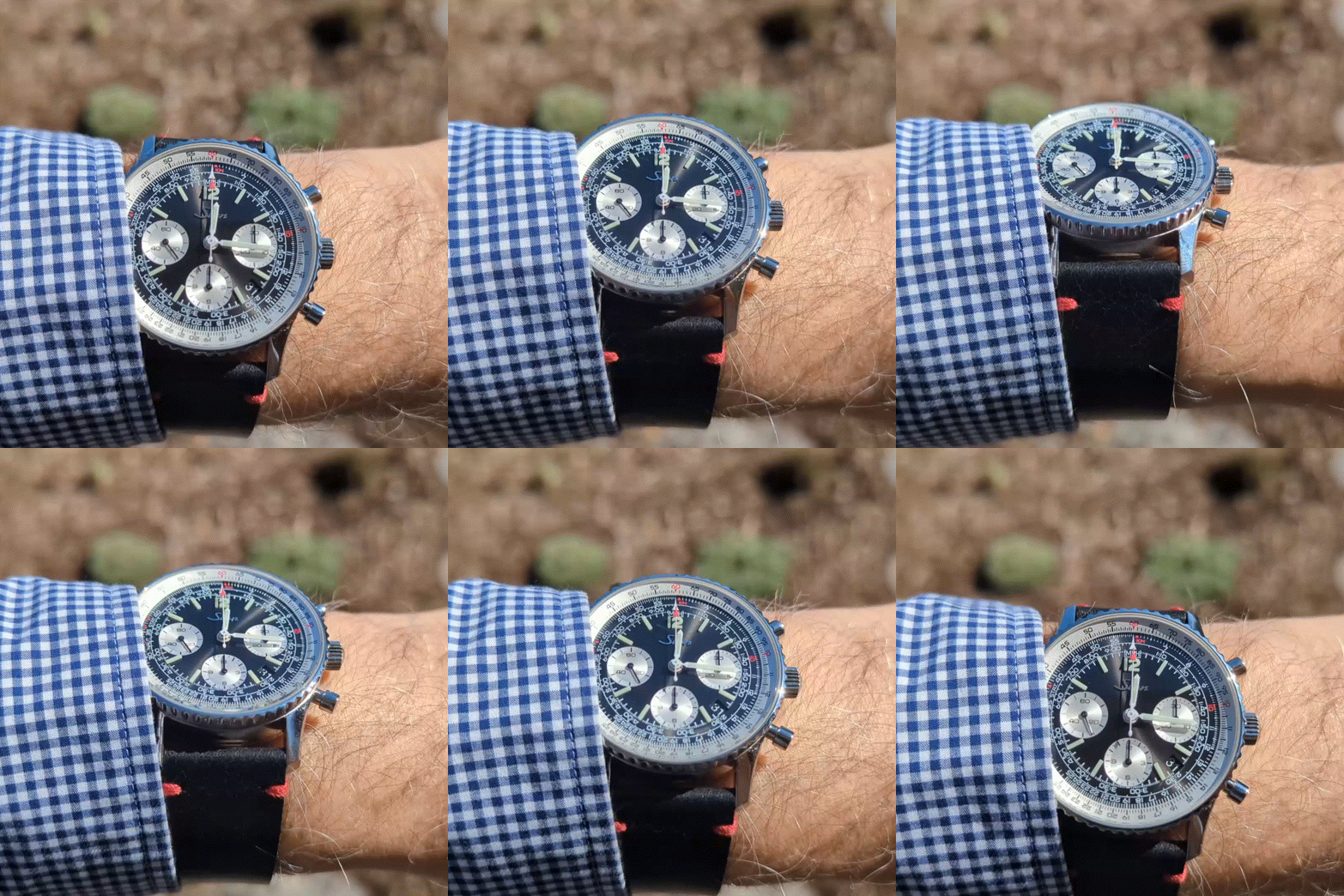
Another cool thing that I hadn’t fully appreciated till I wore this watch was that its dial has a subtle sunburst finish that makes the dial look more dynamic than a plain matte black dial would have looked.
Close-up animated GIF of a man wearing a mechanical watch on his wrist. The watch has black dial, cream coloured hands, and three white coloured sub-dials. The man is standing outside on a sunny day and is twisting his arm towards and away from the camera, which highlights the sunburst pattern on the black dial of the watch.
I’ve only had this watch for two days, but it already fits perfectly with my entire wardrobe and is spot-on for my lifestyle.
Yes, I think I made a really good decision.
So what next?
What’s next is that, in my fifty-first year on this planet, I get to wear this most fantastic watch pretty much all the time!
Close-up photo of a man wearing a mechanical watch on his wrist while seated in the driver’s seat of a parked car. The watch has black dial, cream coloured hands, and three white coloured sub-dials. This watch is a chronograph so it has two pushers on the side that are used to start and reset the chronograph function.
And who knows, maybe I’ll get the Hamilton Intra-Matic that was in second place on my shortlist for my fifty-fifth birthday :)
[1] These days I wear mostly dark and casual clothes but, ten years ago, when I got the Seagull 1963 Airforce watch, with its champagne-coloured dial and dress-watch looks, my work “uniform” used to be khakis with a navy blue check shirt. In other words, this watch was a great fit for the old Ameel – like in the casual-Friday photo from 2019, below – but its colours clash with how the new Ameel dresses every day.
Selfie of a man standing in front of the floor-to-wall window of an office building that overlooks the city. The man is grinning and giving the camera a thumbs-up. He is wearing a textured maroon dress shirt with its sleeves rolled up. On his left wrist he is wearing a small silver watch with a cream-coloured dial: the Seagull 1963 Airforce.
[2] As part of my chronography research, I read or watched all these round-ups from Teddy Baldassarre:
40 Best Chronograph Watches (2026) – article (6,580 words, so 26-29 minutes at normal reading speed and 16-20 minutes at fast reading speed), 2026
The BEST Entry-Level Chronographs – video (16:28min), 2022
The BEST Heritage Chronographs At Every Price Point In 2023 – video (21:33 min), 2023
25 Of The Best Chronographs Under $10,000 – video (30:08 min), 2024
The Most Wearable Chronograph Watches For Smaller To Medium Wrists – video (25:40 min), 2024
19 Of The Best Panda Dial Chronographs From Attainable To Luxury – video (24:00 min), 2024
Best Chronograph At Every Tier (Up to $10,000) – video (38:21 min), 2026
[3] While at the Breitling boutique, I also tried on the 43mm Navitimer and, surprisingly, I think this size looked better on my 19cm/7.5in-diameter wrist than the 41mm version did. What can I say? Breitling watches are fucking cool.
[4] These days I mostly wear black, dark grey, navy blue, maroon, and khaki clothes, with accents in red, orange, yellow, and white. My Oris Divers Sixty-Five 60th Anniversary Edition watch goes with all of these colours, as does my new Sinn 903 St II :)
Collage of four photos, each focusing on a bald man with a salt-and-pepper beard who is wearing glasses. In two of the photos a woman is hugging this man and leaning her head on his chest. In the photos the man is wearing, respectively, a black t-shirt, a dark grey t-shirt, a grey-and-black hoodie, and a navy blue suit.