A chronograph for turning 50

Birthdays, particularly notable birthdays, are a good time to ask for (or buy for yourself) something special that you want but don’t need. For me that special thing is wristwatches and, happily, I’ve asked for and received several over the years.

(My family and friends are awesome.)

A special watch every five years

When I turned 40 in 2016, Nadia and my friends got together and bought me a Seagull 1963 Airforce. This is a dress watch (at least by current standards) with a basic mechanical chronograph complication that was built for the Chinese People’s Liberation Army Air Force in 1963.

Close-up photo of a man wearing a relatively small, stainless steel mechanical watch on his wrist on a brown leather strap. The watch has a cream coloured dial, gold coloured applied numerals, blue-coloured hours/minutes hands, and a red-coloured chronograph seconds-hand.

To celebrate turning 45 in 2021, I wanted to get a nice dive watch that could also be a GADA watch (GADA = Go Anywhere, Do Anything). The watch I went with was the 60th Anniversary Oris Divers 65 with a black-and-blue dial. I love this watch and have worn it more than any other watch in the last five years.

Close-up photo of a man wearing a stainless steel mechanical watch on his wrist on a blue-and-black woven cloth strap. The watch has black and deep-blue coloured dial, cream coloured numerals in a retro 1960s typeface, and silver coloured hands.

Now it’s 2026 and I’m turning 50, and this year I wanted to get a nicer mechanical chronograph. This didn’t have to be a GADA watch, but I did want it to be a genuine tool watch and perhaps even a flex watch.

Deciding which chronograph to get

The only mechanical chronograph I own – the Seagull 1963 Airforce that I got for my fortieth – is one I don’t wear much these days because it’s a light-coloured dress watch and I’m usually in dark-coloured casual clothes. [1]

Also, the watch itself is quite basic. It may be shiny and pretty, but:

  • its styling isn’t particularly sophisticated;

  • its production is mass-market;

  • it’s powered by the the Chinese-made ST1901 movement, the cheapest mechanical chronograph movement available; and

  • it’s not even a particularly useful chronograph because, as a dress watch, its legibility-at-a-glance is severely limited.

What I was after now was a mechanical chronograph with:

  • a nicer, more functional, more tool-watch-ey design;

  • much nicer styling, manufacture, and finishing; and

  • a better chronograph movement, like the Japanese-made Seiko 8R48 or the Swiss-made ETA/Valjoux 7753.

So that’s what I went looking for.

Screenshot from the Time & Tide web store showing a grid of chronograph wristwatches that are available.

Creating a longlist

I started my research broadly, by looking at all the chronographs that are out there [2]. I didn’t focus on price, though I did stop looking at anything that cost more than $15k. Watches that cost more than $15k when new weren’t going to be affordable to me even on the secondary market.

All prices mentioned here are in Australian dollars, by the way.

Looking without shortlisting let me figure out what I liked, what I didn’t like, and what I’d have to settle for in a chronograph – like watches that are 14mm thick (or more) where I normally wear watches in the 10-12mm thickness range.

Through this browsing I was able to set a minimum price above which the design and functionality I wanted became readily available. This came to roughly $3k.

Next I created approximate price bands based on functionality, design, aesthetics, and brand premium:

  • Basic chronographs, $3-4k: Basic mechanical chronograph functionality; wide range of design aesthetics; relatively low water resistance (only 30-50m in many cases). Brands like Hamilton, Baltic, Tissot, and Junghans are represented here.

  • Enthusiast/tool-watch chronographs, $4-5k: Better movements (eg column-wheel chronographs, longer power reserves); higher grade construction (eg 100m water resistance); higher brand premiums; and better finishing. Here you’ll start to see brands like Sinn, Seiko, and Hanhart; as well as some Longines models on the secondary market.

  • Quasi-luxury chronographs, $5-6k: Higher grade construction (eg 200m water resistance, open case back); better finishing; and even higher brand premiums. This is where we get into Longines and where we also find some higher-tier Sinn models and some Oris models that are on sale.

  • Higher tier quasi-luxury chronographs, $6-10k: Better movements (eg even longer power reserves); less bulky (eg smaller diameter, thinner); better finishing; and still higher brand premiums. This is where you’ll find higher-tier Longines models and where brands like Oris, Frederique Constant, and Baume & Mercier come into the picture.

  • Entry-level luxury chronographs, $10k-15k: Even better finishing; even higher brand premiums; additional chronograph functionality (eg fly-back chronograph movements). This is when you get to proper “luxury” brands like Omega, Breitling, Zenith, Tudor, and Tag Heuer.

Finally, based on these price bands and my budget, I set my maximum price for a new or pre-owned watch. This came to roughly $6k, with a little wiggle room if needed.

Shortlisting criteria

Based on my preferences and what I learned from my initial research, I came up with a list of requirements that I could use to create my shortlist:

Movement type: Mechanical chronograph of any construction (ie column or cam wheel; vertical or horizontal clutch).

Size: 38–42mm in diameter; as thin as possible.

Price range: AU $3,000 to $6,000.

Sub-dial configuration: Bicompax or tricompax – I think bicompax sub-dials look cooler but the tricompax configuration is more functional.

Graphic showing promotional photos of two black-dial, stainless steel wristwatches side by side. Text next to the first watch reads, “Bicompax sub-dial configuration” and “Omega Speedmaster ‘57”. This watch has two sub-dials. Text next to the second watch reads, “Tricompax sub-dial configuration” and “Omega Speedmaster Moonwatch Professional”. This watch has three sub-dials.

Dial design: Ideally, contrasting sub-dials in a panda configuration or a reverse-panda configuration – though other dial-colour configurations would do if the design is really good (like the Omega Speedmasters in the graphic above).

Graphic showing three things: the photo of a panda’s face and the promotional photos of two stainless steel wristwatches. Text next to the panda reads, “Panda” and “Panda in China”. Text next to the first watch reads, “Panda dial” and “Tudor Black Bay Chrono”. The design of this watch resembles the panda’s face in that it has a white dial and two horizontally-oriented, black sub-dials that represent the panda’s eyes. Text next to the second watch reads, “Reverse-panda dial” and “Tudor Black Bay Chrono”. This watch has a black dial and two horizontally oriented, white sub-dials.

Style: Aviation and field styles watches over dive and dress styles watches – think more Omega Speedmaster, Zenith Chronomaster, and Breitling Navitimer and less Oris Divers Sixty-Five Chronograph, Baltic Scalegraph, and Junghans Max Bill Chronoscope.

Graphic showing two groups of three wristwatches each. Text above the first group reads, “YES: aviation, field style”. Text below this group reads, “L-R: Omega Speedmaster; Zenith Chronomaster; Breitling Navitimer”. Text above the first group reads, “NO: dive, dress style”. Text below this group reads, “L-R: Oris Divers Sixty-Five Chronograph; Baltic Scalegraph; Junghans Max Bill Chronoscope”.

Inspiration: Watches that draw inspiration from, broadly reference, or make me feel how I feel when I look at my dream chronographs.

My dream chronographs

Graphic showing the promotional photos of five wristwatches. Text below these watches reads, “Breitling Navitimer B01 Chronograph; Omega Speedmaster Moonwatch Professional; TAG Heuer Monaco Chronograph; Zenith Chronomaster Original Automatic; and A. Lange & Söhne Datograph”.

I have five dream chronographs:

The first three of those watches got imprinted on me when I saw them in magazines as a kid in the 1980s – advertising works, folks! – and the last two I fell in love with when I properly got into wristwatches (because I could now afford nicer ones) about sixteen years ago.

Will I ever buy any of my dream chronographs? Yes! My plan is to get the Omega Speedmaster for my 60th birthday, but I don’t think I’ll get any of the others. Why?

  • The Breitling Navitimer is probably my grail watch, but it is very shiny and I’m not sure its something I’ll wear often – which, for me, defeats the purpose of buying an expensive watch.

  • The TAG Heuer Monaco is super cool, but it doesn’t match my usual style – meaning I’d only want to wear it with certain outfits. So, again, I don’t see the point in buying a luxury watch if I’m not going to wear it all, or at least most, of the time.

  • The Zenith Chronomaster is fantastic, but I suspect (hope?) the Speedmaster will have already scratched my tricompax chronograph itch.

  • Unless I win the lottery, and probably not even then, I don’t think I’ll ever buy the Lange Datograph!

Creating a shortlist

In the end, these were the six watches that made it to my shortlist (in increasing order of price):

Let’s look at them one by one.

Tissot Telemeter 1938

If you’re wondering after all my talk of requirements and preferences how this style of watch of made it through my shortlisting criteria, the answer is simple: I adore pulsometer watches! Or, more generally, I love watches with spiral or contrasting-colour scales printed on the dial or the crystal.

Pulsometer watches have been around since the early 1700s and the coolest recent release in that style was the 2015 limited edition Longines Pulsometer Chronograph. I would love to get my hands on this watch, but it isn’t available anywhere.

Graphic showing the promotional photos of a wristwatches with text below it that reads, “Longines Pulsometer Chronograph”.

Probably the nicest pulsometer watches available right now are the Omega Speedmaster Chronoscope series. My favourite is the version with blue spiral track, though the panda version with the red spiral track is cool too.

Graphic showing the promotional photos of two wristwatches with text below them that reads, “Omega Speedmaster Chronoscope”.

All this to say that, when the white-dial Tissot Telemeter 1938 ($3,500) came up in my research, it went straight onto my shortlist. The black-dial version is pretty cool too.

Graphic showing the promotional photos of two wristwatches with text below them that reads, “Tissot Telemeter 1938”.

I checked out both these watches in Tissot’s Melbourne boutique. Sadly, they felt a little unwieldy on my wrist. Also, the black-dial version, while gorgeous, isn’t super legible and is therefore not practical as a chronograph (even though it’d be great as a dress watch). I guess this is a case of watches looking cooler in photos than they are in the metal – at least as far as my current taste in watches and my current watch-buying objectives are concerned.

STATUS: Removed from the shortlist.

Hamilton American Classic Intra-Matic Chronograph H

I fell in love with Hamilton’s Intra-Matic Chronograph series many years ago. In fact, when I decided I was going to get a nice mechanical chronograph for my fiftieth birthday, these were the watches I thought of first.

While I love the automatic, panda version from this series, my favourite is the black-dial, manual-wind, reverse panda: the Hamilton American Classic Intra-Matic Chronograph H ($3,650).

Graphic showing the promotional photos of two wristwatches with text below them that reads, “Hamilton American Classic Intra-Matic Chronograph H” and “Hamilton American Classic Intra-Matic Auto Chrono”.

Funnily enough, it was only while writing this post that I consciously realised that, even though they’re parsecs apart in quality, looks-wise the reverse-panda Intra-Matic for me scratches the same itch as the A. Lange & Söhne Datograph!

Graphic showing the promotional photos of two wristwatches with text below them that reads, “Hamilton American Classic Intra-Matic Chronograph H” and “A. Lange & Söhne Datograph Up/Down”.

Time & Tide, our local Hamilton authorised dealer (AD) didn’t have the reverse-panda version in stock, but I did check out the blue-dial version, which is also super cool.

Status: Black-dial version moved to the top of the shortlist.

Hamilton Khaki Aviation Converter Auto Chrono

I think it’s obvious why the Hamilton Khaki Aviation Converter Auto Chrono ($3,650) made it to my shortlist: its converter dial is reminiscent of the Breitling Navitimer.

The black-dial version of this watch is cool, but I think the blue-dial version is cooler.

Graphic showing the promotional photos of two wristwatches with text below them that reads, “Hamilton Khaki Aviation Converter Auto Chrono”.

I have over the years considered getting one of the quartz-based flight chronographs that pay homage to the Navitimer and Speedmaster: watches like the Citizen Promaster Sky or the Islander Calverton Flight Chronograph (which itself was inspired by the discontinued Seiko Flightmaster).

Graphic showing the promotional photos of two wristwatches. Text below these reads, “Citizen Promaster Sky” and “Islander Calverton Flight Chronograph”.

I never got around to buying one of these though, so this could be my chance to get something in that style but with a mechanical movement.

Sadly, when I tried on this watch at my local AD, it didn’t work. Yes, the watch fit physically on my wrist, it just didn’t have the presence or vibe that I connected with. Oh well.

Status: Removed from the shortlist.

Seiko Prospex Speedtimer

The Seiko Speedtimer has a long history. Released in 1970 as the world’s second automatic chronograph (after the Zenith El Primero in 1969) a slightly newer version of this watch even made it into space in 1973 with American astronaut William Pogue.

Seiko didn’t do much with the Speedtimer during the quartz era, but they revived it in 2021 and have since released a bunch of mechanical and solar-quartz versions.

The black-dial version of the Seiko Prospex Speedtimer ($3,900) is my favourite, but the white-dial version is pretty cool too. And there are many other dial-colour variations to choose from.

Graphic showing the promotional photos of two wristwatches, one with a black dial and one with a white dial, with text below them that reads, “Seiko Prospex Speedtimer”.

People also love this watch because versions of it scratch the Omega Speedmaster Moonwatch Professional and Rolex Cosmograph Daytona itch for a fraction of the price – specifically the SRQ055 and SSC911 shown in the graphic below.

Graphic showing the promotional photos of four wristwatches in two pairs, with some resemblance between the watches that have been paired. Text below the first pair reads, “Omega Speedmaster Moonwatch Professional” and “Seiko Prospex Speedtimer”. Text below the first pair reads, “Rolex Cosmograph Daytona” and “Seiko Prospex Speedtimer”.

I checked out these Speedtimers at two local ADs – and I looked at both the 39mm and 42mm diameter versions – but ultimately decided that, if I was going to get one, I’d get a solar-quartz version ($1,150, but currently on sale for $851) at some point in the future.

Status: Eliminated from the shortlist. (Well, at least from my current birthday shortlist.)

Longines Avigation Big Eye

I was very curious about this watch when I first heard about it. Its design feels like that of a flieger-style aviation watch (which is a style I love) merged with the Omega Speedmaster (which is another style I love) but with the added twist of the 3 o’clock sub-dial being larger than the others – hence the “big eye” name.

Graphic showing the promotional photos of three wristwatches in a mathematical equation. Text below these reads, “Stowa Flieger Classic” plus “Omega Speedmaster Moonwatch Professional” equals the “Longines Avigation Big Eye”.

I initially didn’t shortlist this watch because I thought it was out of my price range, but then I realised I was looking at the blue-dial titanium version ($6,500) and not the black-dial, stainless steel Longines Avigation Big Eye ($5,075 full price, but was on a 30%-off sale).

Graphic showing the promotional photos of two wristwatches, one with a black dial and one with a blue/black gradient dial, with text below them that reads, “Longines Avigation Big Eye”.

The black-dial version wasn’t in stock at my local AD or the Melbourne Longines flagship store, but the flagship store did have the titanium, blue-dial version which I got to check out.

Sadly, this watch just didn’t grab me.

Yes, there is a lot going for it: it is gorgeous, very well-executed, and runs on a high-grade chronograph movement. It was also on a 30%-off, end-of-financial-year sale when I saw it, which is probably the best price I’ll ever get for it.

The problem is that I already own two watches that have the same flieger / aircraft instrument panel look. These are the Stowa Flieger Classic 40 Baumuster B and the Techné GosHawk (Techné being a brand created by a former Longines watch designer).

Graphic showing the promotional photos of three wristwatches with text below them that reads, “Stowa Flieger Classic 40 Baumuster B”, “Techné GosHawk”, and “Longines Avigation Big Eye”.

I wanted a special watch for my fiftieth birthday, not one that’s in the same style as two watches I already own. So, disappointingly, I had to let this one go.

This is not to say I don’t think this watch is cool – it is cool, and I can totally see myself wearing it and loving it – but it’s just not the right watch for me right now.

Status: Moved to second place on my shortlist, but with the knowledge that I’m not going to buy it this time around.

Sinn 903 St II

The final watch on my shortlist was the Sinn 903 St II ($5,600). And while its blue-dial version is cool, I think its OG black-dial version is cooler.

Graphic showing the promotional photos of two wristwatches, one with a black dial and one with a blue dial, with text below them that reads, “Sinn 903 St II” and “Sinn 903 St BE II”.

“But Ameel,” you exclaim, “the Sinn 903 looks just like the Breitling Navitimer! Isn’t this design just a blatant rip-off of the watch you love so much?”

Graphic showing the promotional photos of two wristwatches from two separate brands that look almost identical. Text below these watches reads, “Sinn 903 St II” and “Breitling Navitimer B01 Chronograph 41”.

My reply would be a rather irritating, “You’re not wrong; but you’re not right either.”

I’ll let Brice Goulard, writing in Monochrome, explain:

Before you start commenting on the fact that this watch is a copy of the Breitling Navitimer, let me explain why you’d be right on one side, but also why Sinn has the legitimacy to do so.

Some might not know the story behind the creation of the Sinn 903 and why it is so close to a Navitimer in both design and technical specs. The story is that, back in the late 1970s, Breitling (like many other brands) was in a difficult situation due to the quartz crisis.

Parts of Breitling were liquidated in 1979 and the rights to the Navitimer were sold to the highest bidder. This resulted in Sinn, but also Ollech & Wajs, acquiring not only the design and rights to produce a watch identical to the Navitimer (the name remained the property of Sicura, then returned to Breitling) but also stocks of parts, such as cases and dials.

Sinn obtained the rights and parts of the Navitimer 806 and 809 and then produced watches under its own name with the reference 903…a model that has been in the collection for over 45 years.

So, yes, this is the Breitling Navitimer design but, no, it’s not a rip-off because Sinn legitimately owns this design as well.

Now before I started this round of research, I hadn’t seriously considered buying the Sinn 903 for two reasons:

  1. There is no Sinn AD in Australia

  2. I wasn’t a huge fan of the original Sinn 903 because the only way to rotate the slide-rule bezel was through an additional crown at the 10 o’clock position

Happily, while doing my research I learned two new things:

  1. There is now one (1) Sinn AD in Australia: Define Watches up in Noosa, Queensland

  2. In June 2024 Sinn released the 903 St II, and this upgraded version has a directly-operated slide-rule bezel along with a whole host of other minor upgrades

Woohoo!

Still, I had a problem: this watch was all the way up in Noosa, which meant I wouldn’t be able to get any hands-on time with it pre-acquisition.

So I did the next-best thing: I went into the local Breitling flagship store and checked out the 41mm version of the Navitimer :) I figured if that worked well on my wrist, then the Sinn 903 would too. Happily, it did! And I could totally picture myself wearing a slightly thicker, more tool-watch-like version of that watch very comfortably on my wrist. [3]

Status: Moved to the top of the shortlist, with the Hamilton Intra-Matic pushed down into second place and the Longines Big Eye pushed further down into third place.

Honourable mentions

Graphic showing the promotional photos of five wristwatches. Text below these watches reads, “Baltic Scalegraph Classic Panda; Sinn 356 Pilot; Junghans Telemeter; Longines Master Collection Chrono Moonphase; Oris Divers Sixty-Five Chronograph”.

Before I tell you which watch I ultimately got – as if you haven’t figured it out already – here are six honourable mentions that I want to, well, mention but not go on about:

  • If I wasn’t actively trying to avoid 1930s/40s-style watches (opting instead of 1960s/70s-style watches) I would have shortlisted the Baltic Scalegraph Classic Panda ($2,670). Also, I think it was the 1930s styling of the Tissot Telemeter 1938 chronographs that stopped me from connecting with them when I checked them out in the store.

  • The Sinn 356 Pilot ($3,550) is cool but, like I said when I talked about the Longines Avigation Big Eye earlier, I already have two flieger style watches so I didn’t shortlist this one.

  • When I’m ready to buy a telemeter watch (since I probably won’t be able to find an affordable pulsometer watch) I’ll likely get the lovely Junghans Telemeter ($4,300).

  • The Longines Master Collection Chrono Moonphase ($6,400) was outside of my budget but a great-condition version of it became available on the secondary market ($3,900) so I had to go take a look. Unfortunately, this particular watch was on display at the AD’s Sydney store and I wasn’t going to consider it without seeing it in the metal first.

  • The Oris Divers Sixty-Five Chronograph ($6,800) is great, and I might have found a version on sale that was under my budget, but I already have an Oris Divers Sixty-Five and there was no point doubling up.

Making a decision

By this point I’d pretty much decided that the Sinn 903 was the watch I was going to get.

Screenshot of the Sinn Catalogue 2025-26 showing the ‘Series 903’ watch that is described as “The navigation chronograph”. The screenshot shows the blue-dial and black-dial versions of the watch on one page and text about this series of watches on the second page.

“But why was the Sinn 903 even in consideration?” you might ask. “If you love the Breitling Navitimer so much, wouldn’t it have been better to wait till you’d saved enough money to buy the ‘real thing’?”

Normally, I would agree with that sentiment. If you’re pining for the “real thing”, there’s a decent chance you won’t be satisfied with a less costly substitute – whether that’s a replica, an homage, or something heavily inspired by what you really want.

However, this argument doesn’t work here because the Sinn 903 isn’t a substitute, it is the real thing – it’s just a version that’s built and sold by a different manufacturer.

Yes, the Sinn brand doesn’t have the same historical associations that the Breitling brand does, but as far as watches go, I actually prefer the Sinn 903 over the Breitling Navitimer. Also, I very much love the associations that the Sinn brand does have. I’ll explain all this in my next post because this post is already too long.

The real decision I needed to make was about something else.

Which version of the 903?

The Sinn Series 903 comes in two editions (standard and anniversary) and in five dial colours (black, anthracite, dark blue, green, and sunburst blue). I was pretty sure I wanted to get the standard black-dial version, but before committing to that decision I called up the folks at Define Watches to have a chat.

I wanted to ask about the standard dark-blue-dial version of this watch because, while I love a good blue dial, the blue of that dial needs to be a really good shade. My Oris Divers Sixty-Five 60th Anniversary Edition, for example, has a gorgeous, deep-blue outer dial that I adore, and this shade of blue matches, complements, or nicely contrasts with the colours of pretty much every outfit I own [4].

Close-up photo of a man wearing a stainless steel mechanical watch on his wrist on a blue-and-black woven cloth strap. The watch has black and deep-blue coloured dial, cream coloured numerals in a retro 1960s typeface, and silver coloured hands.

The person I talked to at Define Watches was Peter Petzold, one of the two co-owners, and he told me the blue of the Sinn 903 St II B E’s dial is dark blue, and that too a shade of dark blue that looks black in some light. That was great news.

I then watched a lot of YouTube videos that showed-off this dial colour in high resolution, and I came away impressed.

But even after all that investigation and exploration, I decided to go with the OG black-dial version. Why? Partly because it is the more historically accurate dial colour but mostly because this is the dial colour I fell in love with in the 1980s :)

The fact that this dial colour will never clash with any of the clothes I wear was just a bonus.

How do I feel about my decision?

I feel fantastic! And doubly so since Nadia gave me the watch on my birthday morning and I got to see it in the metal.

Looking at this watch on a screen and wearing it on my wrist are two completely different experiences, and the latter is better than I even imagined it would be.

Close-up photo of a man wearing a mechanical watch on his wrist. The watch has black dial, silver hands filled with a luminous material, and three white coloured sub-dials. This watch is a chronograph so it has two pushers on the side that are used to start and reset the chronograph function. The watch bezel is a slide rule that lets the wearer perform mathematical calculations. The man is wearing a button-down shirt with a navy-blue check, the cuff of which is covering one slice of the watch.

I was concerned, for example, that the watch would be too heavy, too bulky, or too thick. It is none of those things. It does have weight and it does sit taller on my wrist than most of my other watches, but by no means does it feel heavy or look bulky on my wrist. It also doesn’t look too blingy, which is important to me. (More on that in my next post.)

Instead, this watch fits perfectly on my wrist – both in terms of its physical size and its wrist-presence – and the gorgeous, black, vintage-style leather strap I got with it is super comfortable and holds the watch snugly at exactly where I normally wear watches.

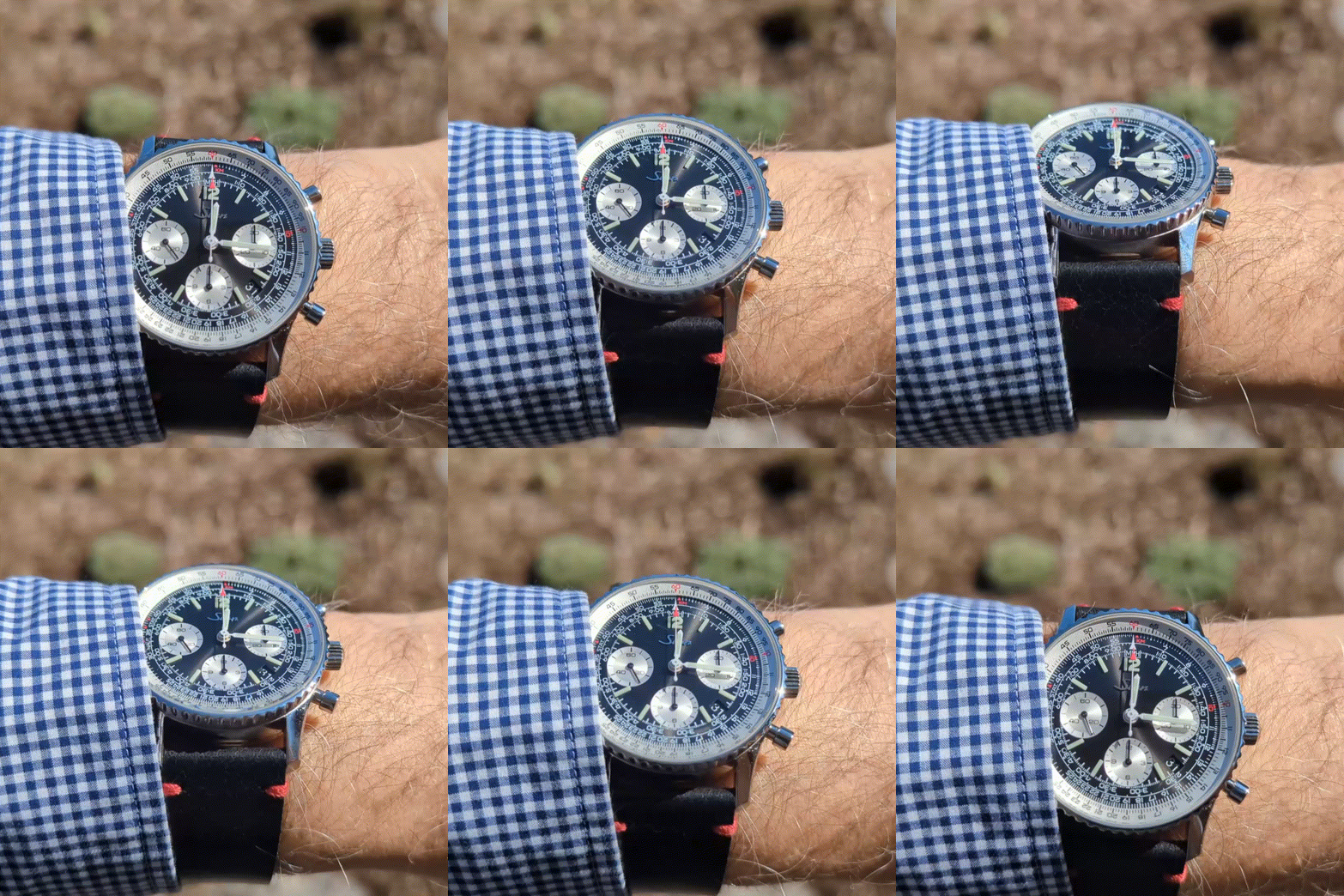
Another cool thing that I hadn’t fully appreciated till I wore this watch was that its dial has a subtle sunburst finish that makes the dial look more dynamic than a plain matte black dial would have looked.

Close-up animated GIF of a man wearing a mechanical watch on his wrist. The watch has black dial, cream coloured hands, and three white coloured sub-dials. The man is standing outside on a sunny day and is twisting his arm towards and away from the camera, which highlights the sunburst pattern on the black dial of the watch.

I’ve only had this watch for two days, but it already fits perfectly with my entire wardrobe and is spot-on for my lifestyle.

Yes, I think I made a really good decision.

So what next?

What’s next is that, in my fifty-first year on this planet, I get to wear this most fantastic watch pretty much all the time!

Close-up photo of a man wearing a mechanical watch on his wrist while seated in the driver’s seat of a parked car. The watch has black dial, cream coloured hands, and three white coloured sub-dials. This watch is a chronograph so it has two pushers on the side that are used to start and reset the chronograph function.

And who knows, maybe I’ll get the Hamilton Intra-Matic that was in second place on my shortlist for my fifty-fifth birthday :)


[1] These days I wear mostly dark and casual clothes but, ten years ago, when I got the Seagull 1963 Airforce watch, with its champagne-coloured dial and dress-watch looks, my work “uniform” used to be khakis with a navy blue check shirt. In other words, this watch was a great fit for the old Ameel – like in the casual-Friday photo from 2019, below – but its colours clash with how the new Ameel dresses every day.

Selfie of a man standing in front of the floor-to-wall window of an office building that overlooks the city. The man is grinning and giving the camera a thumbs-up. He is wearing a textured maroon dress shirt with its sleeves rolled up. On his left wrist he is wearing a small silver watch with a cream-coloured dial: the Seagull 1963 Airforce.

[2] As part of my chronography research, I read or watched all these round-ups from Teddy Baldassarre:

[3] While at the Breitling boutique, I also tried on the 43mm Navitimer and, surprisingly, I think this size looked better on my 19cm/7.5in-diameter wrist than the 41mm version did. What can I say? Breitling watches are fucking cool.

[4] These days I mostly wear black, dark grey, navy blue, maroon, and khaki clothes, with accents in red, orange, yellow, and white. My Oris Divers Sixty-Five 60th Anniversary Edition watch goes with all of these colours, as does my new Sinn 903 St II :)

Collage of four photos, each focusing on a bald man with a salt-and-pepper beard who is wearing glasses. In two of the photos a woman is hugging this man and leaning her head on his chest. In the photos the man is wearing, respectively, a black t-shirt, a dark grey t-shirt, a grey-and-black hoodie, and a navy blue suit.

Celebrating 20 years in Melbourne

This week marks twenty years since Nadia and I moved to Melbourne to pursue our Masters degrees.

Why Melbourne?

After we got married in Pakistan in 2004, Nadia and I wanted to go overseas to study. When deciding where to go, we picked three cities that were (a) great places to live and (b) had multiple universities that the two of us could apply to.

The cities we picked were:

We decided all this just as the southern-hemisphere university admissions cycle started and, as luck would have it, both of us applied to and got into the University of Melbourne. [1]

This was great because my older sister was living in Melbourne at the time and she had just completed her PhD from the University of Melbourne. Meaning not only did she know the city we’d be moving to, she knew the exact university we’d be going to as well.

With our university acceptances in hand, a guaranteed soft landing in a new country, and the full scholarship I was awarded for my MBA studies, we leapt at the chance to head down under.

So it was that on 12 July 2006, Nadia and I hopped on a one-way flight to a place almost 11,000 kilometers away and in a hemisphere that neither of us had been to before.

Scan of a Thai Airways paper ticket for Ameel Zia Khan, departing Islamabad at 11:10pm on 12 July 2004.

20 years on

We landed in Melbourne on Tuesday, 13 July 2006, and the very first place my sister and a family friend (who was also my sister’s housemate) took us to for lunch was A1 Bakery on Sydney Road in Brunswick.

It was fitting, then, that on 13 July 2026, Nadia and I went back to A1 for lunch to mark the occassion :)

Selfie of a man and woman sitting at a table in a large, warehouse-sized Lebanese bakery. The woman is holding a knife and is in the process of cutting the Lebanese pizzas that are lying on platters on the table between them.

Settling down

Nadia completed her MA and went on to do a PhD from UniMelb as well. I completed my MBA and went into the job market. Nadia did a couple of other things, but eventually made her way back to UniMelb, which is where she now teaches.

I don’t remember exactly when we decided that Melbourne was the place we were going to call home, but a big part of why we decided to stay was the people we met here along the way. Which is why we also marked our twenty years in this city with our friends and family at the Cornish Arms rooftop bar this weekend.

Photo of a rooftop bar on a sunny day, with space that's been set aside for a private function. A sign in front of this reserved area has the Cornish Arms logo and reads, “Nadia and Ameel 20 years in Melbourne, 1-4pm”.

Looking forward

What are our plans for the next twenty years? I have no idea, because Nadia and I plan our lives in four-year increments.

I mean that literally, by the way. Ever since Nadia’s PhD graduation in 2013, when our lives were finally disconnected from the degree-seeking schedule that universities impose on you, we’ve been making and documenting four-year life plans.

Actually, that’s not entirely true. We do have over 26 years left on our mortgage. So, if nothing else, in 2046 we’ll still be paying that off!

But my point is that twenty years is a long time so, instead of planning that far ahead, we’re just going to do what we can and roll with the punches when we can’t. That is life, and we’re looking forward to what the next twenty years in Melbourne will bring us.


[1] Yes, technically I got into Melbourne Business School which, back then, was only half-owned by the University of Melbourne. MBS is now wholly owned by UniMelb.

Pie and paracetamol

Pie and paracetamol is how I’m making it through work today.

I’m not ill, just tired. It’s week four of the roughly six weeks it takes me to fully get over each bout of post-viral fatigue.

Happily, this time around I was 80% back to normal by week two! That’s fantastic compared to how debilitating this was last year.

Close-up photo of a slice of cherry pie and two paracetamol tablets lying in a take-away cardboard tray.

We got solar panels!

In 2022 we bought a house in the northern suburbs of Melbourne and this year (2026) we finally had enough money saved up to get solar panels installed on our roof.

Photo looking up from the ground floor at the roof of a double-storey house. The house has a multi-level roof covered in pink concrete tiles. Various roof segments are oriented and angled towards different directions. Three of these segments have single solar panels installed on them. Text call-outs on the image point to each of these solar panels.

Buying solar panels in Australia is surprisingly straightforward these days. Here’s how I went about getting them.

1. Researched solar power for the home

These were some of the resources I used:

2. Figured out what we wanted from solar, now and in the future

In our case this was:

  • Short term: install as many solar panels as possible.

  • Medium term: replace our gas stove with an induction one and our instantaneous gas hot water system with an electric one (either storage or heat pump).

  • Long term: add a home battery and, once we buy an electric vehicle (EV), add an EV charger to our solar system.

This meant we didn’t want to get a basic solar system that would serve just our current needs. We wanted to get a system that would support our future electrification plans.

3. Found solar installers and got quotes

Finding good solar system installers can be a challenge but, fortunately, these two services got me free quotes from qualified and vetted installers:

  1. SolarQuotes, which is the service recommended by CHOICE. I’ve been a member of CHOICE since 2011 and those folks have never once steered me wrong.

  2. Solar Savers, which is a joint local government initiative that helps residents make the switch to solar power.

I ended up requesting two quotes from each service.

I also got a recommendation from a friend who’d had their solar system installed last year.

Graphic showing a collage of two website screenshots, one for SolarQuotes and one for Solar Savers.

4. Picked a solar installer and a solar system configuration

Most of the installers got in touch with me pretty quickly and I had good chats with all of them.

Three of the installers submitted formal quotes and we ended up picking the one that recommended the most appropriate system for our house and also had the best customer service.

This wasn’t the cheapest option presented to us, but it was the one that would give us the most bang-for-buck for our type of roof, because it turns out we have a “complex roof”.

Photo showing the green-and-gold, multi-layered, tall, pointy domes of Saint Sophia'‘s Cathedral in Kyiv, Ukraine. (Source: Jonathan Khoo on Flickr)

Finding an installer who does complex roofs

We have a concrete tile roof but, as you will have seen in the photo at the top of the post, instead of two large, flat surfaces that run the length of the house above the first floor, our roof has lots of smaller segments that are oriented (and, therefore, angled) towards different compass directions. Also, we have roof segments on both the ground and first floor.

Designing and installing a solar system around this type of segmented, multi-level roof takes time, effort, and money, which is something many (if not all) large solar installers don’t want to do. I learned this from the first installer who contacted me about providing a quote.

He was from a large company that (I learned) only does standard installs, which is probably why that company’s pricing is so competitive. After looking at our roof using his web mapping tool, he said he wouldn’t be submitting a quote. He then recommended I find a local, more specialised installer who would take the time to build a personalised and optimised system for us. This would cost us more, he said, but it would get us the best system.

The installer we ended up going with was Specialized Solar & Electrical (aka Spec Solar). Their system designer built us a customised system that, while more expensive than a similar design from another installer, was still within our budget.

Here’s a depiction of the physical layout of our final install, as shown in the SolarEdge smartphone app.

Screenshot of the Solar Edge smartphone app showing graphics of twelve solar panels and how they are physical laid out on the roof of a house. The solar panel elements of this graphic are shaded based on how much energy each panel is currently generating.

The Spec Solar designer managed to squeeze twelve solar panels onto our complex roof, but:

  • only six of these panels are oriented north (ie facing the sun all the time);

  • seven had to be installed as single panels on their own little roof segment; and

  • four had to be installed on ground-floor roof segments because there wasn’t enough space on our first-floor roof segments.

Complexity limits your choice of technology

Given the way we had to spread the solar panels out across different roof levels and orientations, as well as our plan to add a home battery in the future, our best option was to go with an optimised inverter system from SolarEdge. (The second-best option was a microinverter system from Enphase.)

The benefits of the optimised inverter approach are:

Optimised power: With a power optimiser sitting under each solar panel, our system can maintain the highest overall power output regardless of the output of each individual solar panel. Meaning the system’s overall output isn’t limited by panels that are producing the least amount of power at the time (because they’re in the shade or because they’re facing east or west) which is what would happen with a conventional string inverter system.

Battery ready: All SolarEdge inverters are hybrid inverters, which is the type of inverter you need if you want to add a home battery to your system. Had we gone with one of the cheaper quotes, we would have had to upgrade to a hybrid inverter once we were ready to install a battery. (And if we’d swapped to a hybrid inverter in that cheaper quote, its updated price would have been close to the quote we did end up going with.)

Future proofing: Even though our solar panels can produce a maximum of 5.7kW from the sun, we went with a 10kW inverter to convert all this DC current in to useable AC current. We wanted that extra capacity so that our future battery wouldn’t be constrained by the limits of our solar panels. EV chargers, for example, run at 7kW minimum. So to be able to use our (future) battery to charge our (future) EV, or to power the whole house at night off the battery, we’d need an inverter that could handle this higher load.

Graphic showing the working of an optimised solar inverter system. (Source: SolarQuotes)

There is one downside to picking the optimised inverter system we did, and that is being locked into the SolarEdge ecosystem. I’m okay with that though. SolarEdge is more expensive than its (relatively new) optimised-inverter competition, but its current line of products are reliable and they come with a good warranty.

In case you’re interested in the details, these are the components we got installed:

  • a SolarEdge SE10000H single-phase hybrid inverter and

  • twelve AIKO NEOSTAR 3S+54 dual-glass 480W solar panels (with SolarEdge optimisers under each one).

SpecSolar had actually quoted us for AIKO’s 475kW solar panels but those were out of stock at the time of installation, so they upgraded us to the 480kW panels without an extra charge.

Screenshot from a solar system quote showing system details for solar panels and and inverter, as well as a bar chart monthly energy production estimates.

5. Got the installation and inspection done

Once we agreed to proceed with SpecSolar, everything moved pretty quickly.

On 2 February the solar system designer came over to do a site inspection, after which he tweaked the design and sent us a final quote. We signed the quote that same day.

On 10 February the team from SpecSolar came over and did the installation. That took several hours, from 7am to around 3pm.

Photo taken from inside a residential garage with its roller door opened. On the floor of the garage are several large toolboxes, some of which are open. Other construction tools and equipment are also lying on the floor. Parked in the driveway, directly outside the garage, is a trailer filled half-way with uninstalled solar panels.

They don’t switch on your solar system the day they install it, by the way. The electrical part of this installation (the bit installed in our garage) needs to be inspected and signed-off by a licenced electrical inspector first. That happened on 19 February.

So 44 days after I first requested quotes, our solar system was switched on and connected to our house.

6. Activated our feed-in tariff

The final (and technically optional) step in this process was getting our electricity retailer and electricity provider – Momentum Energy and Jemena, respectively – to receive the excess solar power we were generating from our panels.

That whole process took over a month but, happily, SpecSolar managed it all on our behalf.

Our solar feed-in was switched on on 25 March. That means our excess power is now going back into the electricity grid, for which we are being paid a tiny amount ($1.18 for the six days in March that this was active, for example).

7. Profit

So how is everything going? It’s going pretty great, actually!

We generated a good amount of power

March is the first full month we’ve had these solar panels and, over the course of that month, they produced 125kWh of power. We, however, used only 24% of this power.

Screenshot from the SolarEdge smartphone app showing the energy balance from a solar system installation for the month of March 2026. The bar charts and text tell us that 125kWh of energy was produced, 76% of which went to the grid and 24% went to the home. Of the total energy consumed by the home, 52% of that came from the grid and 48% came from the sun.

It didn’t come as a surprise that we used less than a quarter of the power generated. In fact, that was part of the plan.

This solar system wasn’t provisioned for use in just the sunniest days of summer, it was provisioned to provide us with sufficient power even on the gloomiest days of winter.

The proportion of solar power we use in winter will be much higher!

We generated that power in spite of gloomy weather

March 2026 was actually a pretty cloudy month. Here is a table showing the month’s daily weather observations from the Australian Bureau of Meteorology.

Screenshot showing a table titled, “Melbourne, Victoria March 2026 Daily Weather Observations”. The table shows daily minimum and maximum temperatures, as well as readings for rain and wind. It also shows a snapshot of these readings at 9am and 3pm on each day. (Source: Australian Bureau of Meteorology)

The “Cld” (ie cloud cover) column under the 9am and 3pm sections shows the fraction of sky covered by cloud. This is measured in eights, meaning a score of 4 tells us that four-eighths (ie half) of the sky was covered by cloud.

This table tells us that, on 16 of the 31 days of March, we had cloud cover of 4 or above at both 9am and 3pm. And if you count-up the days in which we had cloud cover of 4 or above at either 9am or 3pm, there were 23 of those days in March.

What does this mean? It means we managed to use only 24% of the power generated by our solar panels during a month in which half the sky was covered in cloud for more than half the time :)

Basically, it means I’m confident that our system is provisioned suitably for whatever winter will throw at us.

We used a lot less power from the grid

What about the other side of the equation? How did generating solar power affect the amount of electricity we pulled from the grid?

According to our electricity bills:

  • In March 2025, we drew 291.9kWh of electricity from the grid.

  • In March 2026, we drew 157.1kWH of electricity from the grid – which is 54% of what we used this same time last year :)

That result is pretty much exactly what the Spec Solar predicted for us, by the way: an approximate halving of our electricity bill.

Screenshot of a smartphone notification from the Powerpal app with the title, “Your weekly report is ready!”. The notification reads, “You spent $28.46 – 46% less than last week. Check your report for more ways to save!”

But wait, there’s more!

Getting a solar system installed on our roof isn’t the only energy upgrade we did to our house this year. We also upgraded the insulation in our roof.

The roof above our house already had some insulation (likely around R4) but there were large gaps in the batts where there was no insulation at all. Also, the roof above our garage had zero insulation.

‘R’ is a measure of thermal resistance, by the way, and the level recommended for roofs in Melbourne is between R6.0 and R7.0.

What did we do?

We got R4.1 insulation added to our garage and to the gaps in the rest of our roof. And then we got R2.5 spray insulation added on top this R4.1 insulation.

This means our garage now has R4.1 insulation and our house has about R6.5 insulation :)

Photo of a roof cavity above a house showing the wooden pillars that support the tiles installed on top the roof. A thick layer of white spray insulation has been added to the the existing insulation.

Because of the reduced heat transfer from inside to outside, it will now cost us less to cool our house in summer and to heat our house in winter. In fact, as the weather in Melbourne has cooled, we’re already noticing that the temperature in the upstairs rooms doesn’t drop as quickly at night as it used to.

(We used Solar Savers to get quotes for this insulation installation too, by the way.)

What next?

Those are the only energy upgrades we had planned for this year.

With an approximate halving of our electricity bill, it should take us roughly seven to eight years to pay off our solar system investment. This includes the cost of regular cleaning and maintenance of the equipment we’ve just had installed.

Electric vehicle

If we drove our car a lot, upgrading that to an EV and getting an EV charger installed would be next on our list.

But we drive so little that we only fill-up on petrol every six to seven weeks, so upgrading to an EV is not worth the investment. (And EVs sure are expensive, especially first-hand ones!)

Household appliances

We’ll probably look into upgrading our stove and hot water system next, since both of those currently run on natural gas.

I don’t think that’ll happen for at least another four or five years though.

Home battery

Depending on how well our solar panels perform in winter, though, we might consider getting a home battery installed sooner rather than later.

The largest chunk of our annual electricity expenditure goes towards heating our house in winter, especially at night. If we find that our solar panels are generating enough excess energy during the day in winter – energy that’s enough to cover most or all of our nighttime heating – then it makes financial sense to store that excess in a home battery to use at night.

This will increase our payback time on the whole system, of course. The payback time on a home battery is about as the same as it is on solar panels: seven to eight years. But if the winter daytime excess energy numbers are good, then the total payback time of the combined systems might increase to only ten years instead of doubling to fourteen or fifteen years.

I’ll keep an eye on the stats over winter and we’ll make a determination either way in summer next year.

Enough solar for now

For now, though, we’re just going to enjoy having the sun power about half of our lives.

Sometimes there isn’t even much for the sun to power. A couple of weeks ago, for example, Nadia was teaching at uni and I was working from home. Even though it was a cloudy day with intermittent drizzles, our solar panels still managed to generate enough energy to export most of it to the grid!

(Things would have been different had I been running the air conditioner, dish washer, or washing machine, of course. But that’s not something we do every day in summer.)

Screenshot of the SolarEdge smartphone app showing the amount of energy currently being produced on a rainy, 22 degree Celsius day. 0.62kW of energy is being produced by the solar panels. 0.24kW of that is going to the home and 0.38kW of that is going to the grid.

For now we’re just happy with what we have. The rest we’ll figure out next year.

Footscray West Writers Fest 2026

Nadia was invited to speak at the ‘Poetry & Wine’ sessions at this year’s Footscray West Writers Fest, which is now in its second year of running.

Naturally, I brought my camera along and took a few photos while I was there :)

Graphic showing the Footscray West Writers Fest 2026 logo and a circular collage of black-and-white photos of the speakers at the ‘Poetry & Wine’ session.

Introduction

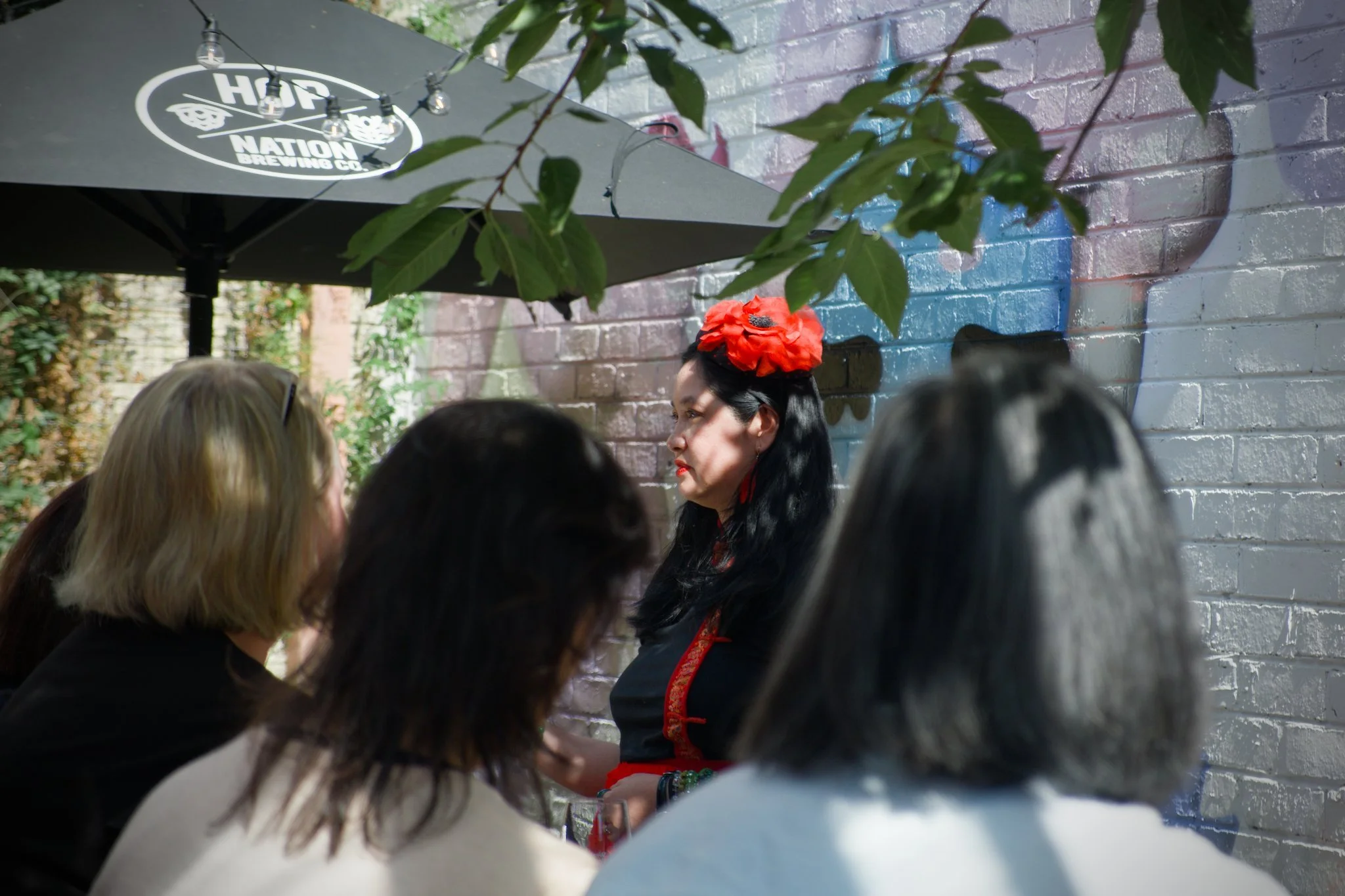
Thuy On kicking off the ‘Poetry & Wine’ session

Photo of poet Thuy On seated in an outdoor courtyard. She is speaking into a microphone that she is holding in her hand. Thuy is wearing a red-and-black dress with a bright-red flower fascinator in her hair.

Jaidyn Attard

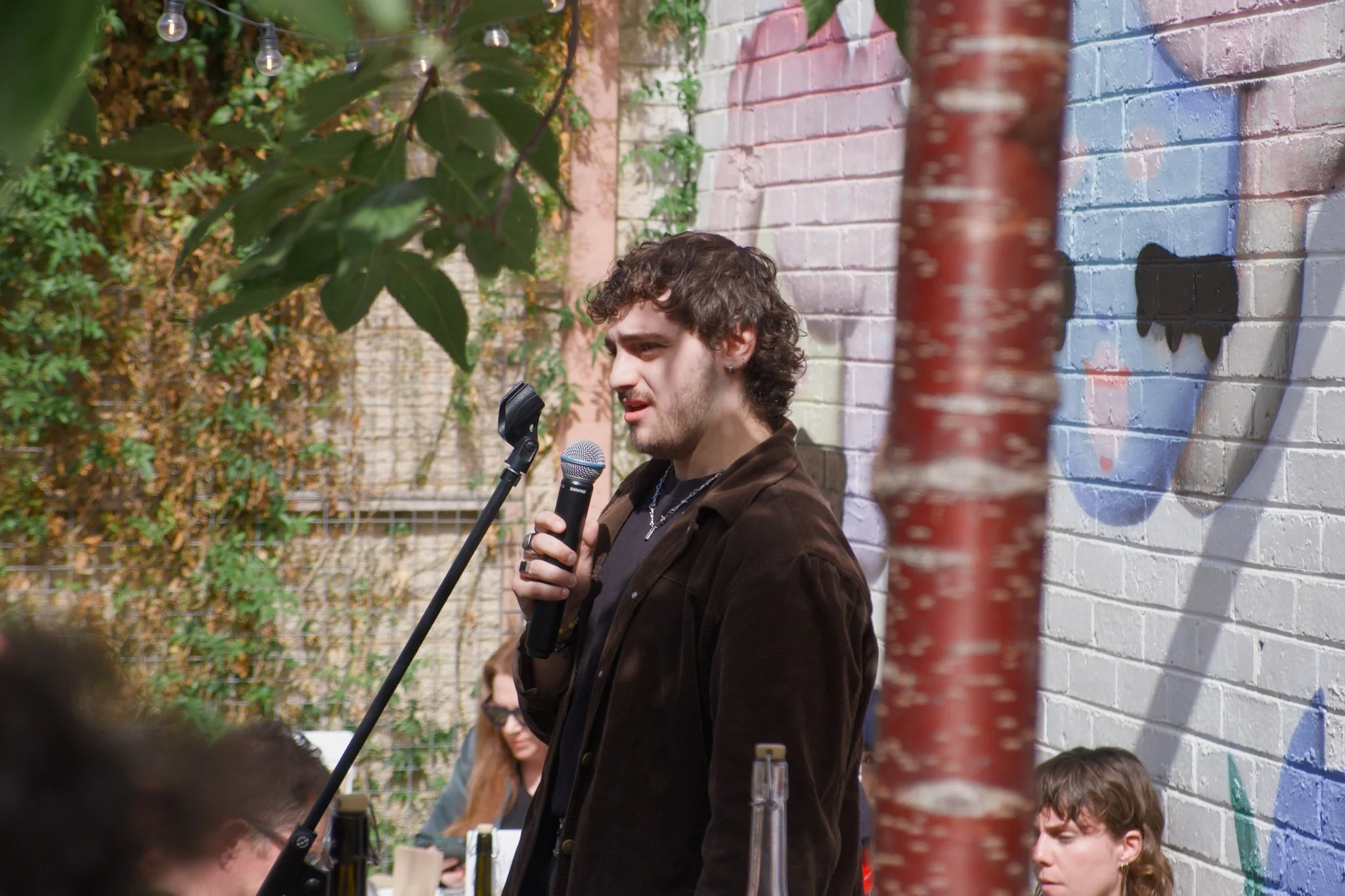
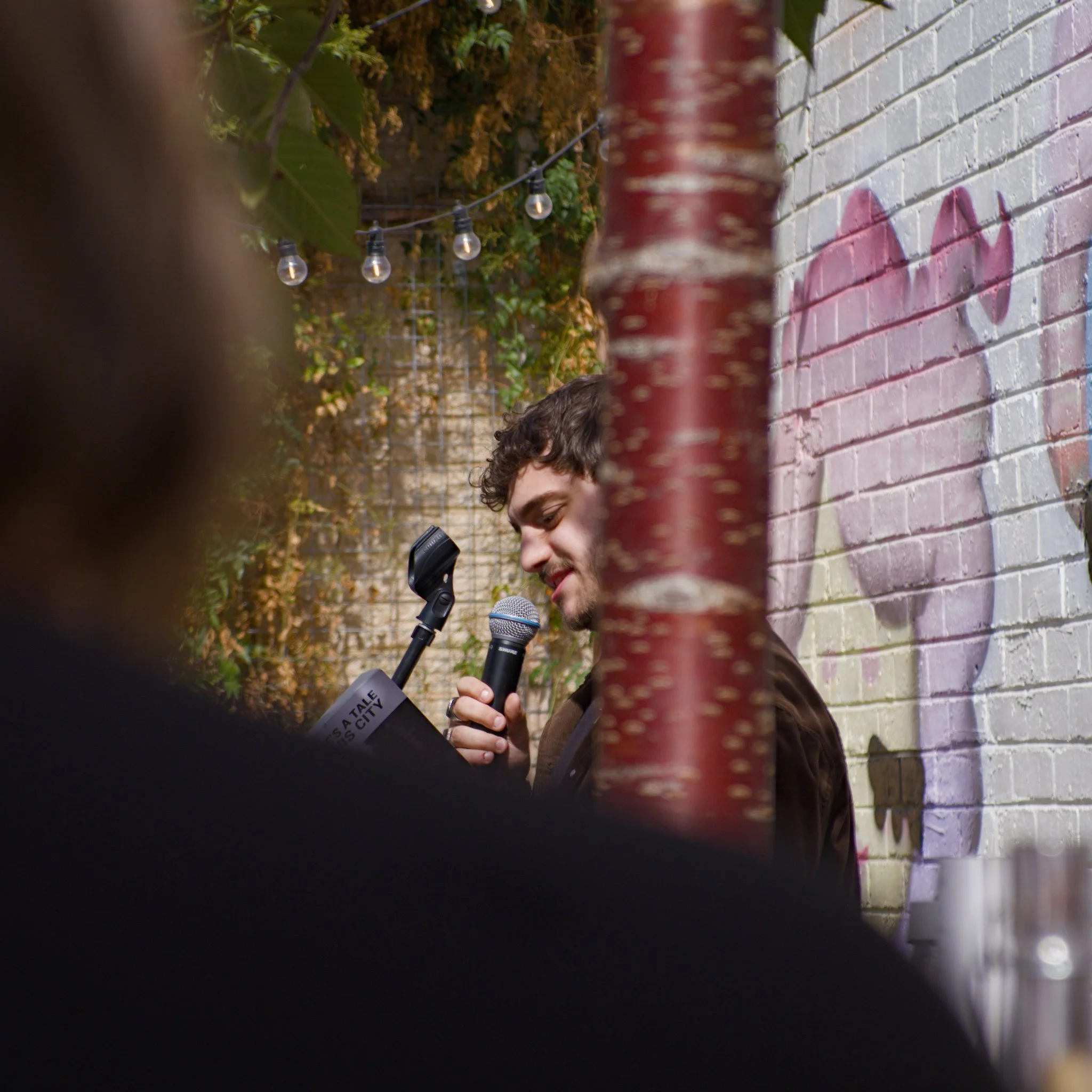
Jaidyn Attart is a street poet and I actually posted a photo of one his poems back in 2024 :)

Jaidyn Attard reciting his poetry - 1

Photo of poet Jaidyn Attard standing in a wine-bar courtyard. He is reciting his poetry into a microphone that he is holding in his hand. Jaidyn is wearing a black t-shirt and brown overshirt. Jaidyn is also looking straight at the photographer taking this photo.

Nadia Niaz

Nadia Niaz getting ready to recite her poetry

Photo of poet Nadia Niaz standing at a table in a wine-bar courtyard. Nadia is sorting through some papers on the table as she prepares to read her poetry to the audience.

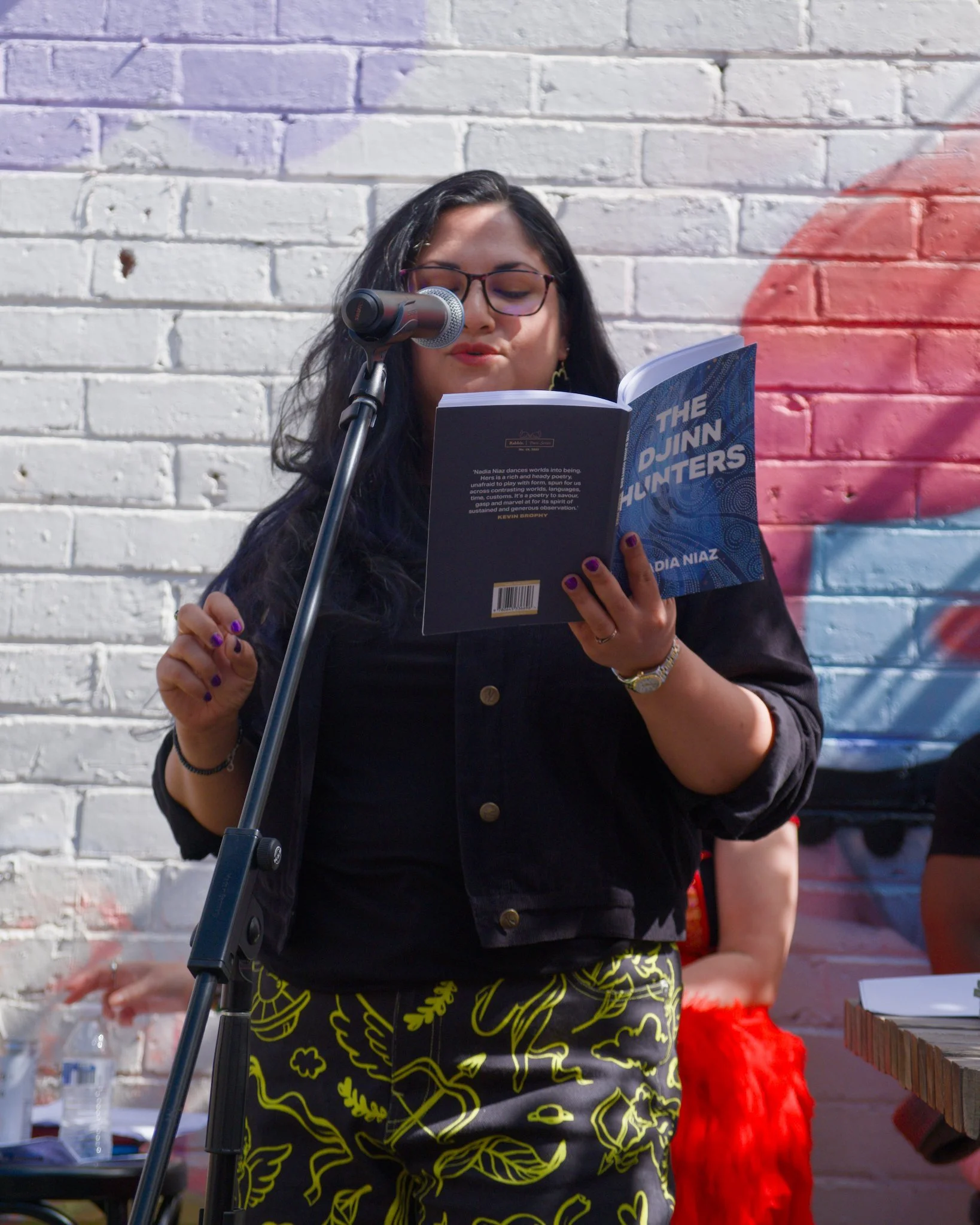
Nadia Niaz reciting her poetry - 1

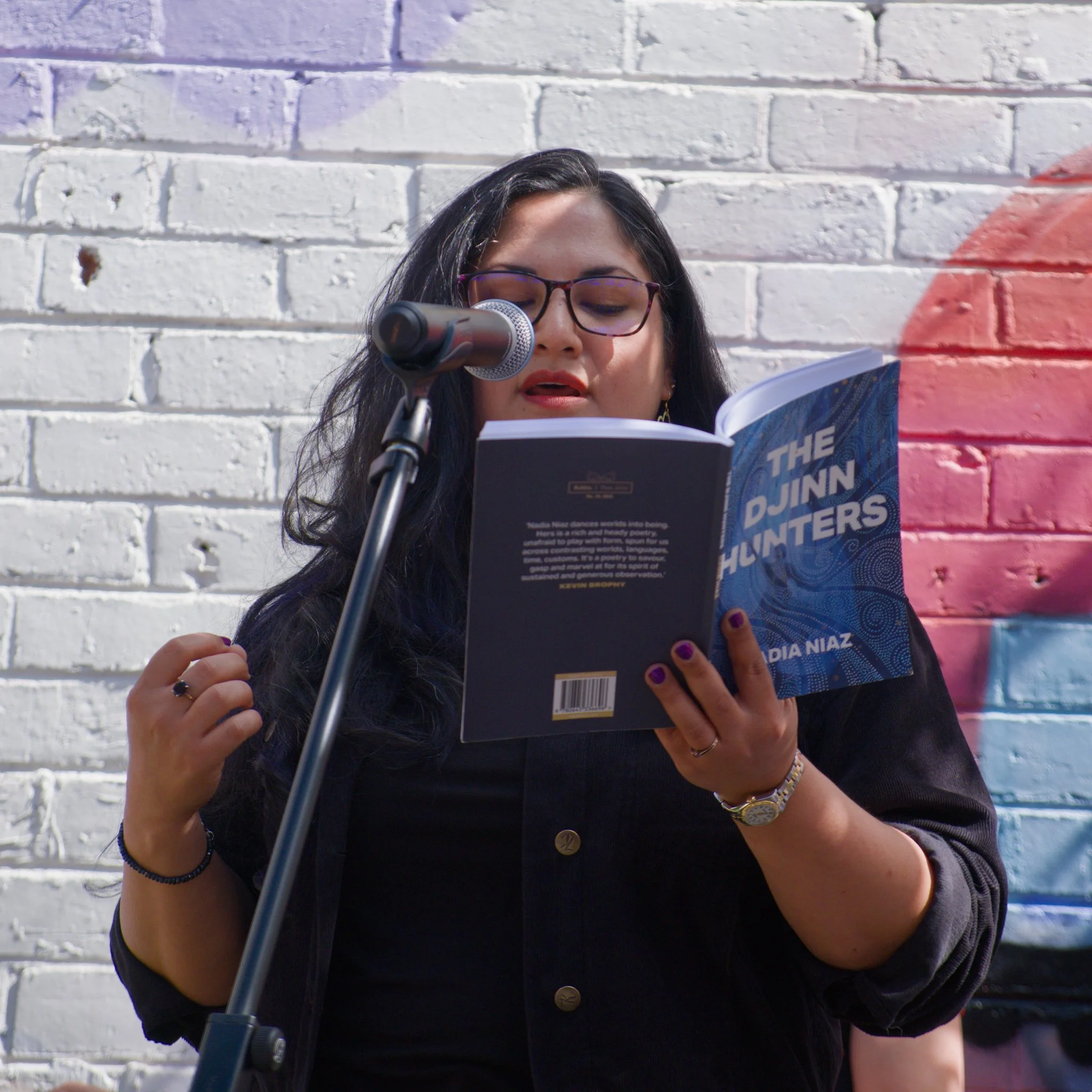
Photo of poet Nadia Niaz standing in a wine-bar courtyard. Nadia is reciting her poetry into the microphone that is on a mic-stand in front of her. She is gesturing with her right hand while holding open her book, The Djinn Hunters, in her left hand. Nadia is wearing a black top and black jacket.

Thuy On

Thuy On reciting her poetry - 1

Photo of poet Thuy On standing in a wine-bar courtyard. Thuy is reciting her poetry into the microphone that is on a mic-stand in front of her. She is holding open one of her poetry books with her right hand. Thuy is wearing a red-and-black dress with a bright-red flower fascinator in her hair.

Random photo

Outdoor LED lighting at West Footscray Wines

Photo of an LED light globe affixed to a string of outdoor lights in a wine-bar courtyard. There are cobwebs on the light fixture and, in the background of the photo, you can see an out-of-focus mural painted on the courtyard wall.

Lili Ward

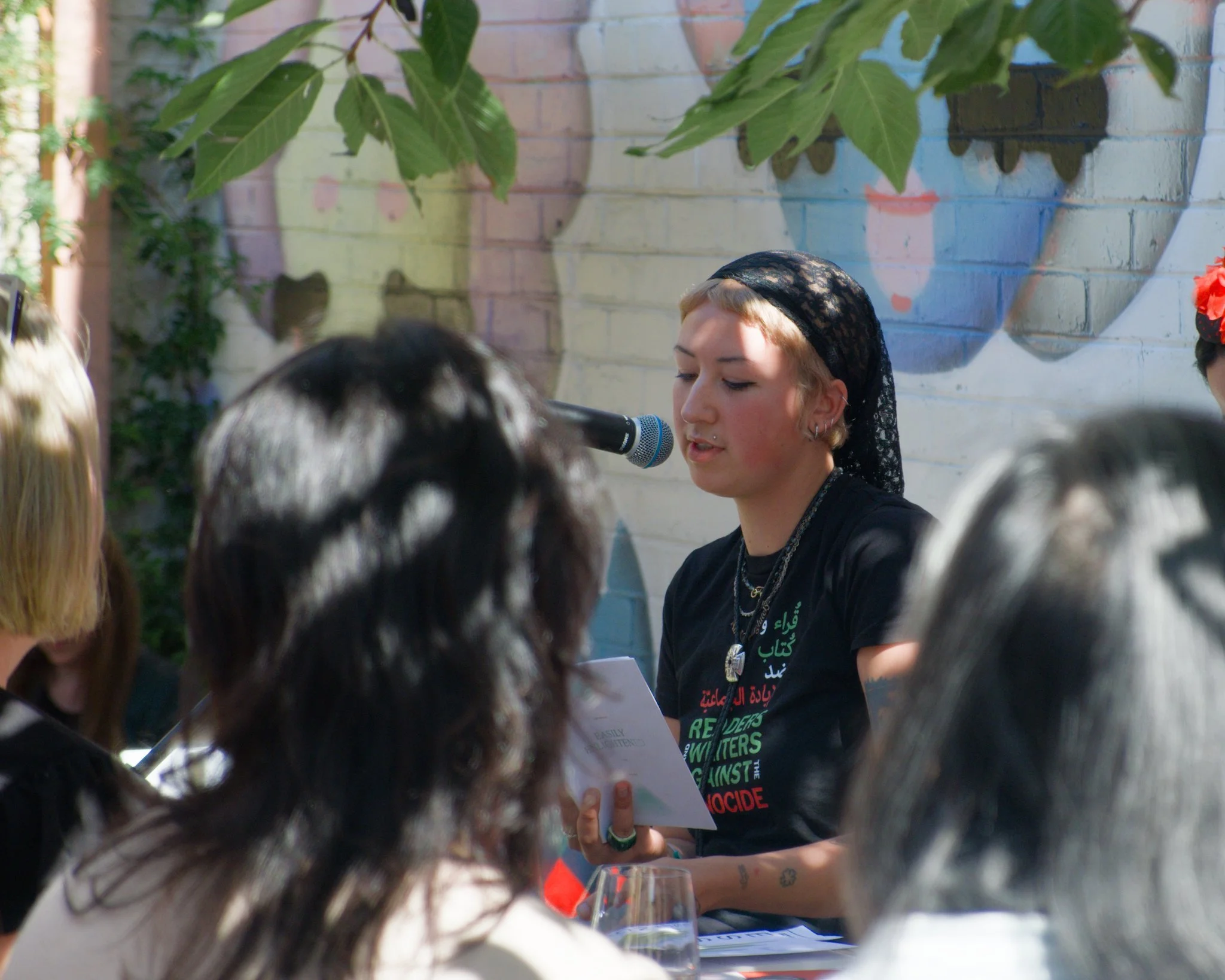
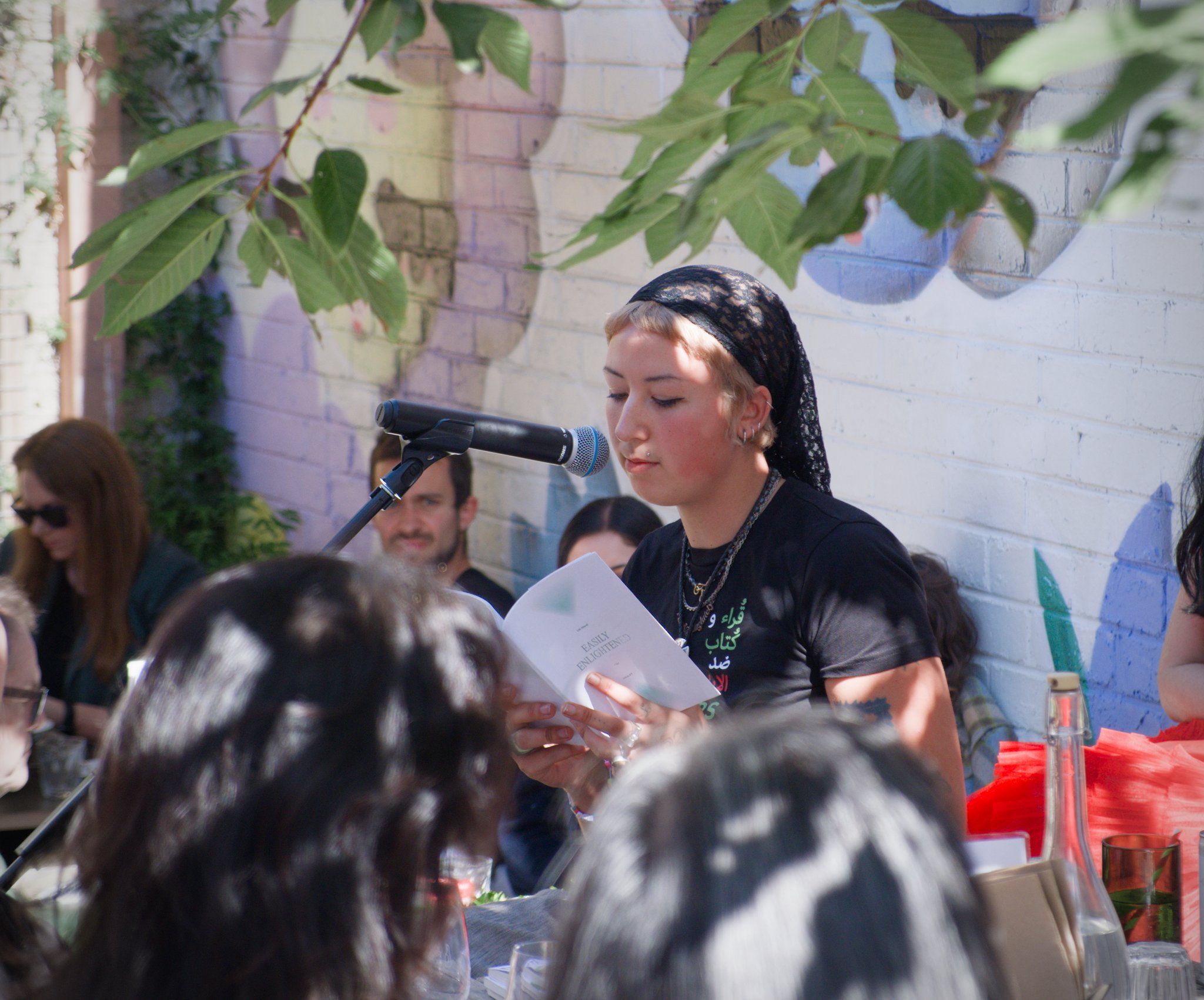
Lili Ward reciting her poetry - 1

Photo of poet Lili Ward seated in a wine-bar courtyard. Lili is reciting her poetry into the microphone that is on a mic-stand in front of her. She is reading from her poetry book, Easily Enlightened. Lili is wearing a black t-shirt that reads, "Readers and writers against the genocide".

Volunteer photographer

Footscray West Writers Fest 2026 volunteer taking a photo - 1

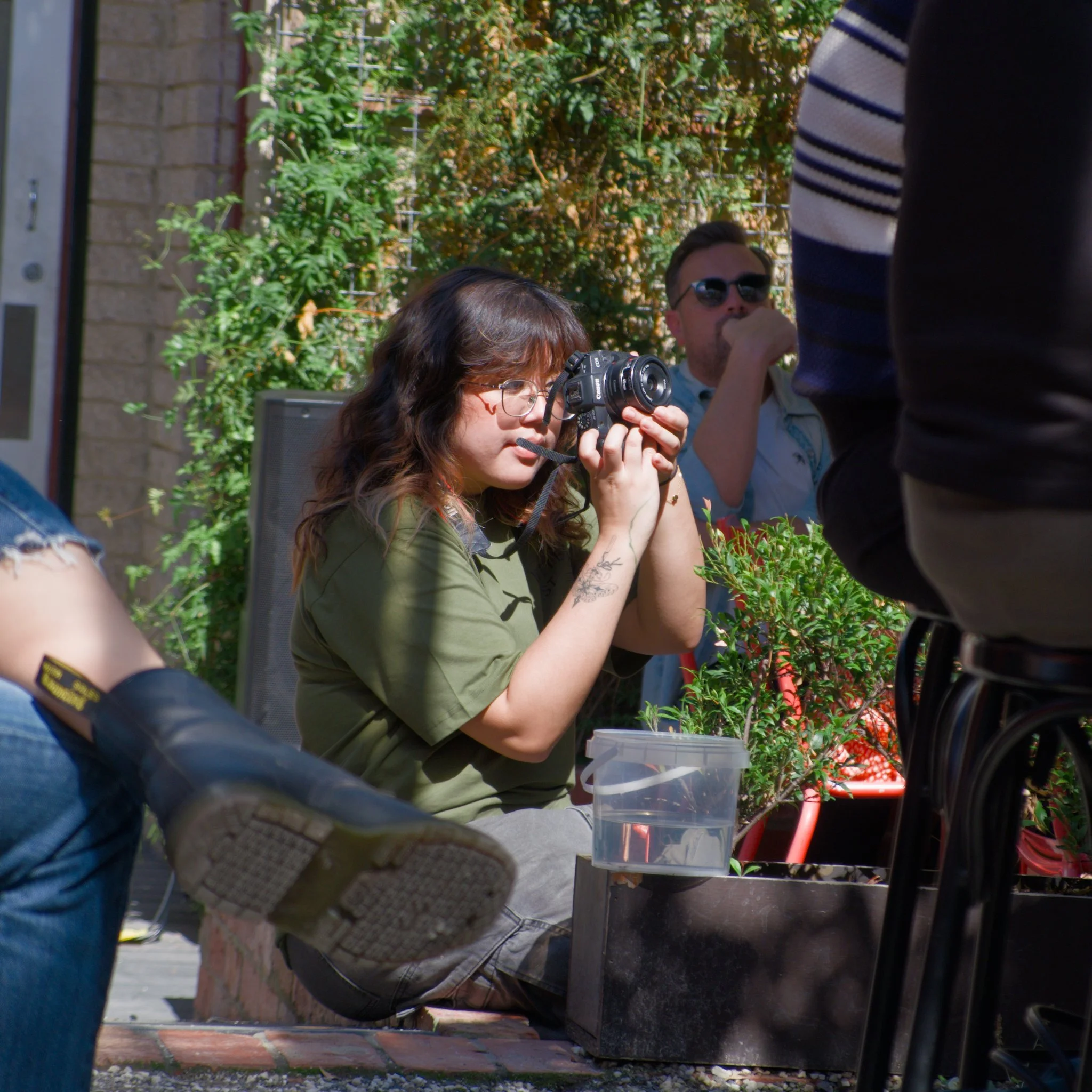
I like taking photos of photographers and videographers, the folks who are usually on the other side of the lens. I even have an album on Flickr with all such photos I’ve taken over the years :)

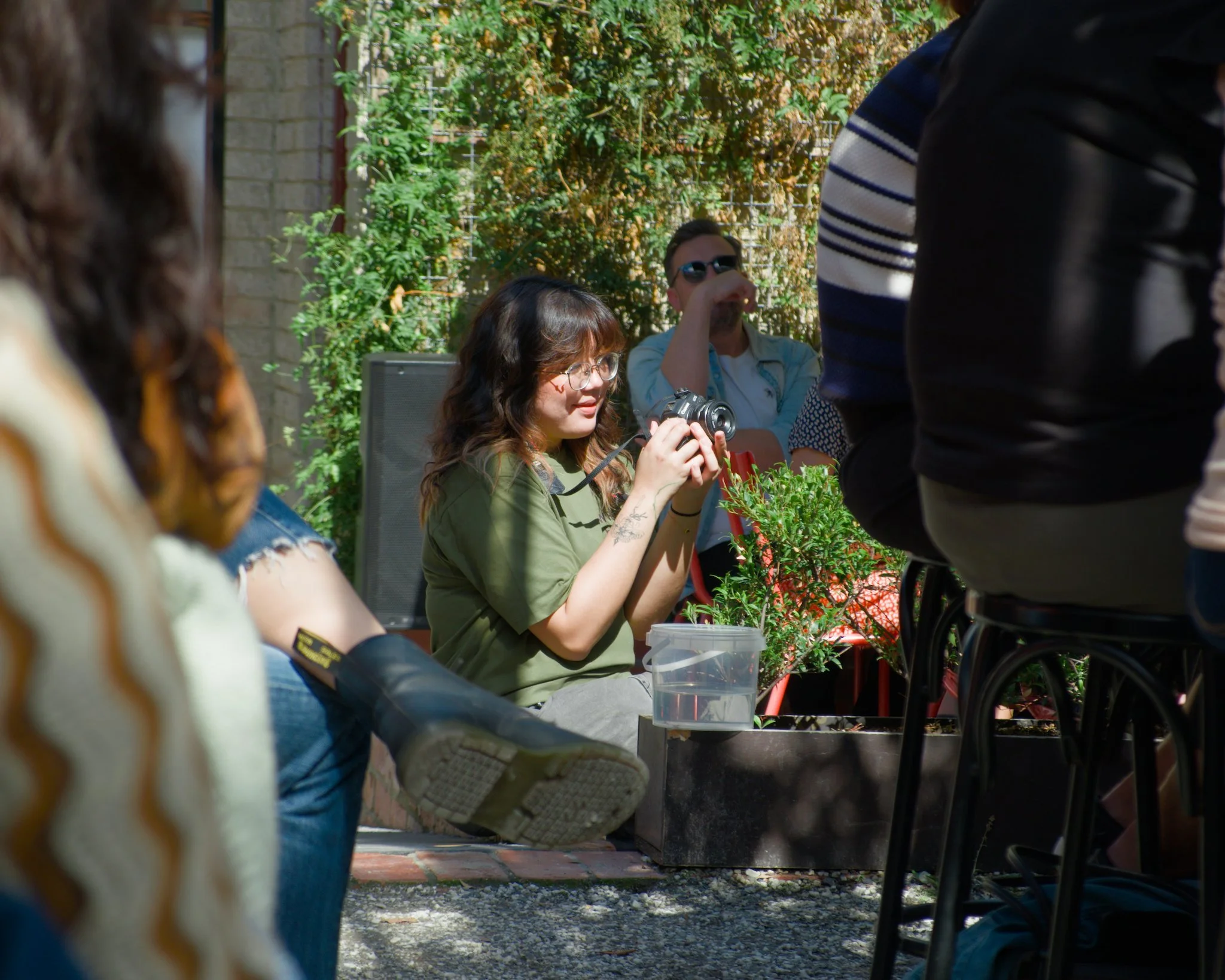
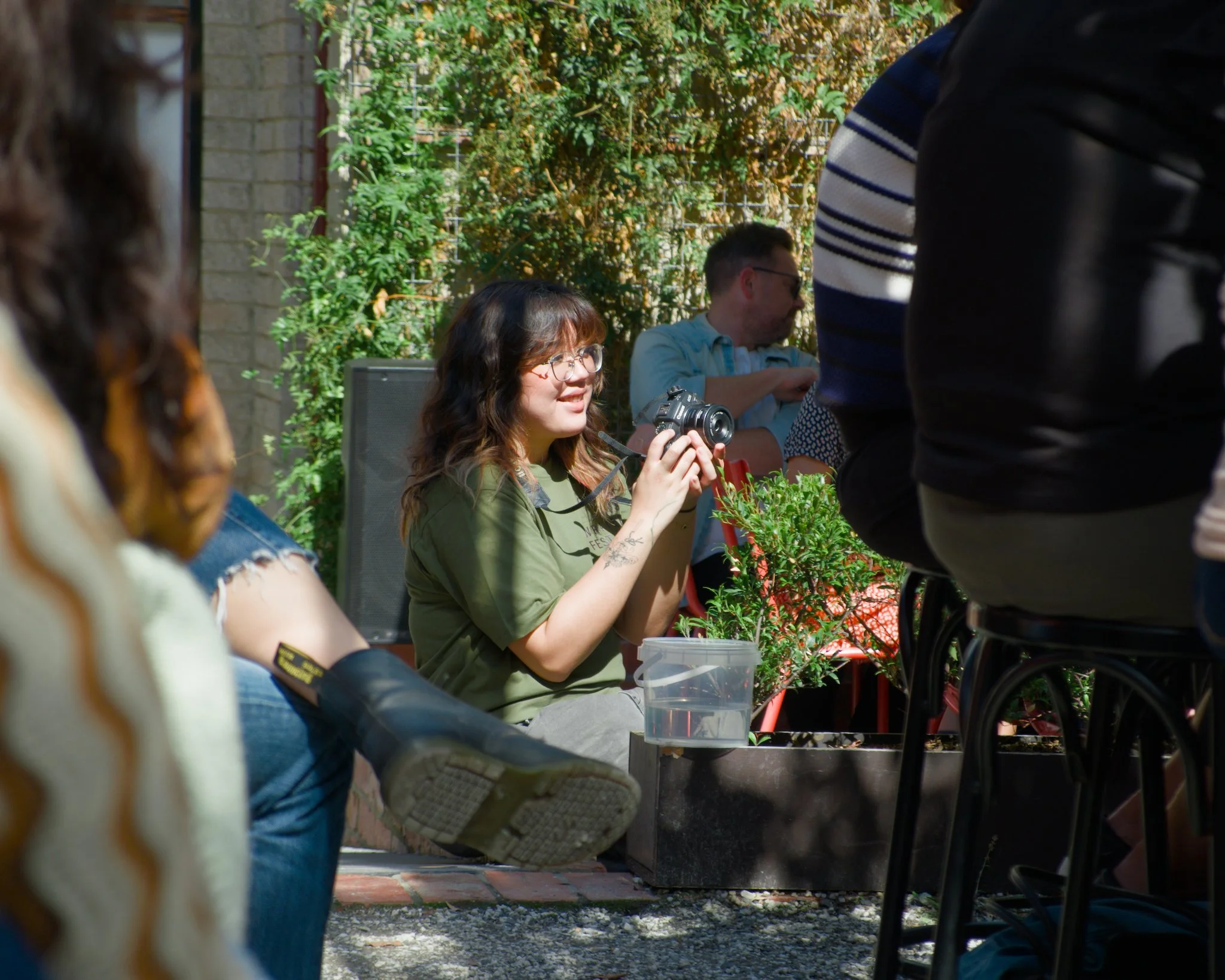
Photo of a young woman wearing grey jeans and an olive green event-branded t-shirt who is sitting on a walkway that connects at wine-bar courtyard to the main building. This photo is taken between rows of audience members seated at an outdoor poetry reading event. The woman is using a Canon DSLR camera to take a photo of the speaker who is currently reciting their poetry.

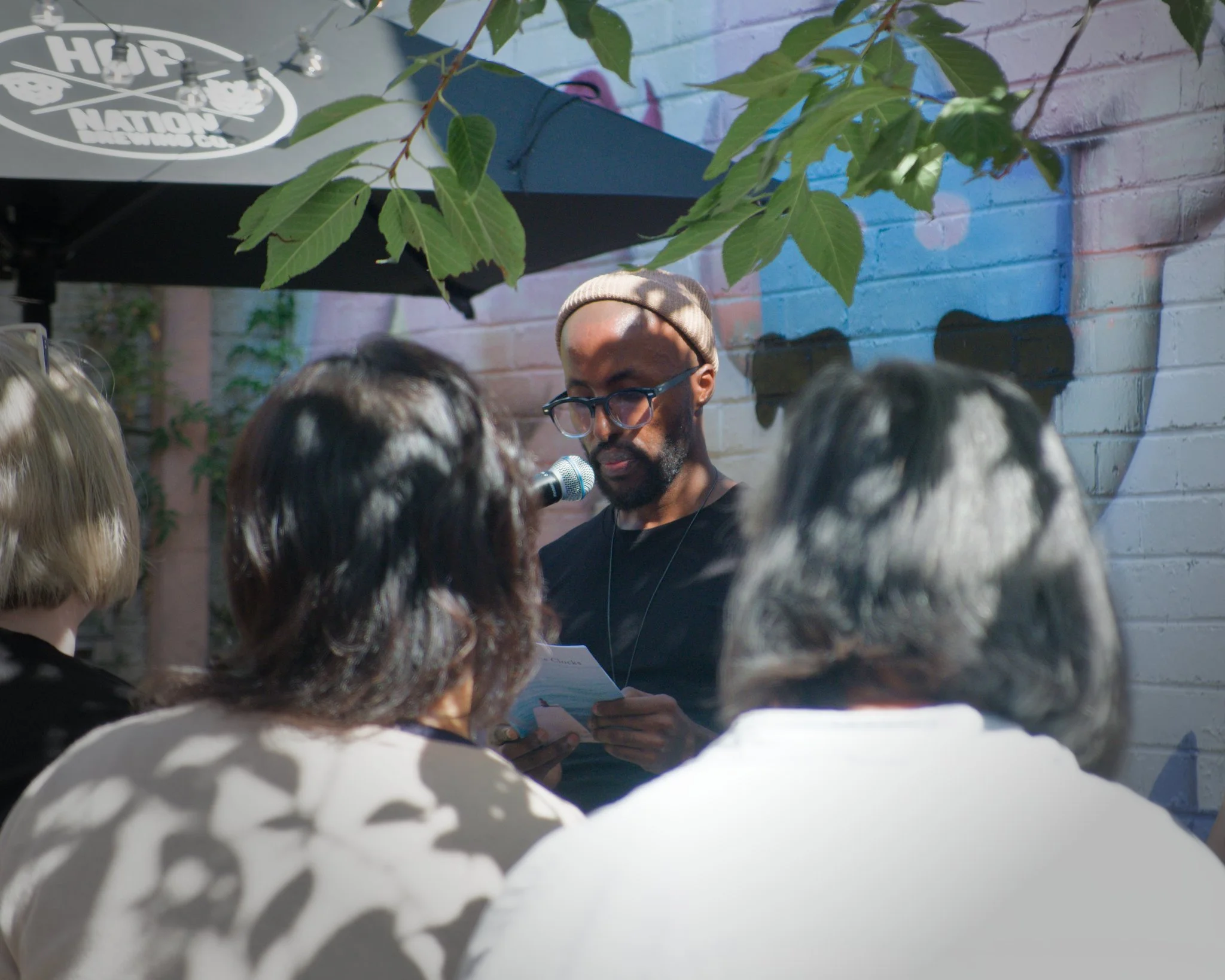
Magan Magan

Magan Magan reciting his poetry - 1

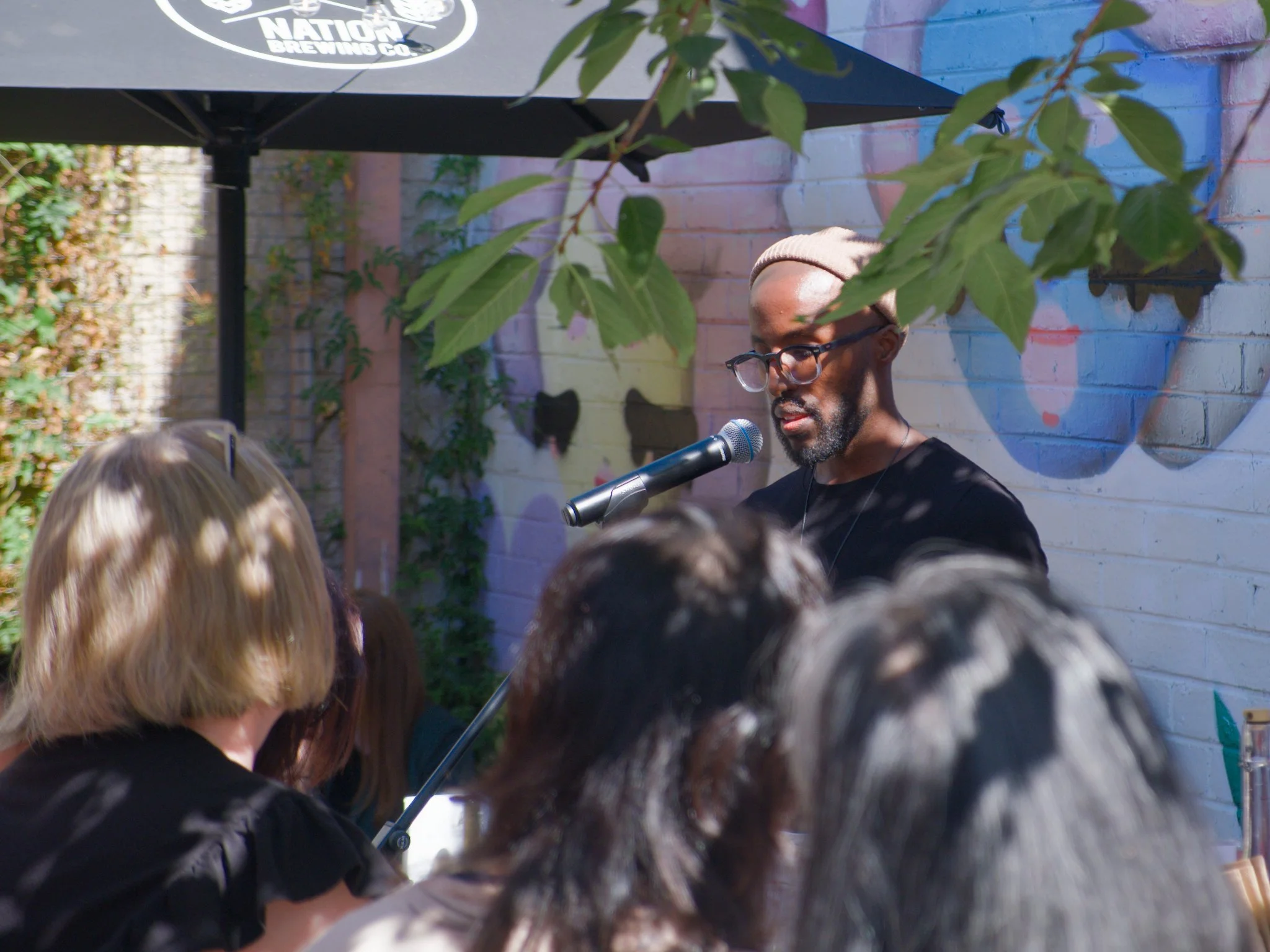
Photo of poet Magan Magan standing in a wine-bar courtyard, as seen above the heads of some audience members. Magan is reciting his poetry into the microphone that is on a mic-stand in front of him. Magain is wearing a black t-shirt and brown wool cap, and he is reading from the smartphone he is holding in his hands.

Linkin Park in Melbourne, 2026

After attending the 8 March Linkin Park concert with Nadia, I attended the 10 March concert by myself. A lot of the folks around me had done exactly the same: attended the first show with their partner and were now attending this second show on their own :)

Since I’d already seen most of this show once – there was a six-song difference between day one and day two – I took more photos and videos during this show than I normally would. Here are some of them.

tl;dr

I only recorded small bits of some of the songs that Linkin Park played because I wanted to spend the rest of the time in the moment. I’m much happier listening to these songs being played live in front of me than focusing on what I’m capturing my phone’s comparatively tiny screen. Anyway, I’ve compiled those clips into a single video.

LPU early entry

I’ve been a member of Linkin Park Underground (LPU), the Linkin Park fan club, since 2010, skipping only the 2022-23 year because that was when we bought a house and got a mortgage, and so I cancelled literally all my subscriptions. (Including my other long-term subscription to Feminist Frequency, which I’d had since 2012.)

One of the benefits of an LPU membership is that, if you have a General Admission (GA) ticket, you can apply for early entry to Linkin Park’s concerts. Only the first 100 LPU members with verified GA tickets who apply are selected and, because I was a little late in applying, I was #74 on the list.

Still, that meant I got to queue up with VIP ticket holders and other early-entry LPU members at 5pm on Tuesday. Doors opened for everyone else at 6:15pm, openers Polaris kicked things off at 7:30pm, and Linkin Park’s set started at 8:45pm.

Waiting in the early entry line at Rod Laver Arena

Photo of a pull-up banner outside of an arena that reads, “LPU early entry”.

We were escorted into the empty Rod Laver Arena floor at 5:30pm, a full 45 minutes before gates opened to the general public at 6:15pm – which was super cool.

Empty Rod Laver Area floor, before doors open to the general public

Photo of a large arena prepped for a concert that that is currently completely empty of attendees.

The Linkin Park team makes an effort to recognise its fan club members so, while we went about arranging ourselves along the barricade at the very front of the arena floor, our LPU avatars were being displayed on the big screen at the back of the stage.

Avatars of early-entry LPU members on display

Photo of a large screen at the back of a massive concert stage. Displayed on the screen is a logo, the text, “Welcome LPU”, and twenty stylised avatars of members of the Linkin Park fan club.

In case you’re wondering, mine is the blue one in the bottom-right corner of this photo :)

Early-entry LPU member avatars on display behind the stage

Photo of part of a large screen at the back of a concert stage. Displayed on the screen is a logo, the text, “Welcome LPU”, and ten stylised avatars of members of the Linkin Park fan club. In the bottom-right corner is a blue-skinned character with a beard and eyeglasses who is wearing a khaki-and-orange industrial-looking hoodie.

A new era for Linkin Park

One of the coolest things about the latest evolution of Linkin Park is how their audience has evolved right along with them. When I attended their show the last time they were in Australia, which was in December 2010, I think around 40% of concert attendees were women. In this new era of Linkin Park, easily 50% of attendees were women or non-binary. That was true on the arena floor as well.

There was also a difference between the Sunday and Tuesday shows. When Mike Shinoda asked for a show of hands on Sunday, about one-third of the crowd indicated they’d attended a Linkin Park concert before, while two-thirds were attending their first one that night. He didn’t repeat this question on Tuesday, but it felt like those numbers were reversed and we had a greater proportion of long-term, die-hard fans in attendance. (Tuesday being a school night also meant there was fewer children there.)

The vibe was different enough on Tuesday that there was a good amount of crowd surfing going on. Even Emily Armstrong crowd surfed for a bit :) I hadn’t noticed any crowd surfing on Sunday, thought that might have just been me not paying enough attention.

Concert etiquette, behaviour, and security practices have come a long way since 2010 because, when Linkin Park performed in Melbourne back then (which was also at Rod Laver Arena), there were clear signs telling us that, “Moshing and Crowd Surfing is NOT PERMITTED”!

Photo of an area with seats rising up to the back wall. A sign attached to the barrier at the front of the seating area reads, “Moshing and Crowd Surfing is NOT PERMITTED”.

Fast forward to 2026 and concert security were constantly making sure folks on the arena floor stayed hydrated at all times – regularly passing down water in paper cups, for example – and they were super efficient at helping crowd surfers get down safely once those folks had made it all the way to the front.

Before the event kicked off, tour management also came by and talked to us about what to expect during the show – like the mosh pit that’s formed during Two Faced – and what to do if we weren’t feeling well.

All told, it was an excellent experience on the arena floor. But then – much like the members of the band itself – Linkin Park’s fans are, on average, more considerate and, frankly, nicer people. At least in my experience.

Video show-and-tell

Speaking of how things have changed from 2010 to 2026, I made a video to show some of the differences between the two live performance.

Aside from the permanent line-up changes – with lead vocalist Emily Armstrong replacing the late Chester Bennington and drummer Colin Brittain replacing Rob Bourdon – their songs are now played in a different key to suit Emily’s vocal range and Alex Feder is their touring lead guitarist because Brad Delson prefers not to go on tour.

Just like the band’s concert technology, my filming technology has also received a massive upgrade. Back in 2010, I was recording video in 720p resolution on a 2000s-era Canon IXUS 120 digital camera. In 2026, I’m recording in 1080p using my Google Pixel 6 Pro smartphone.

The 2010 audio from my Canon camera was completely unusable, by the way. Its tiny microphone could not handle the concert volume and absolutely could not handle the bass! Fortunately, back in the day, LPU members who could show evidence they’d attended a particular concert were able to purchase an audio recording of that show. This was audio recorded straight off the mixing console. This approach obviated the need for any bootlegging recordings and also made the band a bit of additional revenue. I’d bought this recording for the show I attended in 2010, and so I was able to used this in my video instead of the crappy in-camera audio :)

One of the best shows I’ve attended

Here, finally, are some of my photos from Linkin Park’s performance.

Mike singing

Photo of musician Mike Shinoda on stage with a guitar slung across his back while he sings into the microphone that he is holding.

The massive video screens directly above us

Photo of two massive rectangular lighting rigs attached to the roof of an arena. Along the side of these lighting rigs are massive video screens that are showing members of the band that is performing on the stage below.

The joy of standing so close to the confetti canon

Photo of an arena showing a wall of pink and purple confetti that has just been blown out of confetti canons arranged in front of a massive stage.

Those canons really do launch that confetti across the whole arena!

Photo of an arena showing a wall of pink and purple confetti that has been blown out of confetti canons arranged in front of a massive stage. The confetti is floating above the thousands of people standing on the arena floor.

Emily and Mike encouraging fans to sing along

Photo of musicians Emily Armstrong and Mike Shinoda standing on platforms built on top of a stage at an arena concert. Emily is singing into the microphone she is holding while Mike is pointing his microphone at the crowd in front of him, encouraging them to sign along.

Joe taking photos of the crowd

Photo of musician Joe Hahn taking photos of the crowd while his fellow band members perform on stage at a arena concert.

Me in the background of Joe’s photo

I only took a couple of selfies at the show but neither turned out very well. Happily, you can see me (wearing the black face mask) in the top-left corner of this photo that Joe Hahn took and then posted on his Instagram account.

Photo of a woman screaming in delight while wearing a Linkin Park hat. The woman is standing at the barricade at the very front of an arena floor. Directly behind this woman is a bald man wearing glasses and a black face mask who is looking up at musician Mike Shinoda as he raps into his microphone.

The main focus of Joe’s photo is Irene, the LPU member who was gifted a Linkin Park hat signed by the entire band. I was right behind her when this happened and took a video of it, which I later sent to her and she posted on her Instagram :)

Mike rapping while standing on the barricade directly in front of us

Mike is the one who presents this gift to a fan every night, and here’s the photo I took of him rapping to start the next song. Yes, he is standing on top of the barricade that’s directly in front of us.

Photo of musician Mike Shinoda rapping while standing on top of the barricade at the front of an arena floor.

The whole band in one photo

Photo of musicians Mike Shinda, Emily Armstrong, Dave Farrell, Joe Hahn, Alex Feder, and Colin Brittain performing on stage at an arena.

Fantastic laser light show

Photo of a three-dimensional laser and large-screen light show around the stage at an arena concert.

Dave doing his thing

Photo of musician Dave Farrell playing his bass guitar on stage at an arena.

Emily doing her thing

Photo of musician Emily Armstrong singing as she looks down into members of the audience from an arena concert stage.

Bass, rhythm, lead guitar

Photo of musicians Dave Farrell, Mike Shinoda, and Alex Feder – bass, rhythm, and lead guitarists, respectively – performing at the front of an arena stage.

Emily connecting with at a fan

Photo of musician Emily Armstrong pointing at a fan as she walks towards her during an arena concert.

Lights turned all the way up after the end of the show

Photo of a massive arena stage with all its white lights turned on. The concert has ended and all the musicians have left the stage.

The crowd behind me, right after the show ended

Photo of thousands of people standing on an arena floor at the end of a concert, with several thousand more seated in chairs all around the arena. Rod Laver Arena can hold over fifteen thousand attendees during concerts.

Confetti’s gonna confetti

Photo looking down at an arena floor that has no people on it, but is full of pink and purple coloured confetti. The photographers shoes, legs, and shorts are visible in the bottom of the photo frame.

So that’s that.

I’ve been in GA crowds several time over the years, but this was probably the most fun that I’ve had in one. It helped that all of us early-entry people were avid, even nerdy, Linkin Park fans and we quickly made friends with the folks around us. When you’re jumping up and down, squeezed between your neighbours, with the bass pounding and confetti flying, it’s good to know the names of the folks around you and that you’ll all look out for each other over the course of the night :)

Summer 2026 events round-up

Like I’ve mentioned before, I don’t take many photos and videos at events like concerts, talks, and comedy shows because I prefer being present in the moment.

That said, I do like to take at least a couple of photos for posterity. So here are some of the event photos and videos I’ve taken over the last few months.

I’m going to skip over one event I attended because this was a rare exception to my take-very-few-photos rule. I’ll cover that in the next post.

Garbage

12 Dec 2025. Garbage is one of my all-time favourite bands. I had to travel for work when these folks toured Australia in 2016, but this time I made sure I was there. Nadia and I attended the concert (and went out for dinner before that) with a whole bunch of friends and we had a fantastic time.

Garbage performing at the Palais Theatre in Melbourne

Photo of alternative rock band Garbage performing on stage.

Elderbrook

14 Jan 2026. Elderbrook is one of my favourite electronic musicians/DJ. He toured Australia as part of the summer music festival circuit and we got to watch him at the Australian Open concert series. (Yes, the AusOpen tennis tournament is about a lot more than just world class tennis.)

Elderbrook playing the drums during his set

Photo of electronic musician and DJ Elderbrook performing at a medium-sized outdoor festival-like stage. Elderbrook is drumming on some electronic drum pads set up on the stage next to his DJ rig. The super wide, wrap-around video screens behind him are displaying a fiery orange pattern.

Here’s a super short video from this concert too.

Gianmarco Soresi

24 Jan 2026. Gianmarco Soresi’s stand-up material ranges from very personal to very political. Your face won’t hurt at the end of his show because you laughed too much – his shows aren’t like that – but your brain will be full of zingy thoughts and unhinged imagery that you were absolutely not expecting.

The Capitol is such a gorgeous theatre

Photo of the a large theatre with a layered, three-dimensional, rectangular roof with hidden white, blue, and purple lighting.

Wet Leg

10 Feb 2026. I’m not hugely into post-punk revival, but I do love Wet Leg. We didn’t have the best spot from which to watch this show, but it was a fun concert nonetheless.

Wet Leg at Northcote Town Hall

Photo of indie rock band Wet Leg performing on stage.

Nerd Nite #67

11 Feb 2026. Since this is probably the first time you’re hearing about this: Nerd Nite is “evidence-based entertainment” – a series of informal talks given at a pub by nerds, for nerds. Started in Boston, USA in 2003, the concept spread all over the world, though I believe Melbourne Nerd Nite is the last chapter still running in Australia.

I’ve watched a lot of these talks online, but this was the first time I attended in person. It is so energising being around that many nerds! Nadia and I will try to attend all these talks going forward.

Nerd Nite at the Howler in Brunswick

Photo of a stage with a cinema-sized projector screen at the back. The screen shows a graphic of a stylised Melbourne tram with ‘Nerd Nite 2026’ written in graffiti on it.

Linkin Park

8, 10 Mar 2026. Linkin Park is one of my all-time favourite bands and the group were performing two shows in Melbourne. Nadia and I attended the first of those concerts together.

Selfie from Linkin Park’s From Zero world tour

Selfie of a man and woman wearing glasses and black face masks sitting in the crowd at a concert.

I’m a Linkin Park Underground (ie fan club) member, so I get access to ticket sales really early. That meant we got excellent seats: right in the centre and just four rows back from the mixing desk :)

Seated right behind the mixing desk at Rod Laver Arena for Linkin Park

Wide-angle photo of a large sports arena with a currently empty stage. Thousands of attendees, especially the ones on the floor of the arena, have their smartphones out and are filming what is about to happen on the stage. In the foreground of the photo are production techs standing in front of dozens of screens and control boards that make up a modern concert sound and lighting control set-up.

I attended Linkin Park’s second show by myself (this time in General Admission) and I’ll show you the photos and videos I took there in my next post.

Laura Ramoso

13 Mar 2026. Unlike Gianmarco Soresi, you do come out of Laura Ramoso’s stand-up shows with your face hurting from laughing so much. Laura did a fantastic job at transposing and translating her online skits and characters to the stage.

Waiting for Laura Ramoso at The Palais Theatre in St Kilda

Photo of an empty stage with text projected on the curtain at the back of the stage. This text reads, “Laura Ramoso” and “Calm Down Tour”.

This has been a really fun summer, and though we have fewer events planned for the rest of the calendar year, I’m looking forward to all of those as well.

2026 NBN update: the final upgrade

tl;dr

We upgraded our NBN connection from FTTC to FTTP, and because the switch to FTTP allowed us to upgrade to the Home Ultrafast speed tier, now our download speeds are ten times faster and our upload speeds are four times faster that before.

Screenshot of an internet speed test from OpenSpeedTest that shows a download speed of 958.61Mbps, jitter of 0.00ms, ping of 3.0ms, and upload speed of 73.41Mbps.

The start of our NBN story

We got connected to Australia’s National Broadband Network (NBN) in December 2015.

Then, because we were renting, we moved house a few times. That meant both our connection speed and connection type changed every few years (which I documented along the way using the ‘NBN’ tag on this blog, in case you’re interested).

Screenshot from the NBN website showing the various types of fixed line connections available on the NBN: Fibre to the Premises; Fibre to the Building; Fibre to the Curb; Fibre to the Node; and Hybrid Fibre Coaxial. (Source)

All that stopped in 2022 when we bought a house in the northern suburbs of Melbourne that had a Fibre to the Curb (FTTC) NBN connection. That’s the connection type in which the fibre optic cable carrying the internet signal terminates at a distribution box on your street (ie the “curb”) and a standard copper cable goes from there to your house.

The speeds on this connection type were decent, but not great: 95Mbps down and 19Mbps up.

The upload speed, in particular, was irritating because it was half of what we’d had with a Fibre to the Premises (FTTP) connection in our previous places. Now it took me a lot longer to back-up my media to the cloud, for example, and I had to make sure I wasn’t doing any uploading when Nadia or I were on a video conference call for work (especially if Nadia was teaching a class). First world problems, I know, but irritating ones nonetheless.

A new hope

You can upgrade! No, you can’t.

Happily, in January 2025, NBN Co announced its ‘full fibre upgrade’ program. This would let 622,000 properties across Australia upgrade their existing, slower connection types to the fastest-possible Fibre to the Premises (FTTP) connection.

I immediately tried to sign up to this upgrade but found that we weren’t eligible yet. We live in a property with only three units and, at the time, NBN Co was prioritising upgrades for properties with four or more units.

*sigh*

You can upgrade now! Wait, no, you still can’t.

Not too long after, in October 2025, all types of properties became eligible for the upgrade so I immediately signed us up.

Screenshot of an email with the heading, “We’ve received your request” and the text, “Hi Ameel Zia Khan, We appreciate your interest in the nbn Full Fibre Upgrade for Complex Multi-Dwelling Properties at” followed by an address that has been blacked out. An italicised sentence just below this paragraph reads, “Please note that this application applies to all units/premises within the building or complex, not individual units or lots.”

I didn’t hear anything till November 2025, when someone from the Fibre Upgrades team at NBN Co reached out to say our application was still under review.

Then, in January 2026, they reached out to say we could now formally proceed with the upgrade. We just needed to fill out a form and each unit on the property needed to pay $275 to cover the remainder of the government-subsidised installation cost.

Unfortunately, in the intervening months, things had changed at our end: one of the units on our property had been sold and, when I reached out to the new owners to say, “hey, we’re now all set to do the NBN upgrade” these folks said they didn’t want to do the upgrade.

Animated GIF showing a woman standing up and shouting, “Noooo!”

So that was that. End of story. No upgrade for me.

(Obviously that’s not how the story ended.)

The twist ending

Snatching victory from the jaws of defeat, at the end of February 2026, I got one final email from NBN Co that read:

Hi Ameel,

We’re writing to share an important update regarding the nbn® fibre upgrade at [YOUR ADDRESS].

Your premises/complex was previously progressing through the nbn Full Fibre Upgrade for Complex Multi‑Dwelling Properties program. Following a recent assessment, it has now been reclassified and is eligible to individually order an nbn® Fibre to the Premises (FTTP) service via a High-Speed Tier plan.

What this means

Instead of continuing through the Complex MDU upgrade pathway, individual premises within the complex/block can now request an order directly with their preferred retail service provider (RSP), provided they select an eligible high‑speed plan.

This meant our upgrade to FTTP was no longer an all-or-nothing deal for the whole property. Individual owners of each unit could now apply separately through their internet service providers (ISPs) to upgrade just their own NBN connections!

Woohoo!

Happily every after

From then on, things proceeded at pace.

Our ISP is iiNet – who we’ve been with since 2009! – so shortly after I received this email, I went to their ‘Fibre upgrade’ page and signed up for a free upgrade.

The very next day I got a message to say our upgrade-installation was booked for exactly one week later.

One week later, which was yesterday, the installer turned up and, within two hours, had:

  • laid the new fibre optic cable from the street to our unit,

  • installed two new connection boxes (outside box shown below), and

  • activated our new NBN FTTP connection.

Photo showing an large while box stamped NBN Co installed on a brick wall.

All I needed to do was log into our modem and uncheck the VLAN tagging checkbox that was needed for the old FTTC connection but was stopping our new FTTP connection from working.

And just like that, we were done.

Serious speed upgrade

So what speeds are we getting now?

Well, not only did we upgrade our connection type to FTTP, we also upgraded to the ‘Home Ultrafast’ speed tier that gives you download speeds of up to 1,000Mbps (ie one gigabit per second) and upload speeds of up to 100Mbps :)

And because we’d upgraded to the latest Synology router in 2024 – the WRX560, with its 2.5Gbps WAN port – I knew all our hardware (and the Ethernet cables in our walls) could handle the speed upgrade just fine.

Here, then, are our current download and upload speeds.

Graphic with two bar charts showing, respectively, download and upload speeds in megabits per second from 2009 to 2026. The bars are divided into groups by connection type. 2009 ADSL speeds are 6.9Mbps down, 0.9Mbps up. 2015 FTTB speeds are 46.7 down, 22.6 up. 2016 and 2018 FTTP speeds are 75.7 and 105.2 down, 36.5 and 37.2 up. 2020 and 2022 FTTC speeds are 91.9 and 94.7 down, 18.2 and 18.9 up. Finally, a differently coloured bar for 2026 Ultrafast FTTP shows speeds of 937.3 down, 89.0 up.

We’re currently getting speeds of 937Mbps up and 89Mbps down – which is a whopping ten times faster for downloads and four times faster for uploads!

What now?

So that’s it. The end of the road. Our final NBN upgrade is complete.

Yes, NBN Co has announced an Ultrafast II speed tier that gives you 2GBps download speeds, but that is absolutely not something we need at home so our upgrading days are very much over.

Now we just get to enjoy blazingly fast download and upload speeds, and the next time I need to upload a few terabytes of data to the cloud, I won’t have to leave my desktop switched on continuously for a few days in a row!

As someone whose work and personal life is inextricably intertwined with the internet, I am a very happy person right now :)

Australian Open 2026

Unlike last year’s Australian Open tennis tournament – during which there was a thunderstorm – this year’s tournament featured two heatwaves.

¯\_(ツ)_/¯

We were there during the second of those heatwaves, but we took good care of ourselves :)

Here are my photos from this year’s tournament.

Our 2026 annual Australian Open selfie

Selfie of a man and a woman sitting outside a tennis complex on a sunny day. The man is wearing a black t-shirt and glasses; the woman is wearing a black sleeveless top and sunglasses. They are both wearing straw hats.

Lots of shaded seating at ANZ Arena

Wide-angle photo of an outdoor tennis court at a tennis tournament. The tennis court has seating all around, and shading has been erected so that almost all the seats are in the shade. The blue-coloured tennis court is empty because the next scheduled match has not yet started.

Hanyu Guo serving in her round 2 women’s doubles match

Photo of professional tennis player Hanyu Guo (China) in the air while in the middle of her tennis serve. The players are playing in a tennis court with a hard, blue coloured surface.

Australian supporters at Australian Open 2026

Photo of five women sitting in a row in the stands of a tennis court during a tournament. They are all wearing identical, patterned green-and-yellow tops as well as green straw hats with a yellow tennis ball affixed to the top.

View of Rod Laver Arena from ANZ Arena

Photo of the signage at the top of the Rod Laver Arena tennis court, as seem from the stands of a nearby outdoor tennis court.

Ball kid running to grab a tennis ball

Photo of a ball kid in blue shorts, a blue shirt, and a blue hat stopping his run across a blue-coloured tennis court as he approaches a tennis ball lying on the ground.

Ball kid running back having grabbed a tennis ball

Photo of a ball kid in blue shorts, a blue shirt, and a blue hat running back across a blue-coloured tennis court after he has retrieved the tennis ball that was lying on the ground.

Ball kid passing tennis balls across the court

Photo of a ball kid in blue shorts, a blue shirt, and a blue hat rolling tennis balls across a blue-coloured tennis court to another ball kid that’s off-camera.

Ball kid holding up a tennis ball for the serving tennis player

Photo of a ball kid holding up a tennis ball in case the serving tennis player wants another ball. Only the top of the ball kid’s hat at the ball kid’s arm are visible, with the rest being blocked from view by the wall of the tennis court.

Talia Gibson’s ball toss

Photo of professional tennis player Talia Gibson (Australia) tossing a tennis ball in the air at the start of her serve during a tennis match.

Talia Gibson ready to strike the ball

Photo of professional tennis player Talia Gibson (Australia) mid-swing as she prepares to strike a tennis ball during her women’s doubles match.

Sara Errani winning the point / everyone going in a different direction

Photo of professional tennis player Sara Errani (Italy) as she hits a ball into the opposing court during a tennis match.

Ball kid waiting for Kimbery Birrell to serve

Photo of a ball kid waiting by the side of the net at a tennis tournament. In the background of the photo professional tennis player Kimbery Birrell (Australia) prepares to serve.

West Gate Tunnel Discovery Day

Last weekend Nadia and I were among the fifty thousand people who ran, walk, or wheeled their way around the newly-built West Gate Tunnel in Melbourne during its Discovery Day.

Here are my photos from that event. Well, except for that random Southern Cross station one at the start :)

Quiet afternoon at Southern Cross Railway Station in Melbourne

Photo looking down from the first-floor concourse of a major urban railway station. The station has a massive, wave-shaped roof and you can see all the way to the elevated concourse on the other end of the many platforms.

Entry portal of the newly-built West Gate Tunnel in Melbourne

Photo of a massive, curved structure above the entrance to a road tunnel. The design of this entry portal is inspired by the nets used to catch eels – historically an important Aboriginal food source. Hundreds of visitors are walking in and out of this entryway during what a banner says is West Gate Tunnel Discovery Day.

Eel-net inspired design of the West Gate Tunnel entry portal - 1

Black-and-white photo of the eel-net inspired design of a road tunnel entryway portal. Thick curved beams create successively shallower arches across the entrance. Thinner beams crisscross these large beams at an angle, creating the effect of a traditional eel net.

Eel-net inspired design of the West Gate Tunnel entry portal - 2

Black-and-white photo of the eel-net inspired design of a road tunnel entryway portal. Thick curved beams create successively shallower arches across the entrance. Thinner beams crisscross these large beams at an angle, creating the effect of a traditional eel net.

Eel-net inspired design of the West Gate Tunnel entry portal - 3

Photo of the eel-net inspired design of a road tunnel entryway portal. Thick curved beams create successively shallower arches across the entrance. Thinner beams crisscross these large beams at an angle, creating the effect of a traditional eel net. All the beams are made of metal but are painted a streaky brown colour to resemble natural materials like wood and twine.

Nadia pointing out the transition from deluge zone 2 to 3

Photo of the inside of large road tunnel. White panel segments along the wall have text painted on them tells us that we’re moving from deluge zone two to deluge zone three. A woman in jeans and t-shirt with a comically excited expression on her face is pointing to the transition point between the two zones.

Thousands of people walking through the newly-built West Gate Tunnel

Extremely wide-cropped, wide-angle photo of thousand of visitors walking into a massive road tunnel while, on the left, an equally large number of people are walking out.

Nadia inside the West Gate Tunnel on Discovery Day

Photo of a woman wearing jeans and a t-shirt posing near the wall of a massive road tunnel. She is surrounded by hundreds of other visitors and you can see the light at the end of the tunnel in the far background of the photo. The woman is wearing jeans and t-shirt, with pink coloured text printed on the t-shirt that reads, “Less stress, more boogie”.

People checking out the newly-built West Gate Tunnel on Discovery Day - 1

Wide-cropped, wide-angle photo of thousand of visitors walking out a massive road tunnel while, on the left, an equally large number of people are walking in.

People checking out the newly-built West Gate Tunnel on Discovery Day - 2

Extremely wide-cropped, wide-angle, black-and-white photo of thousand of visitors walking out a massive road tunnel while, on the left, an equally large number of people are walking in.

Coming back from post-viral fatigue

After not posting anything here for three months, I’m back!

Why was I away for so long? I got a cold and, shortly after that, caught some viral infection or the other. (It wasn’t COVID, Influenza, or RSV; I checked and was also independently tested.)

The time I was absent from here is the time I spent recovering from those illnesses and the post-viral fatigue that followed.

Photo of a medical centre waiting room with comfortable chairs, side tables, and inspirational/advertorial posters about the medical practice hung on the wall.

Post-viral fatigue?

I’ve had COVID-19 only once (at the start of 2024) and that infection seriously messed up my immune system. [1] Now when I get even a mild cold or viral infection, instead of feeling unwell for a few days, I get knocked down hard for, like, six to eight weeks. [2]

During those weeks I tire easily and I get a massive headache every time I concentrate on something for more than an hour or so. That means the most I can do is sit on the sofa, take frequent naps, listen to music, read a book, or watch TV. [3] Anything more than those simple activities requires concentration. I can’t check my emails or browse my RSS feeds, I can’t drive for too long in heavy traffic, I can’t even cook anything more complicated that a fried egg. It is not a fun time.

This was the second bout of post-viral fatigue I’ve been through, so at least this time I knew what was happening. Last time (back in May/June 2024) I kept trying to live my life as normal and almost collapsed from exhaustion while walking the dog! [4]

Road to recovery

Sadly, all you can do when you’re suffering through this type of fatigue is rest, so that’s what I did.

Once you’re a little better, you start gentle physical and mental exercise, ramping this up as you get stronger. I did that too. [5]

Happily, this approach worked – like it did last year as well – and now I’m pretty much back to normal.

I still have some stuff to organise from my end – which I am very much looking forward to blogging about, by the way – but that shouldn’t take too long, so posting will resume here shortly.

Yay!


[1] Regular influenza infections also mess with my immune system, but those effects last only a few months. The effects of the ‘spicy flu’ infection have lasted for a year and half so far. *sigh*

[2] Because my immune system is weak these days, I also catch colds and various types of viruses much more easily. Wearing a high-quality, well-fitted, 5-ply, medical face mask helps – and I do wear one whenever I’m in a medium risk situation – but that’s just a single line of defence against infection. And it doesn’t help that I’m often the only person in a room who is wearing such a mask.

[3] On the up side, I used this time to read a lot of books; catch up on a lot of movies and TV shows; and listen to a lot of music on my new audiophile-grade sound system :)

[4] When this happened I called Nurse-on-Call to get some immediate advice and then I went to see my GP the next morning. My GP got me to do a battery of tests (just in case) but those all came out normal and so post-viral fatigue was declared the cause. Turns out this type of fatigue has become much more common in the “post-COVID” era. Most people who suffer through this fully recover in about six weeks, but if the symptoms last for more than six months, then you might be looking at long COVID or chronic fatigue.

[5] Frustrated by doing nothing but consuming media all day, I figured the way I should gently exercise my brain is by creating media instead. For me that meant finally learning how to play bass guitar :) I’m now halfway through the Beginner to Badass course from BassBuzz. That is an excellent course. 10/10 would recommend.

Photo of the body of an all-black electric bass guitar resting on a guitar stand in a living room in front of a shelf of books.

21 years!

Nadia and I are laughing all the way to our 21st wedding anniversary :)

Selfie of a man and a woman laughing while trying to take a selfie. The man is bald, with a salt-and-pepper beard. He is wearing eyeglasses and a while linen button-down shirt. The woman has long hair. She is wearing glasses, large gold earrings, a gold necklace, and a dark-and-light green printed dress.

Australian Open 2025

Less than an hour into day one at the 2025 Australian Open tennis tournament and a big thunderstorm rolled across Melbourne.

And the intermittent heavy rain stuck around till late in the afternoon.

Screenshot of a weather app showing a severe thunderstorm warning with heavy rainfall expected for most of Melbourne city and surrounds.

Fortunately, Nadia and I got there just as the gates opened, so we managed to watch at least a little bit of tennis on the outside courts before the rain came.

Importantly, we managed to take our annual Australia Open selfie :)

Here are my photos (and selfies!) from the day.

Court-side camera operator

Photo looking down from the stands at a video camera operator sitting on the side of a blue-coloured, hard-surface tennis court. The operator is wearing a cap and a bulky pair of headphones, and there is a small, blue umbrella over his head. The camera has a waterproof cover on it.

Umpire and ball kids

Photo looking down at the net of a blue-coloured, hard-surface tennis court. Two ball kids are standing on either end of the net, and a tennis umpire is sitting on a raised chair at the far end of the net.

Tatjana Maria’s ball toss

Photo of tennis player Tatjana Maria who has just tossed a tennis ball into the air as part of her serve.

Watching the first round match

This photo was entirely accidental! I was trying to get a photo of the player framed between the out-of-focus heads of the people sitting in front of me (which I managed to do in the next photo). But when taking this photo, I’d mistakenly left my camera on its ‘zone focus’ setting and it picked the wrong subject to focus on. Oh well. Even though this photo was an accident, it was a happy one because I quite like how the photo turned out :)

Photo of the back and side of a woman and her young daughter watching a women’s singles tennis match.

Tatjana Maria’s service

Photo of tennis player Tatjana Maria at full stretch as she serves the ball on a blue-coloured, hard-surface tennis court.

Ball kid retrieving the ball

Photo looking down from the stands at a blue-coloured, hard-surface tennis court. One of the ball kids is running up to retrieve a ball from the middle of the left-side court.

Orange shoe and dropped corn snacks

Photo looking down between the spectator chairs at a tennis arena. The subject of the photo is the foot of a person wearing grey-and-white New Balance sneakers with bright orange highlights. Next to this shoe are two orange corn kernels that have been dropped on the concrete.

Airplane disappearing into the clouds above Melbourne

Photo of a small jet engine aircraft flying above some tall buildings on an overcast day. The aircraft is climbing and is about to disappear into the cloud cover.

Thunderstorm less than an hour into the first day’s play

Photo of the outside of a tennis arena with large photo banners set along its side showing past championship winners. The outside area is almost completely empty of spectators because it is raining heavily. Despite the heavy rain, ushers wearing black pants and yellow shirts are standing under red umbrellas that have been affixed next to each area entrance. A supervisor wearing a black skirt and blue polo shirt is walking between two of these umbrellas with a blue folder over her head to minimise the amount of rain she gets on her eyeglasses.

2025 edition of our annual Australian Open selfie 1/3

Selfie of a man and woman smiling at the camera while they sit on blue coloured seats at a tennis court. Both are wearing straw hats and sunglasses. The woman is wearing a white, sleeveless top and the man is wearing a printed black t-shirt.

2025 edition of our annual Australian Open selfie 2/3

Selfie of a man and woman smiling at the camera while standing outside the entrance to Margaret Court Arena, a tennis arena in Melbourne, Australia. Both are wearing straw hats and glasses. The the man is wearing a printed black t-shirt and the woman is wearing a white, sleeveless top.

2025 edition of our annual Australian Open selfie 3/3

Selfie of a man and woman smiling at the camera while standing outside the steps that lead to the entrance of Rod Laver Arena, a large tennis arena in Melbourne, Australia. Both are wearing straw hats, glasses, and black face masks. The the man is wearing a printed black t-shirt and the woman is wearing a white, sleeveless top.

Remembering Maggie (2013-2024)

Today would have been our eighth Maggie-versay because we adopted Maggie – our red heeler/kelpie mix – on 30 December 2016.

Photo looking down at a red/brown with big ears looking up at the photographer.

Sadly Maggie didn’t make it to this milestone, passing away at home with the help of the lovely folks at Goodbye Good Boy on the night of 27 December.

What happened?

Maggie loved food. So it was a bit of a surprise when, around the middle of October, she refused to eat her monthly flea and tick medication, and then didn’t finish her dinner that night. When she kept refusing food, we took her to our vet. A couple of tests later we confirmed that she had chronic kidney disease, likely brought on by old age.

When she continued to feel unwell, she was referred to a specialist vet. After some more tests we learned that she also had a urinary tract infection. Fortunately, this infection was quickly treated with antibiotics and she bounced back from feeling miserable in just a day or two.

Chronic kidney disease, however, is incurable. And, depending on what stage the disease is at, you really just have a few weeks to a few months left. You can slow its progress, of course. But, as we discovered, hers was quite advanced.  

(She also had a small tumour next to one of her kidneys, which a biopsy showed contained a slow-moving cancer. But given the rest of her diagnosis, that ended up being a non-issue – just like her arthritis, which we kept treating even though we knew it wasn’t going to be an ongoing concern.)

Photo of a Patient Discharge Information folder from Advanced Vetcare, a veterinary specialist centre and 24 hour emergency hospital. Handwritten on the folder in black marker is the name ‘Maggie’ with a little love heart icon drawn after her name.

So what did we do?

Once your pet has received a chronic kidney disease diagnosis, all you can do is take care of them till it’s time for them to go. The HHHHHMM quality of life scale developed by veterinary oncologist Dr Alice Villalobos helps you decide when that time has come.

Maggie was a happy, energetic, stubborn, no-nonsense dog with an insatiable appetite who led a really good life with us, so she made the best of her last few weeks as well. She wasn’t eating much, so she didn’t have as much energy as before. But we stayed home to spend as much time with her as we could, so she hung out with us all the time. We took her for her daily walks, which were the highlight of her day. Even on her last day, we went for a short walk on our street, which she would have happily extended if she hadn’t been feeling so worn out.

But worn out she was. Over a two week period in December her quality of life score dropped from the 50s to the 40s. A score of 35 or more is considered an acceptable quality of life, but it’s best to let your pet go just before they start to get miserable. So on 27 December we made the call.

Maggie had had her daily walk; she’d spent time in the garden, getting pats and cuddles from all of us; and she’d even eaten a bite of beef-steak fat, which was her favourite.

She passed away in her favourite orange, fuzzy bed, asleep and snoring like a champ.

Remembering Maggie through photos

To remember the fabulous years we had with Maggie, here are some photos of her that I haven’t uploaded before.

Maggie’s first walk with us (31 Dec 2016)

Photo of a woman walking a dog in a large public park.

Licking Nadia (2017)

Photo of a woman in a living room, sitting and leaning back on the right-side arm of a black leather sofa. She is holding a red/brown dog in her lap, with the dog stretching-out and raising her head so she can lick the woman’s cheek. 

Sleeping between Ameel and Nadia (2019)

Photo of a half-asleep red/brown dog lying in a large bed. The dog is sleeping between the two humans in the bed, with its head on a pillow, while facing the photographer.

Dog with the Pearl Earring (2019)

(I have uploaded a version of this collage before, but this one is better.)

Collage of two photos that have a passing similarity. The one on the left is of a red/brown dog with a yellow bed cover over its head that is covering both its ears. The dog is looking over its left shoulder at the photographer. On the right is a photo of the painting ‘Girl with a Pearl Earring’ by Johannes Vermeer. The painting is of a woman wearing a yellow-and-blue turban looking who is looking over her left shoulder at the painter. The woman is wearing what appears to be a very large pearl as an earring.

Cuddles with Nadia, who is just back from the gym (2020)

Photo of a woman in gym gear cuddling a resigned looking red/brown dog on a sofa.

You can find all my published photos of Maggie in the ‘Maggie’ category on this blog (or in the ‘Maggie’ album on my Flickr profile).

End of an era

Maggie’s passing is the end of an era for me and Nadia. We’ve both acquired, raised, and lost dogs before, but that was always with our families. Maggie was our family in Australia, and now we’re one family member short. *sigh*

Photo of a red/brown dog waiting in anticipation at the top of a flight of steps. The photo is taken from near ground level, behind the dog’s bum.

Photos from my desk

I was checking something on my camera while at my desk when I saw a couple of photo opportunities.

Afternoon scene from a window

Photo looking through a window from inside the house. The scene through the window shows the roof of a neighbouring house, the tops of some trees, and some power lines.

Maggie is snuggled up in her bed in the corner of the room

Photo of a red/brown dog sleeping in a round fuzzy bed with her face pressed up against the side of the bed.

COVID-19 booster FTW!

It’s been eight months since I got COVID-19, and with some travel planned for the end of the year, it was time to get a booster.

Selfie of a man sitting in a car with his t-shirt sleeve rolled up to show the band-aid placed on his upper arm.

And like I said when I got my flu shot a couple of months ago, does a vaccine even work these days if you don’t take a selfie and post about it? :)

Belinda Carlisle – finally!

In August 2021 Nadia and I bought tickets to go see Belinda Carlisle in concert in February 2022.

Screenshot of a ticket purchase confirmation email that reads, “Ameel, You’re In!”. The ticket is for a Belinda Carlisle concert at the Palais Theatre in St Kilda for 8pm on Friday, 11 February 2022.

Unfortunately, the concert got rescheduled thrice: twice because of pandemic lockdowns and once because Belinda was having knee-replacement surgery.

But three years later it all finally worked out :)

Photo of a man and woman standing in front of a massive poster for Belinda Carlisle’s ‘Decades’ tour at the Palais Theatre.

And the concert was great!

Photo of an indoor concert stage on which Belinda Carlisle and her band are performing.

I thought I’d come out of this with one of her mega hits stuck in my head, but instead it was In Too Deep and Big Scary Animal – both of which I love. So yay!

Village drive-in FTW!

I wanted to watch Twisters at the drive-in cinema, but it had just stopped playing there. Oh well. Our alternative film was Deadpool & Wolverine and that was a really fun watch too :)

Photo of a large outdoor projection screen at a drive-in cinema. The screen shows the Village Cinemas logo. There are few cars parked between the photographer and the screen.